Culinary Advisor
A cooking platform built around craft, culture, and the stories behind what we eat.
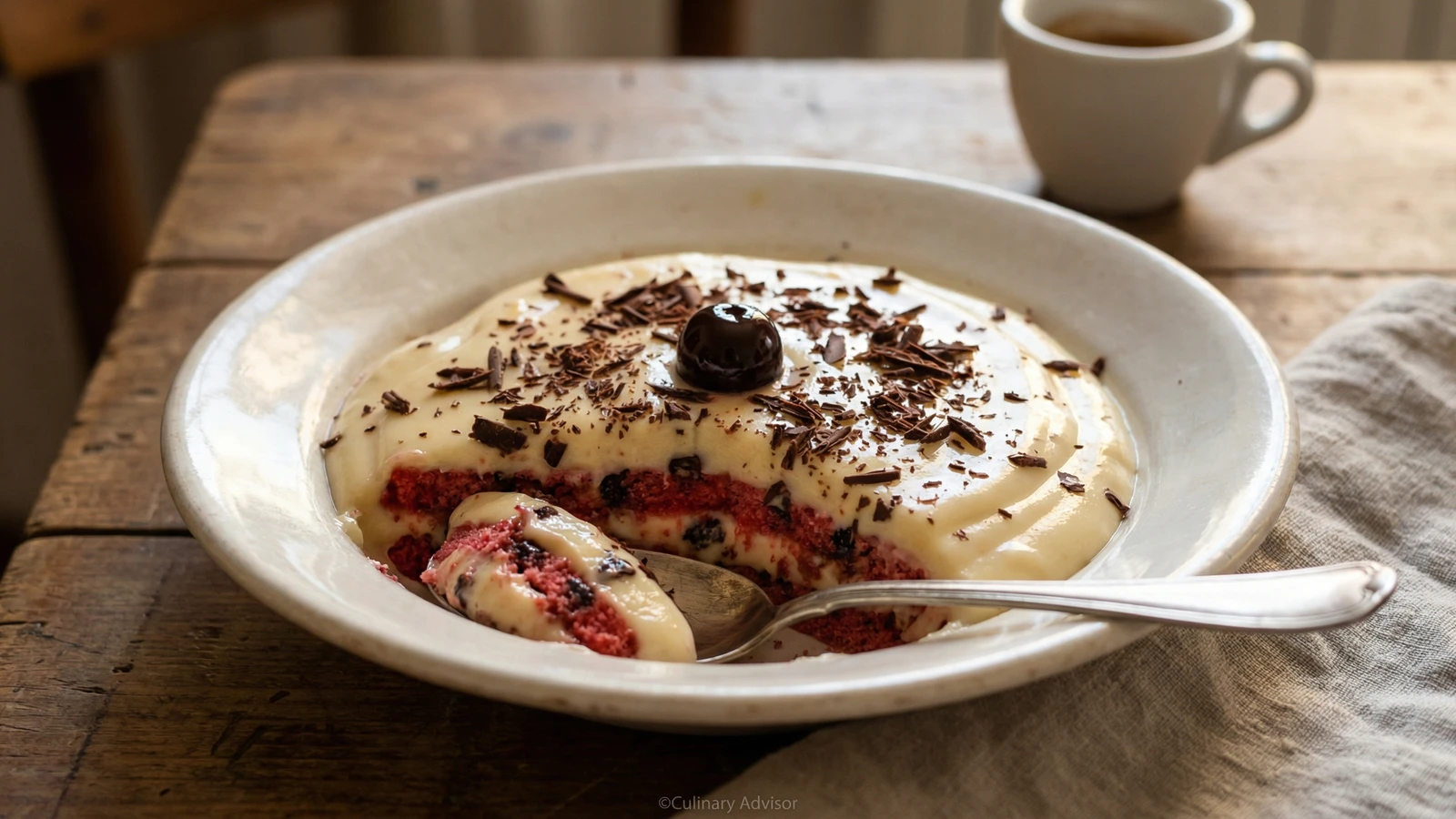
Zuppa Inglese Emiliana
Created by Chef Graziella
Layers of silken custard and liqueur-soaked sponge, the jewel-toned dessert that Emilian grandmothers have assembled for generations. This is not English, and it is not soup. It is something far better.
The name is a lie, or perhaps a joke. Zuppa Inglese is neither soup nor English. It is Emilian to its core, a dessert of patient layering, of custard made properly with egg yolks and good vanilla, of sponge cake soaked in alchermes until it turns the color of rubies.
Americans know trifle, that British thing with too much whipped cream and not enough structure. Zuppa Inglese is not that. The custard here is crema pasticcera, the same pastry cream that fills bomboloni and lines fruit tarts across Italy. It must be thick enough to hold its shape, silken enough to melt on the tongue. There is no whipped cream to dilute the richness. There is only custard, cake, and liqueur.
The alchermes is essential. This scarlet liqueur, spiced with cinnamon and clove and colored with cochineal, has perfumed Florentine and Emilian pastries since the Renaissance. If you cannot find it, you can substitute rum or a mixture of rum and maraschino, but know that you are making something else. The color will be wrong. The flavor will be different. It will still be good. It will not be authentic.
This is a dessert that rewards patience. Make the custard a day ahead. Let the assembled zuppa rest overnight. The flavors marry, the cake softens, and what emerges is greater than its parts.
The name 'Zuppa Inglese' appeared in Italian cookbooks by the late 18th century, likely inspired by English trifle brought by British merchants trading in Livorno and other ports. Emilia-Romagna and Tuscany both claim it, but the Emilian version, built with alchermes from the Certosini monks and the region's legendary eggs, became the standard against which others are measured.
The technique, the tradition, and the story behind every dish.
Discover Culinary AdvisorIngredients
large egg yolks
Quantity
6
granulated sugar
Quantity
3/4 cup
all-purpose flour
Quantity
1/3 cup
sifted
whole milk
Quantity
2 cups
vanilla bean
Quantity
1
split lengthwise
fine sea salt
Quantity
pinch
alchermes liqueur
Quantity
1 1/2 cups
water
Quantity
1/2 cup
granulated sugar for syrup
Quantity
1 tablespoon
Italian sponge cake (pan di Spagna)
Quantity
14 ounces
cut into 1/2-inch slices
bittersweet chocolate
Quantity
2 ounces
finely chopped
candied cherries (optional)
Quantity
for garnish
| Ingredient | Quantity |
|---|---|
| large egg yolks | 6 |
| granulated sugar | 3/4 cup |
| all-purpose floursifted | 1/3 cup |
| whole milk | 2 cups |
| vanilla beansplit lengthwise | 1 |
| fine sea salt | pinch |
| alchermes liqueur | 1 1/2 cups |
| water | 1/2 cup |
| granulated sugar for syrup | 1 tablespoon |
| Italian sponge cake (pan di Spagna)cut into 1/2-inch slices | 14 ounces |
| bittersweet chocolatefinely chopped | 2 ounces |
| candied cherries (optional) | for garnish |
Equipment Needed
- •Heavy-bottomed 3-quart saucepan
- •Large mixing bowl
- •Fine-mesh sieve
- •9-by-13-inch baking dish or deep glass serving bowl
- •Offset spatula
- •Plastic wrap
Instructions
- 1
Prepare the custard base
In a heavy-bottomed saucepan, combine the milk with the split vanilla bean and its scraped seeds. Set over medium heat and bring just to a simmer, small bubbles forming at the edges. Remove from heat and let steep for 15 minutes. Remove the vanilla pod. If using vanilla extract, skip the steeping and add the extract at the end of cooking.
- 2
Beat the egg yolks
In a large bowl, whisk the egg yolks with the sugar until pale and thick, about 3 minutes by hand. The mixture should fall from the whisk in a slowly dissolving ribbon. Add the sifted flour and the salt, whisking until completely smooth with no lumps. This is not optional. Lumpy custard cannot be saved.
Sift the flour twice if necessary. A single lump of flour in your finished custard will ruin the texture. - 3
Temper the eggs
Slowly pour the warm milk into the egg mixture in a thin stream, whisking constantly. You are tempering the eggs, raising their temperature gradually so they do not curdle. Add about half the milk this way, whisking continuously, then pour everything back into the saucepan.
- 4
Cook the custard
Set the saucepan over medium heat. Stir constantly with a wooden spoon or silicone spatula, reaching into the corners and across the bottom where the custard is most likely to scorch. The custard will thicken gradually, then suddenly. When it reaches a full boil and large bubbles plop on the surface, cook for exactly one more minute, stirring vigorously. This cooks the flour completely.
Unlike egg-only custards, flour-thickened crema pasticcera must boil briefly. The flour needs the heat to lose its raw taste. One minute at a boil, no more. - 5
Cool the custard properly
Remove from heat immediately. If using vanilla extract, stir it in now. Pour the custard into a shallow bowl or baking dish to cool quickly. Press plastic wrap directly onto the surface to prevent a skin from forming. Refrigerate until completely cold, at least 2 hours. The custard can be made a day ahead.
- 6
Make the soaking syrup
In a shallow bowl, combine the alchermes with the water and the tablespoon of sugar. Stir until the sugar dissolves. The syrup should taste sweet but still potent with the liqueur's spice. It will mellow once absorbed into the cake.
- 7
Assemble the first layer
Select a 9-by-13-inch baking dish or a deep glass serving bowl. Dip slices of sponge cake briefly into the alchermes syrup, just enough to color and moisten them without making them sodden. They should be pink, not dripping. Arrange in a single layer on the bottom of the dish, cutting pieces to fit if necessary.
If using savoiardi, dip them quickly, one at a time. They absorb liquid faster than sponge cake. Three seconds per side is sufficient. - 8
Add the custard
Stir the chilled custard until smooth. Spread half of it evenly over the soaked cake layer. The custard should be thick enough to spread without running. If it seems too thick, stir in a tablespoon of cold milk.
- 9
Create the chocolate layer
Scatter half the chopped chocolate over the custard. The traditional version includes this bitter counterpoint to the sweet liqueur. Some families omit it. Others would not recognize zuppa inglese without it.
- 10
Repeat the layers
Dip more sponge cake in the remaining alchermes syrup and arrange a second layer over the chocolate. Spread the remaining custard on top, smoothing it with an offset spatula. Scatter the rest of the chocolate over the surface.
- 11
Rest before serving
Cover with plastic wrap and refrigerate for at least 6 hours, preferably overnight. The cake continues to absorb the custard and liqueur, the layers meld, and the flavors deepen. Patience is not optional here.
The dessert is at its best 24 hours after assembly. By the second day, the texture begins to soften too much. Plan accordingly. - 12
Serve properly
Remove from the refrigerator 15 minutes before serving to take the chill off. Garnish with candied cherries if you like, though purists consider this unnecessary. Spoon into shallow bowls, making sure each serving includes all the layers. Serve cold but not ice-cold.
Chef Tips
- •Alchermes can be difficult to find outside Italy. Specialty liquor stores may stock it, or you can order it online. There is no perfect substitute. Rum and a few drops of red food coloring mimics the appearance but not the distinctive spice. Accept this compromise only if necessary.
- •For pan di Spagna, you can bake your own or purchase Italian sponge cake from a good bakery. Do not use American yellow cake. The texture is wrong, too dense, too sweet. Savoiardi are the safer choice if good sponge cake is unavailable.
- •Some Emilian families add a layer of chocolate custard instead of scattered chocolate. To make this variation, divide the custard before chilling and melt 3 ounces of chocolate into half while still warm. The labor is greater. The result is magnificent.
Advance Preparation
- •The custard must be made at least 2 hours ahead and can be refrigerated up to 2 days before assembly.
- •The assembled dessert requires at least 6 hours of refrigeration, preferably overnight. It is at its best after 24 hours.
- •Zuppa Inglese does not freeze well. The custard weeps and the cake becomes unpleasantly soft upon thawing.
Frequently Asked Questions
Nutrition Information
1 serving (about 175g)
Where cooking meets culture.
Culinary mentorship, cultural storytelling, and the editorial depth that makes cooking meaningful.
Explore Culinary Advisor