Culinary Advisor
A cooking platform built around craft, culture, and the stories behind what we eat.
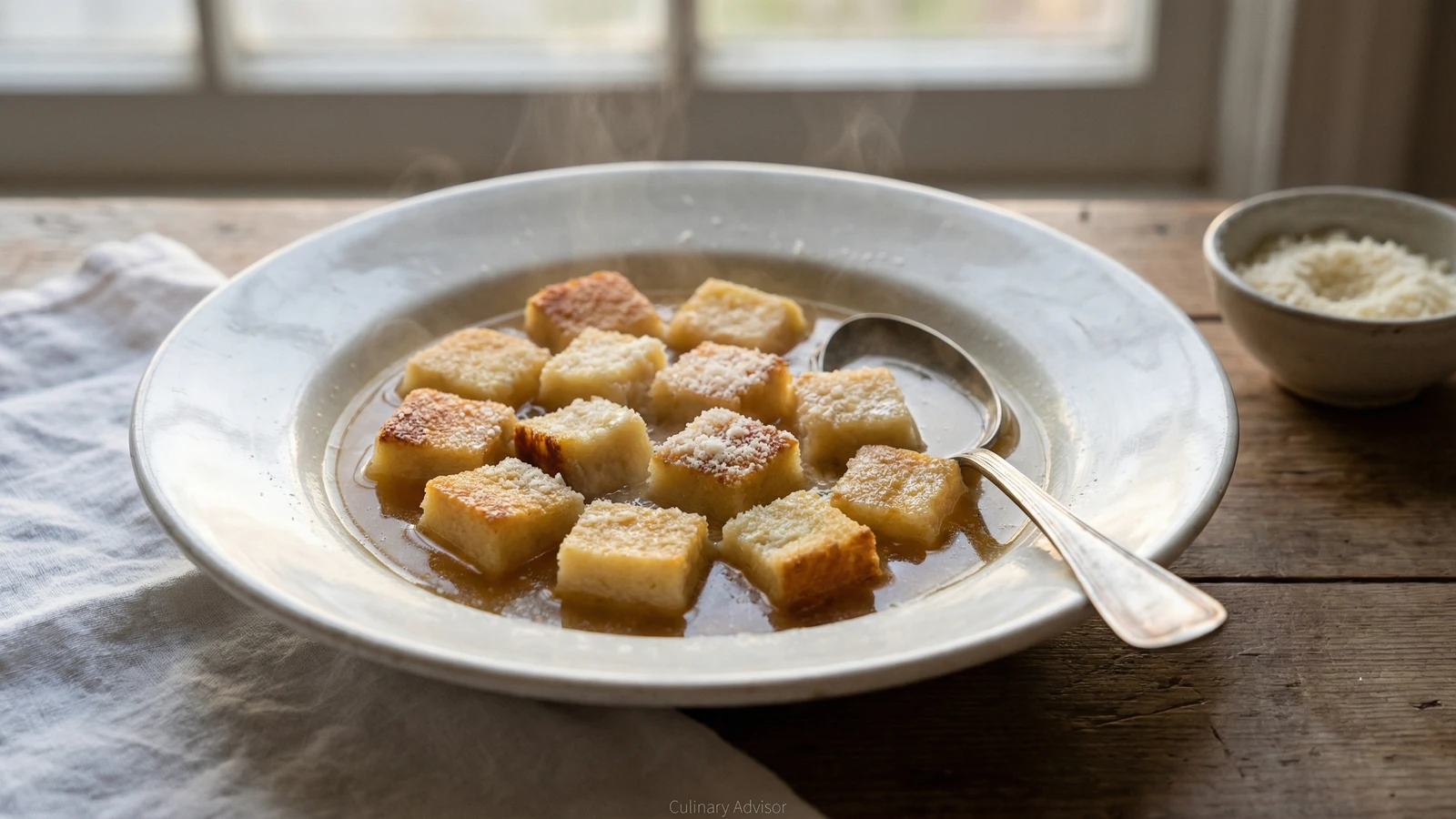
Zuppa Imperiale
Created by Chef Graziella
The noble soup of Bologna's Christmas table, where golden cubes of baked semolina float in crystalline broth. Lighter than tortellini in brodo, yet every bit as festive.
In Bologna, when Christmas approaches, the debate begins: tortellini in brodo or zuppa imperiale? The tortellini have their partisans, but for those who find filled pasta too rich after the antipasti, the imperiale offers elegance without heaviness. Golden cubes of semolina, enriched with butter, eggs, and Parmigiano-Reggiano, float in clear capon broth like small pillows of sunshine.
The technique is simple but demands precision. The semolina mixture must be thick enough to hold its shape when baked, yet tender enough to yield to the spoon. Overbake it and the cubes become dense as paving stones. Underbake and they dissolve into the broth. You are looking for a texture that is firm at the edges, slightly yielding at the center.
This is not restaurant food. This is what Bolognese grandmothers make when the family gathers, when the table must accommodate twenty relatives and the first course must be elegant but not exhausting. The broth does the heavy lifting. Your job is to make it properly and to cut your cubes with care.
Zuppa imperiale appears in Bolognese cookbooks from the 19th century, though its origins likely reach further back to the aristocratic kitchens of Emilia-Romagna. The name 'imperial' suggests noble tables, and the dish was indeed considered suitable for important guests. It became associated with Christmas and Easter celebrations, when capon broth was traditional and a lighter first course allowed room for the roasts to follow.
The technique, the tradition, and the story behind every dish.
Discover Culinary AdvisorIngredients
large eggs
Quantity
4
unsalted butter
Quantity
4 tablespoons
softened
Parmigiano-Reggiano
Quantity
1 cup (about 3 ounces)
finely grated
fine semolina flour
Quantity
1 cup
nutmeg
Quantity
1/4 teaspoon
freshly grated
fine sea salt
Quantity
1/4 teaspoon
capon broth or beef broth
Quantity
10 cups
homemade
Parmigiano-Reggiano
Quantity
for serving
freshly grated
| Ingredient | Quantity |
|---|---|
| large eggs | 4 |
| unsalted buttersoftened | 4 tablespoons |
| Parmigiano-Reggianofinely grated | 1 cup (about 3 ounces) |
| fine semolina flour | 1 cup |
| nutmegfreshly grated | 1/4 teaspoon |
| fine sea salt | 1/4 teaspoon |
| capon broth or beef brothhomemade | 10 cups |
| Parmigiano-Reggianofreshly grated | for serving |
Equipment Needed
- •9-inch square baking dish or quarter sheet pan
- •Large mixing bowl
- •Wooden spoon or electric mixer
- •Sharp knife for cutting cubes
- •Large pot for broth
- •Ladle
Instructions
- 1
Prepare the pan
Heat your oven to 350°F. Butter a 9-inch square baking dish or a quarter sheet pan generously. The butter prevents sticking and adds flavor to the crust that forms. Set aside.
- 2
Cream the butter
In a large bowl, beat the softened butter until pale and fluffy, about 2 minutes with a wooden spoon or 1 minute with an electric mixer. The butter must be properly softened, not melted. Melted butter changes the texture entirely.
If your butter is too cold, it will not incorporate properly. If too warm, the mixture becomes greasy. Room temperature means the butter yields to gentle pressure but holds its shape. - 3
Add the eggs
Add the eggs one at a time, beating well after each addition. The mixture may look curdled after the first egg. Continue. It will smooth out as you add the remaining eggs. Beat until the mixture is uniform and light.
- 4
Incorporate dry ingredients
Add the grated Parmigiano-Reggiano, semolina, nutmeg, and salt. Stir until you have a thick, smooth batter. It should drop heavily from the spoon, not pour. If it seems too loose, let it rest for 5 minutes. The semolina will absorb moisture and thicken.
Use the finest semolina you can find, labeled 'semola rimacinata' or 'semolina flour.' Coarse semolina creates a gritty texture that is unpleasant in this delicate preparation. - 5
Spread and bake
Spread the batter evenly in the prepared pan. It should be about half an inch thick. Smooth the top with a spatula dipped in water. Bake until the top is golden and the center is set, 25 to 30 minutes. A toothpick inserted in the center should come out clean. The edges will be slightly darker than the center.
- 6
Cool completely
Remove from the oven and let cool completely in the pan, at least 30 minutes. Do not rush this step. Warm semolina cuts poorly and crumbles. Cold semolina cuts cleanly into precise cubes.
The baked semolina can be made a day ahead. Cover and refrigerate once cool. Cold semolina is actually easier to cut than room temperature. - 7
Cut into cubes
Turn the cooled semolina onto a cutting board. Using a sharp knife, cut into cubes approximately half an inch on each side. Precision matters for even cooking and elegant presentation. You should have roughly 100 small cubes.
- 8
Heat the broth
Bring the broth to a gentle simmer in a large pot. The broth must be homemade. Bouillon cubes and canned broth are not acceptable substitutes. Capon broth is traditional for Christmas. Rich beef broth made from bones and marrow is appropriate at other times. Taste and adjust the salt.
The broth is the soul of this soup. A weak or salty commercial broth will ruin everything. If you do not have proper broth, make it before attempting this recipe. - 9
Serve immediately
Divide the semolina cubes among warm soup bowls, about 12 cubes per serving. Ladle the hot broth over the cubes. Serve immediately with additional grated Parmigiano-Reggiano at the table. The cubes will soften slightly in the hot broth but should maintain their shape through the meal. Do not let the soup sit, do not let the cubes soak. Bring the bowls to the table and eat.
Chef Tips
- •The ratio of butter to eggs to semolina must remain in balance. Do not reduce the butter thinking to make the dish lighter. The butter is what makes the cubes tender rather than rubbery.
- •Grate the Parmigiano-Reggiano on the finest holes of your grater, almost to a powder. Large shreds do not incorporate properly and create an uneven texture.
- •If serving a large group, keep the broth at a bare simmer and the cubes at room temperature. Ladle broth over cubes in each bowl as you serve. Never add the cubes to the pot of broth, where they will become waterlogged.
- •For Christmas dinner, make the semolina the day before. The cubes can wait in the refrigerator while you attend to everything else. Only the broth needs last-minute attention.
Advance Preparation
- •The baked semolina can be prepared up to two days ahead. Cool completely, wrap tightly, and refrigerate. Cut into cubes when ready to serve.
- •Capon or beef broth can be made three to four days ahead and refrigerated, or frozen for up to three months. Skim solidified fat before reheating.
- •The cubes can be cut several hours before serving and left at room temperature, covered with a clean towel.
Frequently Asked Questions
Nutrition Information
1 serving (about 370g)
Where cooking meets culture.
Culinary mentorship, cultural storytelling, and the editorial depth that makes cooking meaningful.
Explore Culinary Advisor