Culinary Advisor
A cooking platform built around craft, culture, and the stories behind what we eat.
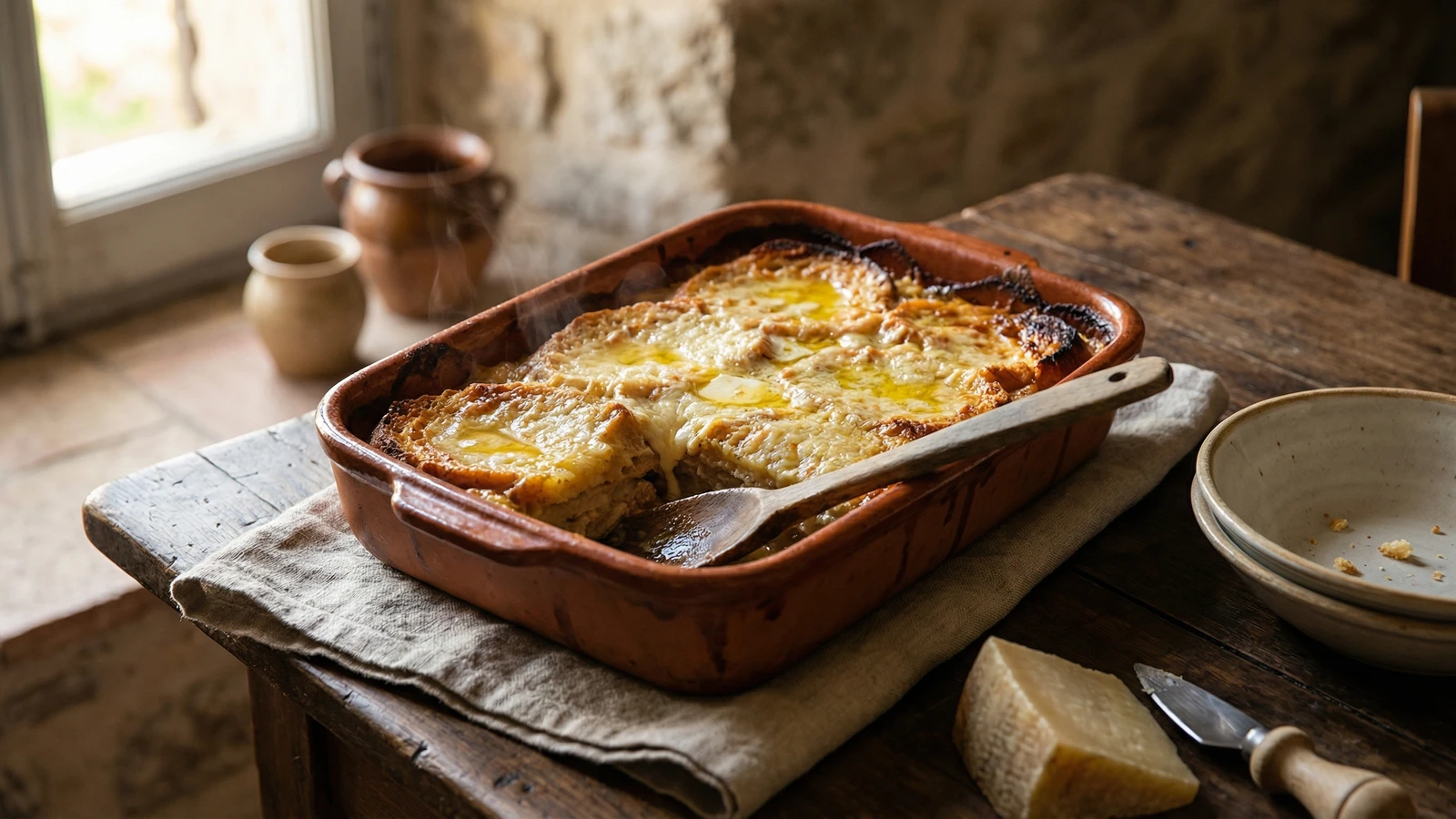
Zuppa Gallurese
Created by Chef Graziella
The layered bread soup of Sardinia's Gallura region, where stale pane carasau, aged pecorino sardo, and rich sheep broth become something greater than their humble parts through patient baking.
This is not soup as you know it. Zuppa Gallurese arrives at the table golden and bubbling, more gratin than broth, the bread having absorbed every drop of liquid and transformed into something between custard and casserole. The shepherds of Gallura, the northeastern corner of Sardinia, created this dish from what they had: stale bread, aged cheese from their flocks, and broth made from lamb bones.
The bread must be stale. I say this about every bread soup, and I will keep saying it until people listen. Fresh bread turns to paste. Stale bread absorbs liquid while maintaining structure. Pane carasau, the paper-thin Sardinian flatbread, is traditional, but any good rustic bread dried for two days will serve.
What distinguishes Zuppa Gallurese from Tuscan ribollita or Roman stracciatella is the baking. You build layers like lasagna, pour hot broth over everything, and let the oven do its work. The top becomes a cheese crust, the interior becomes rich and yielding. It is shepherd food, utterly satisfying, and it proves once again that poverty creates genius when cooks refuse to waste what they have.
Zuppa Gallurese emerged from the pastoral traditions of Sardinia's Gallura region, where shepherds transformed stale bread, aged pecorino from their flocks, and lamb broth into a sustaining meal. The dish appears in local records dating to the 18th century, though shepherds had surely made it for generations before anyone thought to write it down. Sardinians sometimes call it suppa cuata, meaning 'hidden soup,' because the broth disappears entirely into the bread during baking.
The technique, the tradition, and the story behind every dish.
Discover Culinary AdvisorIngredients
stale pane carasau or rustic country bread
Quantity
1 pound
torn into pieces
lamb or sheep broth
Quantity
8 cups
homemade preferred
aged pecorino sardo
Quantity
8 ounces
grated
fresh pecorino or young sheep's milk cheese
Quantity
4 ounces
sliced thin
fresh Italian parsley
Quantity
1/2 cup leaves
chopped
fresh mint leaves
Quantity
1/4 cup
chopped
nutmeg
Quantity
1/4 teaspoon
freshly grated
black pepper
Quantity
to taste
freshly ground
unsalted butter
Quantity
3 tablespoons
cut into small pieces
| Ingredient | Quantity |
|---|---|
| stale pane carasau or rustic country breadtorn into pieces | 1 pound |
| lamb or sheep brothhomemade preferred | 8 cups |
| aged pecorino sardograted | 8 ounces |
| fresh pecorino or young sheep's milk cheesesliced thin | 4 ounces |
| fresh Italian parsleychopped | 1/2 cup leaves |
| fresh mint leaveschopped | 1/4 cup |
| nutmegfreshly grated | 1/4 teaspoon |
| black pepperfreshly ground | to taste |
| unsalted buttercut into small pieces | 3 tablespoons |
Equipment Needed
- •Deep 9x13-inch baking dish or 3-quart gratin dish
- •Large saucepan for heating broth
- •Ladle
Instructions
- 1
Prepare the bread
If using pane carasau, break it into rough pieces about two inches across. If using country bread, tear it into similar chunks and spread on a baking sheet. The bread must be thoroughly stale, dry enough that it cracks rather than tears. If your bread is not stale, dry it in a 250°F oven for 30 minutes. Let it cool completely before proceeding.
Fresh bread will turn this dish to mush. There are no exceptions to this rule. Plan ahead or choose a different recipe. - 2
Heat the broth
Bring the lamb broth to a gentle simmer in a saucepan. Taste it. If it lacks depth, you will taste that lack in the finished dish. Good broth makes good soup. There is no way around this. Keep the broth hot while you assemble the layers.
- 3
Prepare the herbs
Combine the chopped parsley and mint in a small bowl. Add the nutmeg and a generous grinding of black pepper. Mix together. This mixture will season each layer.
- 4
Build the first layer
Preheat your oven to 375°F. Butter a deep 9x13-inch baking dish or a 3-quart gratin dish. Arrange one-third of the bread pieces in a single layer on the bottom. Scatter one-third of the herb mixture over the bread. Top with one-third of the grated aged pecorino and a few slices of the fresh cheese.
- 5
Continue layering
Repeat the layers twice more: bread, herbs, cheeses. End with cheese on top. The layers should come within an inch of the rim. Press down gently but do not compact the bread. It needs room to absorb the broth.
The proportion of cheese to bread matters. Be generous with the pecorino. It provides salt, depth, and the golden crust that defines this dish. - 6
Add the broth
Ladle the hot broth slowly and evenly over the layered bread and cheese. Pour it around the edges and let it seep toward the center. The bread will absorb liquid immediately. Continue adding broth until you see it pooling slightly around the edges. The bread should be saturated but not swimming. You may not need all 8 cups. Dot the surface with butter pieces.
- 7
Bake until golden
Bake uncovered for 45 to 50 minutes. The top should be deeply golden brown, the edges bubbling, and a knife inserted in the center should meet no resistance. The bread will have absorbed all visible liquid. Let it rest for 10 minutes before serving. It will be extremely hot.
- 8
Serve properly
Cut into squares like lasagna or scoop with a large spoon, making sure each portion includes the crusty top and the soft layers beneath. Serve in warm shallow bowls. No garnish is required. The dish is complete.
Chef Tips
- •Lamb broth is traditional and preferable. Beef broth works adequately. Chicken broth lacks the depth this dish requires. If you must use chicken, enrich it by simmering lamb bones in it for an hour.
- •Pecorino sardo comes in varying ages. Use stagionato (aged) for grating and fresco (fresh) for the slices. The combination provides both sharp depth and mild creaminess.
- •If pane carasau proves impossible to find, use ciabatta or any rustic Italian bread without seeds. Slice it thin, dry it thoroughly, and proceed. The texture will differ slightly, but the spirit remains.
- •This is a dish that reheats well the next day. Cover with foil and warm at 325°F for 20 minutes. Some say it improves, as bread soups often do.
Advance Preparation
- •The broth can and should be made days ahead. Lamb broth requires roasted bones and long simmering. It keeps refrigerated for five days or frozen for three months.
- •The dish can be assembled, covered, and refrigerated for up to 4 hours before baking. Add the hot broth just before it goes in the oven.
- •Leftovers keep refrigerated for three days. Reheat covered at 325°F until warmed through.
Frequently Asked Questions
Nutrition Information
1 serving (about 370g)
Where cooking meets culture.
Culinary mentorship, cultural storytelling, and the editorial depth that makes cooking meaningful.
Explore Culinary Advisor