Culinary Advisor
A cooking platform built around craft, culture, and the stories behind what we eat.
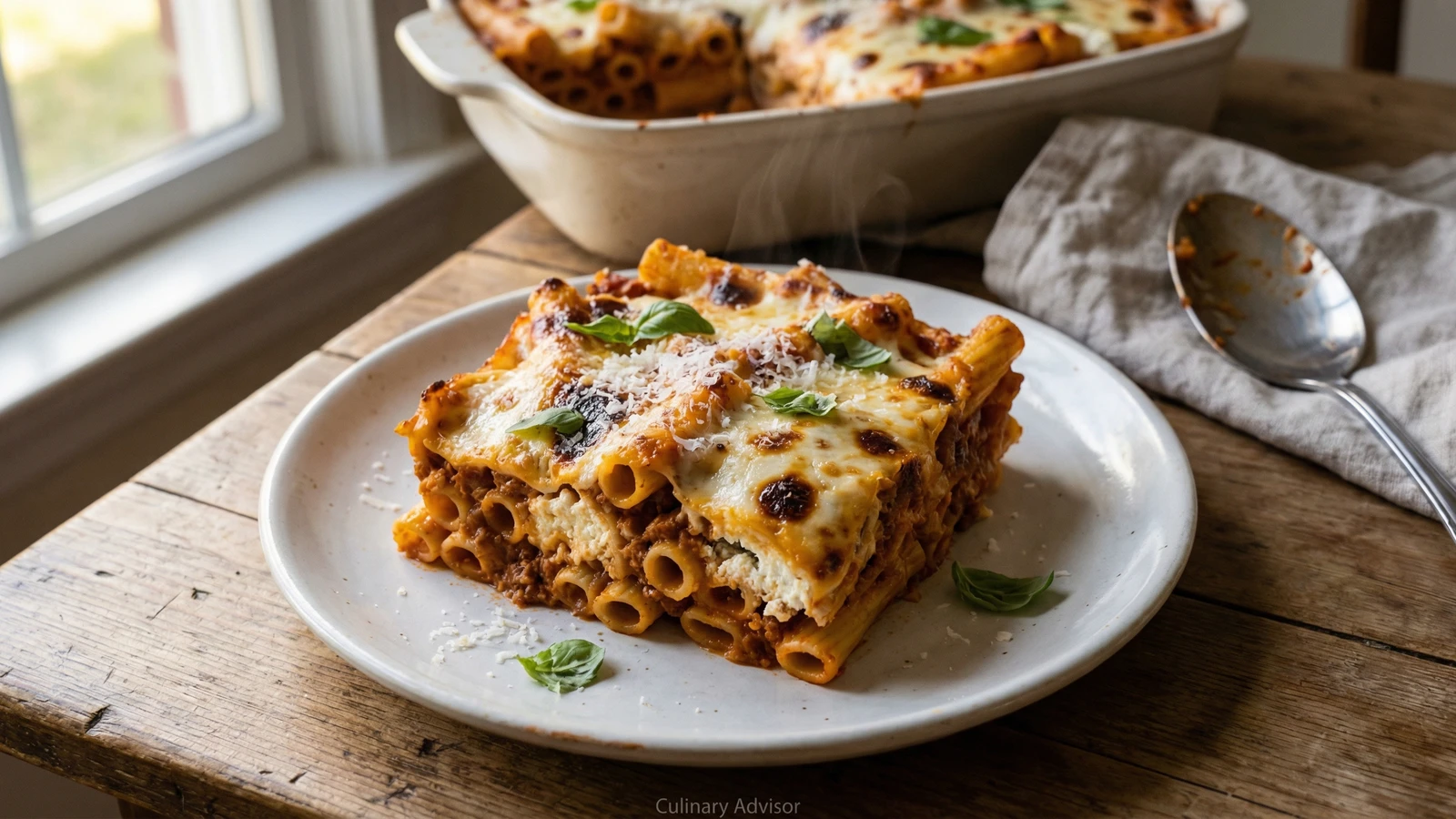
Ziti al Forno
Created by Chef Graziella
The celebratory baked pasta of Naples, where long tubes of ziti are broken by hand, layered with slow-simmered ragù, ricotta, and mozzarella, then baked until the top bubbles and browns.
In Naples, this is what you serve when something matters. A wedding. A christening. Sunday, when the family gathers. The pasta must be ziti, the long tubes that Neapolitan brides have broken by hand for generations. Not penne. Not rigatoni. Ziti.
The breaking is not arbitrary. You snap them into pieces roughly two inches long, irregular and imperfect. This creates edges that catch the ragù and cheese, surfaces that brown in the oven. Factory-cut pasta cannot replicate this.
What you keep out is as significant as what you put in. There is no béchamel here, no cream, none of the northern richness that would smother the bright acidity of the tomatoes. The ricotta goes in as dollops, not stirred through. The mozzarella must be fresh, sliced by hand, not the pre-shredded rubber that melts into grease. The ragù simmers for hours until the pork surrenders completely.
This is not difficult food. It is patient food. The ragù takes time. The layering takes care. The baking takes attention. But a child could learn it, and in Naples, children do.
Ziti takes its name from 'zita,' the Neapolitan word for bride. This was the traditional pasta served at wedding feasts across Campania, where the long tubes symbolized the bond of marriage. Breaking the pasta by hand before cooking was the work of grandmothers and aunts gathered in the kitchen, transforming preparation into ceremony.
The technique, the tradition, and the story behind every dish.
Discover Culinary AdvisorIngredients
extra virgin olive oil
Quantity
1/4 cup
yellow onion
Quantity
1 medium
diced fine
carrot
Quantity
1 medium
peeled and diced fine
celery stalk
Quantity
1
diced fine
pork shoulder
Quantity
1 pound
cut into 2-inch chunks
dry red wine
Quantity
1/2 cup
San Marzano tomatoes
Quantity
2 cans (28 ounces each)
crushed by hand
kosher salt
Quantity
to taste
black pepper
Quantity
to taste
freshly ground
dried ziti
Quantity
1 pound
fresh mozzarella
Quantity
1 pound
sliced 1/4-inch thick
whole milk ricotta
Quantity
2 cups
Parmigiano-Reggiano
Quantity
1 cup
freshly grated
fresh basil leaves
Quantity
1/2 cup
| Ingredient | Quantity |
|---|---|
| extra virgin olive oil | 1/4 cup |
| yellow oniondiced fine | 1 medium |
| carrotpeeled and diced fine | 1 medium |
| celery stalkdiced fine | 1 |
| pork shouldercut into 2-inch chunks | 1 pound |
| dry red wine | 1/2 cup |
| San Marzano tomatoescrushed by hand | 2 cans (28 ounces each) |
| kosher salt | to taste |
| black pepperfreshly ground | to taste |
| dried ziti | 1 pound |
| fresh mozzarellasliced 1/4-inch thick | 1 pound |
| whole milk ricotta | 2 cups |
| Parmigiano-Reggianofreshly grated | 1 cup |
| fresh basil leaves | 1/2 cup |
Equipment Needed
- •Heavy 6-quart Dutch oven for the ragù
- •9x13-inch baking dish (ceramic or enameled)
- •Large pot for boiling pasta
Instructions
- 1
Build the soffritto
In a heavy Dutch oven, warm the olive oil over medium heat. Add the onion, carrot, and celery. Cook slowly, stirring occasionally, until the vegetables are completely soft and the onion has turned pale gold, about 15 minutes. Do not rush this. FLAVOR, IN ITALIAN DISHES, builds up from the bottom. An imperfectly executed soffritto will impair the flavor of the entire dish.
- 2
Brown the pork
Push the soffritto to the sides of the pot. Add the pork chunks to the center and raise heat to medium-high. Brown the meat on all sides, turning every few minutes, until deeply colored. This takes 10 to 12 minutes. The meat must brown, not steam. If the pot is crowded, work in batches.
Pork shoulder contains the fat and connective tissue that will melt into the ragù over hours of simmering. Lean cuts produce lean, disappointing sauce. - 3
Add the wine
Pour in the red wine. Let it bubble vigorously, scraping up any browned bits from the bottom of the pot with a wooden spoon. Cook until the wine has nearly evaporated and you can no longer smell alcohol, about 3 minutes.
- 4
Simmer the ragù
Add the crushed tomatoes and stir to combine. Season lightly with salt and pepper. Bring to a gentle simmer, then reduce heat to the lowest setting. The sauce should bubble lazily, with only an occasional blip breaking the surface. Partially cover the pot and cook for 2 to 2 1/2 hours, stirring occasionally, until the pork is falling apart and the sauce has thickened considerably.
If the sauce reduces too quickly, add water by the half cup. You want a sauce that coats a spoon thickly. If it becomes too thick, thin it with pasta water later. - 5
Shred the meat
Remove the pork chunks from the sauce. Using two forks, shred the meat into rough pieces, discarding any large pieces of fat. Return the shredded meat to the sauce and stir to combine. Taste and adjust seasoning. The ragù can be made to this point up to three days ahead.
- 6
Break and cook the ziti
Preheat oven to 375°F. Bring a large pot of water to a vigorous boil. Salt it generously. Take the ziti in your hands and break them into pieces roughly two inches long. The breaks will be uneven. This is correct. Cook the broken ziti until very al dente, about 2 minutes less than the package directs. The pasta will finish cooking in the oven. Drain, reserving one cup of pasta water.
Undercooked pasta is essential. Fully cooked pasta becomes mushy after baking. Mushy lasagna is an abomination, and this rule applies equally to ziti al forno. - 7
Combine pasta and sauce
Add the drained ziti to the pot with the ragù. Toss well to coat, adding pasta water as needed to help the sauce cling. Tear half of the basil leaves and fold them in. The mixture should be saucy but not soupy.
- 8
Layer the baking dish
Spread one third of the pasta mixture in a 9x13-inch baking dish. Arrange one third of the mozzarella slices over the pasta. Drop spoonfuls of ricotta across the surface, using about one third of the ricotta. Do not spread it; leave it in distinct dollops. Sprinkle with one third of the Parmigiano. Repeat the layering twice more, ending with mozzarella, ricotta dollops, and a final shower of Parmigiano.
- 9
Bake until bubbling
Bake uncovered until the top is bubbling vigorously and spotted with brown, 35 to 45 minutes. The edges should be slightly darker than the center, the cheese golden in patches. If the top browns too quickly before the center is heated through, tent loosely with foil.
- 10
Rest before serving
Remove from the oven and let rest for 15 minutes. This is not optional. The dish must set so that portions hold together on the plate. Scatter the remaining basil leaves over the top before serving.
Chef Tips
- •The ragù improves with time. Make it two or three days ahead if possible. The flavors deepen overnight in a way that cannot be achieved by longer simmering.
- •Fresh mozzarella must be dried before using. Slice it and lay the slices on paper towels for 30 minutes, pressing gently. Wet mozzarella creates puddles and steams rather than browns.
- •Buy ricotta from an Italian market if you can find one. The mass-produced versions are too wet and too bland. If using supermarket ricotta, drain it in a fine-mesh strainer for an hour.
- •This reheats beautifully. Cover with foil and warm in a 325°F oven until heated through, about 30 minutes. The edges become even more caramelized, which is a virtue.
Advance Preparation
- •The ragù can be made up to three days ahead and refrigerated. It freezes well for up to three months.
- •The entire dish can be assembled, covered tightly, and refrigerated for up to 24 hours before baking. Add 10 to 15 minutes to the baking time if starting from cold.
- •Leftover baked ziti keeps four days refrigerated and reheats well covered in a 325°F oven.
Frequently Asked Questions
Nutrition Information
1 serving (about 425g)
Where cooking meets culture.
Culinary mentorship, cultural storytelling, and the editorial depth that makes cooking meaningful.
Explore Culinary Advisor