Culinary Advisor
A cooking platform built around craft, culture, and the stories behind what we eat.
Ymer med Ymerdrys
Created by Chef Freja
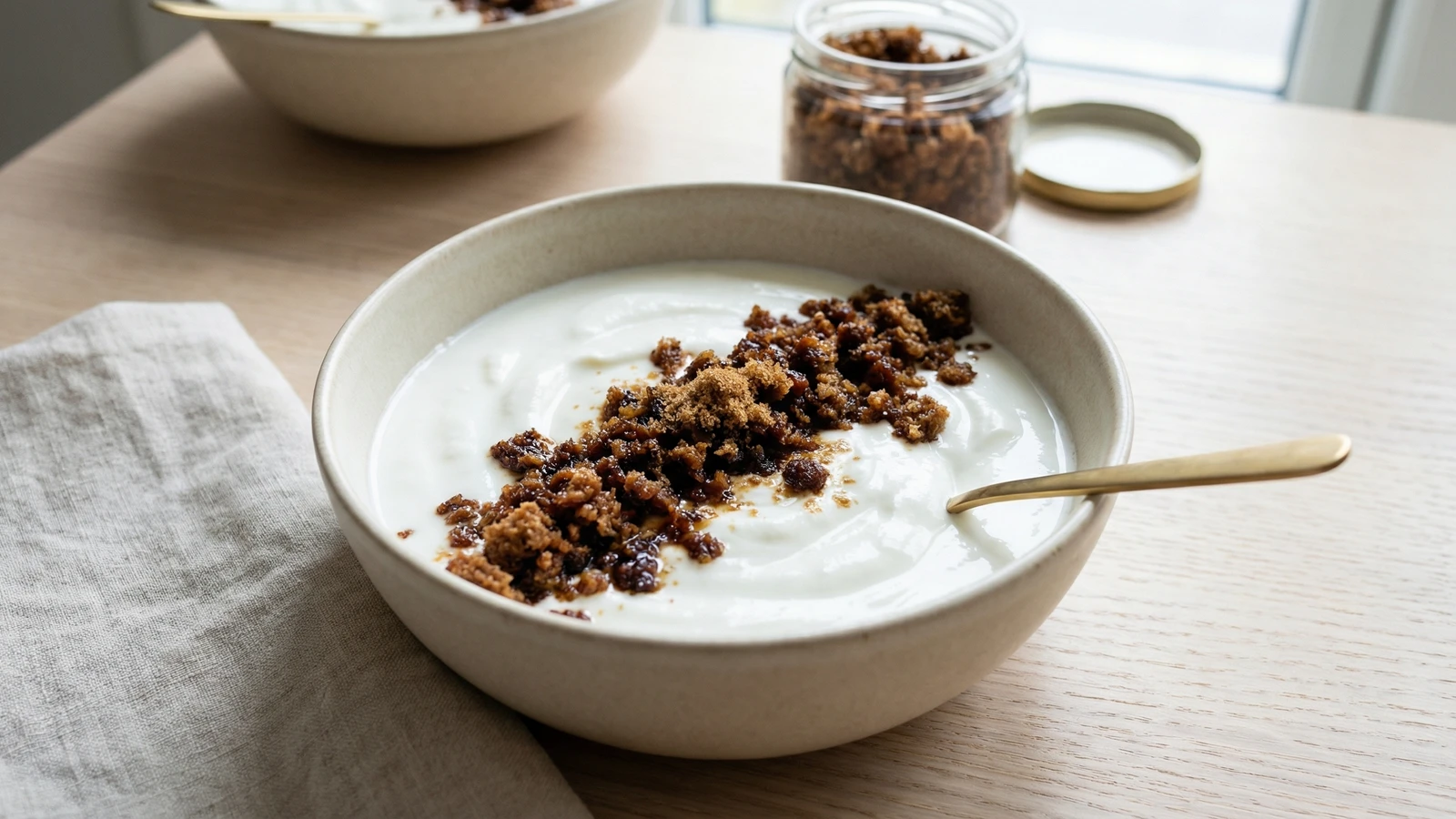
Cold, thick Danish cultured milk under a dark rye crumble that crackles against the spoon. Five minutes on a weekday morning, and one of the few breakfasts in the world that exists nowhere else.
Ymer is the breakfast Danes grew up on and the breakfast they come back to. It looks like a bowl of thick yogurt and it isn't. Ymer is its own thing, a cultured milk soured by a specific Danish bacterial strain that gives it a clean, almost lemony tang and a spoon-coating thickness you don't find in anything else. You cannot substitute it. Greek yogurt, skyr, quark, none of them are ymer. This is one of the dishes Denmark keeps to itself.
The bowl is simple. Cold ymer, a thick scatter of ymerdrys on top, a last pinch of brown sugar. Ymerdrys means ymer-sprinkle, and it's what you make from the heel of yesterday's rugbrod, the dense dark rye loaf that sits on every Danish kitchen counter. You dry the bread in a low oven, crush it into coarse crumbs, and toast them with a little butter and dark brown sugar until they smell of nuts and caramel. That's the whole recipe. It takes twenty minutes and most of it is hands-off.
What matters here is the contrast. The ymer has to be properly cold and the crumbs have to be properly crisp. If the crumbs go soft in the bowl, the dish is gone. So dry the rugbrod all the way through, let it cool before you crush it, and assemble right at the table. Pay attention to the butter and sugar stage in particular. The sugar melts quickly and burns just after, and the difference between toasted and burnt is about fifteen seconds of inattention. You'll smell it when it's right. Tak for mad.
Ymer was developed in 1930 at a Danish dairy looking for a way to use up surplus skim milk, and it was named after Ymir, the primordial frost giant of Norse mythology from whose body the world was said to be formed. The specific culture responsible for its character, Lactococcus lactis subsp. cremoris, is legally protected in Denmark, and true ymer cannot be produced outside the country without access to these cultures. Ymerdrys, the rye crumble topping, comes from the older Danish habit of never wasting a piece of rugbrod, and generations of Danish children learned their first kitchen task drying yesterday's bread for the morning bowl.
The technique, the tradition, and the story behind every dish.
Discover Culinary AdvisorIngredients
ymer
Quantity
500g
well chilled
stale dark rugbrod
Quantity
4 thick slices, about 150g total
dark brown sugar
Quantity
40g, plus extra to finish
unsalted butter (optional)
Quantity
1 tablespoon
melted
fine sea salt
Quantity
small pinch
| Ingredient | Quantity |
|---|---|
| ymerwell chilled | 500g |
| stale dark rugbrod | 4 thick slices, about 150g total |
| dark brown sugar | 40g, plus extra to finish |
| unsalted butter (optional)melted | 1 tablespoon |
| fine sea salt | small pinch |
Equipment Needed
- •Baking sheet
- •Food processor or rolling pin and sturdy bag
- •Heavy frying pan
- •Deep bowls for serving
Instructions
- 1
Dry the rugbrod
Heat the oven to 150C. Tear the rugbrod into rough pieces and spread them on a baking sheet in a single layer. Slide them into the oven for about fifteen minutes, turning once, until the bread is dry all the way through and the edges have darkened a shade. You are not toasting for color. You are driving out the moisture so the crumbs will stay crisp on top of the cool ymer. Wet crumbs turn to sludge the moment they hit the bowl, and that is exactly what you are avoiding.
Day-old rugbrod is ideal. Fresh bread holds too much moisture and takes twice as long to dry out. The stale end of the loaf that nobody wanted is the piece you want here. - 2
Crumble the bread
Let the dried rugbrod cool on the tray for a few minutes. It will go from slightly bendy to properly crisp as it sits. Tip the pieces into a food processor and pulse until you have coarse crumbs, somewhere between breadcrumbs and gravel. You want texture, not dust. A few larger pieces are welcome. If you do not have a processor, put the bread in a bag and crush it with a rolling pin.
Pulse, do not run the processor continuously. Continuous blending heats the crumbs and pulls out the moisture you just worked to remove. - 3
Toast with butter and sugar
Tip the crumbs into a dry frying pan over medium heat. Add the pinch of salt. Toast them for two or three minutes, shaking the pan, until they smell nutty and toasted, like a darker version of themselves. Drizzle in the melted butter and scatter the brown sugar over the top. Stir constantly for another minute until the sugar has melted into the crumbs and each piece is coated and glossy. Tip everything straight onto a cold plate to stop the cooking. The crumbs will crisp as they cool.
The sugar can go from melted to burnt in fifteen seconds. Keep the heat moderate and your spoon moving. You will know it is right when the whole kitchen smells of toasted rye and caramel. - 4
Serve
Stir the ymer in its tub to loosen it slightly. It should fall from the spoon in thick, heavy ribbons, never pour. Spoon a generous portion into each bowl. Scatter the ymerdrys across the top in a thick layer, right to the edges, and finish with a last pinch of dark brown sugar. Eat immediately, while the crumbs are still crisp against the cool ymer. That temperature contrast and the crackle of the rugbrod against the soft dairy is the whole dish. You will know when it is right because the first spoonful tells you everything you need to know.
Chef Tips
- •If you cannot find ymer outside Denmark, the nearest honest substitute is a thick, well-drained skyr stirred with a small splash of buttermilk to loosen it and add a touch of tang. It is not the same thing, but it respects the spirit of the dish. Greek yogurt is too rich. Regular yogurt is too thin.
- •Make the ymerdrys in a larger batch than you need. It keeps for two weeks in a sealed jar at room temperature and turns any bowl of ymer, skyr, or even cold porridge into breakfast in under a minute. A jar of ymerdrys on the counter is a small act of kindness to your weekday self.
- •Dark brown sugar matters. Light brown sugar is too clean, white sugar is too sharp. You want the molasses depth of a dark muscovado, something that reads as caramel and a little smoke against the sour ymer.
- •For a slightly richer version, add a tablespoon of rolled oats to the pan with the rugbrod crumbs. They toast alongside the rye and add a second layer of texture. This is how some Jutland kitchens make it.
Advance Preparation
- •The ymerdrys can be made up to two weeks ahead and stored in a sealed jar at room temperature. Check it for crispness before serving; if it has softened, a quick minute in a dry pan over medium heat will bring it back.
- •Assemble the bowls only at the moment of serving. Ymerdrys scattered onto ymer in advance will soften within minutes, and the whole point of the dish is the crackle against the cool dairy.
Frequently Asked Questions
Nutrition Information
1 serving (about 175g)
Where cooking meets culture.
Culinary mentorship, cultural storytelling, and the editorial depth that makes cooking meaningful.
Explore Culinary Advisor