Culinary Advisor
A cooking platform built around craft, culture, and the stories behind what we eat.
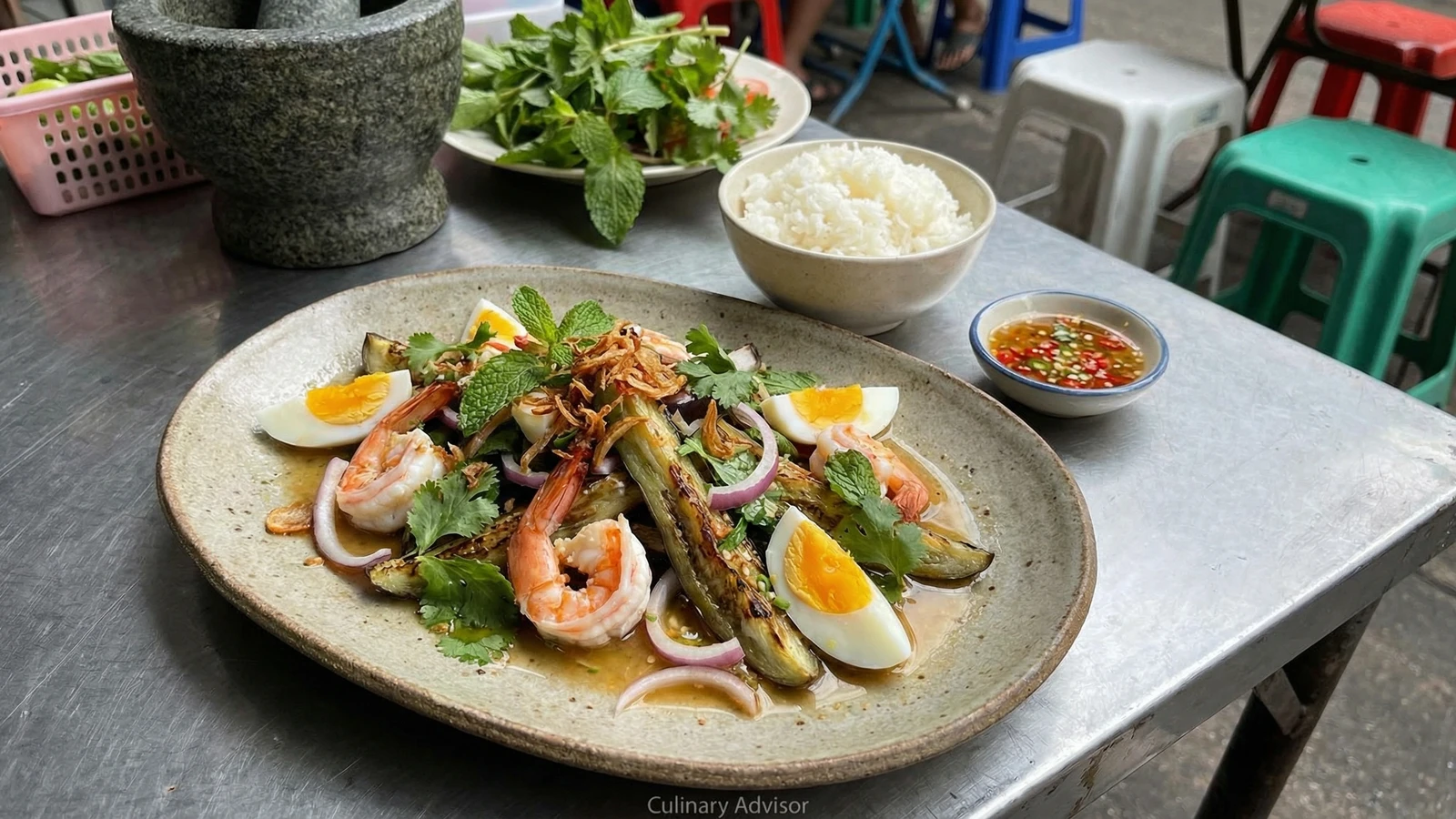
Roasted Eggplant Salad (Yam Makhuea Yao)
Created by
The four pillars in a dressing: nam pla for salt, manao for sour, nam tan pip for sweet, prik for heat. Char the eggplant whole until it collapses, then let the dressing do what the system was built to do.
Every Central Thai yam is a lesson in the four pillars disguised as a salad. Fish sauce for salt. Lime for sour. Palm sugar for sweet. Chili for heat. That's the dressing. That's the law. The protein changes, the vegetables change, but the dressing stays the same because it IS the system, made portable.
Ajarn always said: "If you can dress a yam correctly, you understand Thai flavor." He wasn't being poetic. He meant it literally. The yam dressing is the four pillars stripped down to their purest expression, no coconut cream to soften them, no kreung tam to build complexity. Just the raw architecture of Thai flavor in a bowl.
Yam makhuea yao adds one more dimension: smoke. You roast the eggplant whole over direct flame until the skin is blackened and the flesh inside has completely surrendered. Collapsed. Silky. Almost liquid. That char isn't decoration. It's a fifth flavor in the dish, a bitterness and depth that balances the sharp acidity of the lime. When you peel back the charred skin and the soft flesh meets the bright, punchy dressing, the warm eggplant opens up and drinks it in. That's why you dress it while it's still warm. Heat opens flavor. Cold shuts it down.
I teach this dish in every Fai Thai workshop because it's the fastest way to prove that Thai food is a system, not a menu. You learn the dressing ratio once, and you can yam anything: seafood, grilled meat, vegetables. The eggplant version is where I start because it's cheap, it's forgiving, and it forces you to trust the fire. Char it until you think you've gone too far. You haven't.
Yam makhuea yao is a Central Thai home-cooking staple with roots in the agricultural heartland around the Chao Phraya River basin, where long eggplant (Solanum melongena) grows prolifically in the hot season. The technique of charring vegetables whole over charcoal before dressing them predates modern Thai cuisine and connects to a broader Southeast Asian tradition of fire-roasting found from Myanmar to Vietnam. In Thailand, this dish sits firmly in the category of ahaan tham sang (อาหารทำแซ่ง), made-to-order food, and remains a staple of Central Thai lunch stalls where the eggplants are charred over charcoal in the morning and dressed throughout the day.
The technique, the tradition, and the story behind every dish.
Discover Culinary AdvisorIngredients
long Asian eggplant (makhuea yao)
Quantity
4 (about 500g total)
medium shrimp
Quantity
150g
shell-on
hard-boiled eggs
Quantity
2
peeled and quartered
lime juice (nam manao)
Quantity
3 tablespoons (about 2-3 limes)
fish sauce (nam pla)
Quantity
2 tablespoons
palm sugar (nam tan pip)
Quantity
1 tablespoon
shaved or grated
bird's eye chilies (prik khi nu)
Quantity
5
sliced thin
shallots (hom daeng)
Quantity
3
sliced thin
fresh cilantro leaves and stems
Quantity
1 handful
fresh mint leaves
Quantity
1 handful
fried shallots (hom jiaw) (optional)
Quantity
2 tablespoons
| Ingredient | Quantity |
|---|---|
| long Asian eggplant (makhuea yao) | 4 (about 500g total) |
| medium shrimpshell-on | 150g |
| hard-boiled eggspeeled and quartered | 2 |
| lime juice (nam manao) | 3 tablespoons (about 2-3 limes) |
| fish sauce (nam pla) | 2 tablespoons |
| palm sugar (nam tan pip)shaved or grated | 1 tablespoon |
| bird's eye chilies (prik khi nu)sliced thin | 5 |
| shallots (hom daeng)sliced thin | 3 |
| fresh cilantro leaves and stems | 1 handful |
| fresh mint leaves | 1 handful |
| fried shallots (hom jiaw) (optional) | 2 tablespoons |
Equipment Needed
- •Gas burner, charcoal grill, or oven broiler
- •Long tongs for turning eggplant
- •Small mixing bowl for dressing
Instructions
- 1
Char the eggplant
Place the whole eggplants directly over an open gas flame, on a charcoal grill, or under a broiler set to high. Turn them with tongs every few minutes. The skin should blister, crack, and blacken completely. Don't be timid. You want full collapse: the eggplant should feel soft and floppy when you press it with the tongs, like a bag of warm silk. This takes 12-15 minutes over a gas burner, longer on charcoal. The kitchen will smell like smoke. Good. That's flavor entering the flesh.
If you pull the eggplant off the flame too early, the flesh inside will still be firm and fibrous. You want it completely surrendered. When you think it's done, give it two more minutes. The char on the outside is not waste. It flavors the flesh beneath it. - 2
Peel and cool briefly
Let the charred eggplant rest for 2 minutes, just enough to handle. Peel the blackened skin away with your fingers or a knife. Some char will cling to the flesh. Leave it. That smokiness is the whole point. Tear the peeled eggplant into rough strips with a fork or your hands and lay them on a serving plate. Don't chop them into precise pieces. This is rustic. The texture should be silky and irregular.
- 3
Poach the shrimp
Bring a small pot of water to a boil. Drop the shrimp in, shell on. Cook for 2 minutes until pink and just curled. Drain immediately and run under cold water to stop the cooking. Peel the shells and devein. The shrimp should be firm but tender, not rubbery. Halve them lengthwise if they're large. Set aside.
- 4
Make the yam dressing
In a small bowl, combine the fish sauce, lime juice, and palm sugar. Stir until the sugar dissolves completely. Add the sliced chilies. Taste it. The dressing should hit sour first, salty second, sweet as a quiet backdrop, and heat building at the finish. This is the four pillars in liquid form. Adjust now, before it touches the eggplant. More lime if it needs brightness. More fish sauce if it needs backbone. The palm sugar should round the edges, not make it sweet.
Ajarn always said: "Add sour last, add sour slowly." In a yam dressing you're mixing it separately, so you can taste and correct. But the same rule applies. Lime is the dominant note. It should be assertive but not punishing. If you overshoot, a tiny bit more palm sugar pulls it back. - 5
Dress while warm
Spoon the dressing over the warm eggplant. This is critical. The eggplant should still be warm, not hot, not cold. Warm flesh absorbs dressing. Cold flesh repels it. The silky eggplant will soak up the lime and fish sauce and the flavors will merge instead of sitting on the surface. Tilt the plate and spoon pooled dressing back over the top.
- 6
Assemble and serve
Arrange the poached shrimp and quartered hard-boiled eggs over the dressed eggplant. Scatter the raw sliced shallots across the top. Pile the cilantro and mint generously. These herbs are structural, not decoration. Every bite should include a leaf. Finish with a handful of fried shallots (hom jiaw) for crunch. Serve at room temperature with steamed jasmine rice. Never from the fridge. A yam is alive at room temperature and dead when it's cold.
Chef Tips
- •The long Asian eggplant (makhuea yao) is essential. Don't use globe eggplant or Italian eggplant. The Thai long variety has thinner skin, fewer seeds, and a creamier, less bitter flesh when charred. It collapses into silk. Globe eggplant gives you mush with a different, more bitter flavor profile. If you can't find Thai long eggplant, Japanese eggplant is the closest substitute.
- •Charcoal gives the best smoke flavor, but a gas burner works. An oven broiler is your last resort. The point is direct, aggressive heat that blackens the outside while steaming the inside. Whatever method you choose, commit to the char. Half-roasted eggplant tastes like nothing.
- •The dressing ratio for any Central Thai yam is the same architecture: fish sauce, lime, palm sugar, chili. Once you nail this balance, you can dress grilled squid, poached shrimp, sliced beef, blanched morning glory, anything. The yam dressing is the system made portable. Learn it once, use it forever.
- •Fried shallots (hom jiaw) are the textural bridge. The eggplant is soft. The herbs are fresh. The shallots are crispy and sweet. That contrast is built into the dish. You can buy them pre-made at any Asian grocery, or fry thinly sliced shallots in oil over medium heat until deep golden. Drain on paper. They keep for days in a sealed container.
Advance Preparation
- •Eggplant can be charred up to 2 hours ahead and left at room temperature. Peel when ready to serve. Do not refrigerate: cold eggplant loses its silky texture and won't absorb dressing properly.
- •Shrimp can be poached and peeled up to a few hours ahead and kept covered at room temperature if serving within 2 hours, or refrigerated and brought back to room temperature before assembling.
- •The dressing can be mixed ahead but add the lime juice within 30 minutes of serving. Lime juice loses its sharp brightness over time. It goes flat. Fresh squeeze, always.
- •Hard-boiled eggs can be prepared up to a day ahead and refrigerated. Bring to room temperature before assembling.
Frequently Asked Questions
Nutrition Information
1 serving (about 350g)
Where cooking meets culture.
Culinary mentorship, cultural storytelling, and the editorial depth that makes cooking meaningful.
Explore Culinary Advisor