Culinary Advisor
A cooking platform built around craft, culture, and the stories behind what we eat.
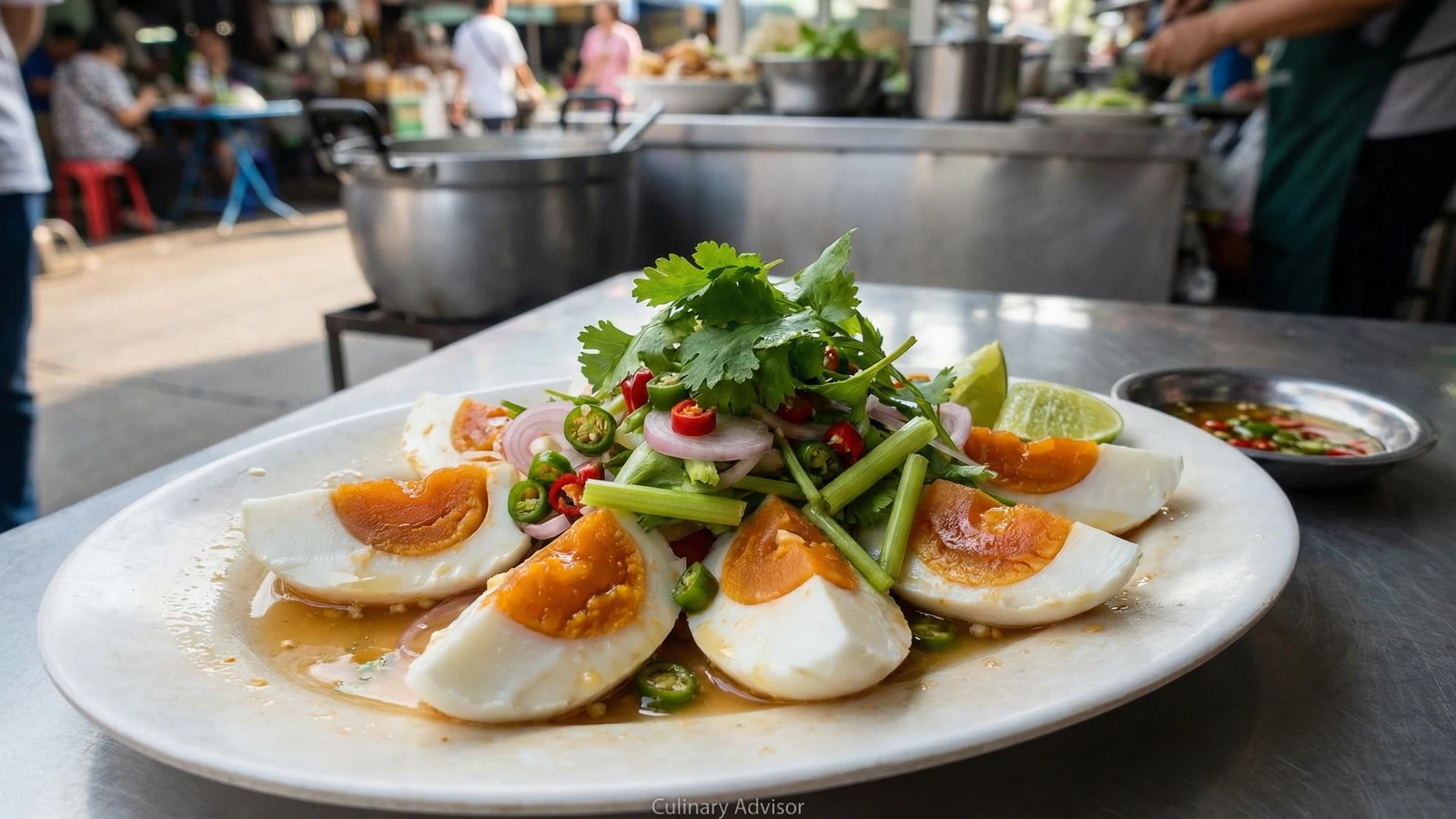
Salted Egg Salad (Yam Khai Kem)
Created by
When the protein brings its own salt, the four-pillar dressing bends around it: less nam pla, more manao, palm sugar stepping forward. The system adapts. That's the whole point.
The four pillars govern every yam. Fish sauce for salt. Palm sugar for sweet. Lime for sour. Chili for heat. That's the dressing formula, portable and universal, the same ratio that runs through every Central Thai dressed salad from yam woon sen to yam talay.
But here's where the system shows its intelligence. Khai kem (salted duck egg) arrives already loaded with salt. Weeks of sitting in brine have done the work that fish sauce usually does. So you recalibrate. Pull back on the nam pla. Push the lime forward. Let the palm sugar play a bigger role against that dense, saline yolk. The principle doesn't change. The ratio shifts because the ingredient demands it. That's what Ajarn meant when he said "principles, not recipes." A recipe would tell you two tablespoons of fish sauce. The principle tells you to taste and adjust because your main ingredient already brought its own salt to the table.
This is a weeknight dish. Fifteen minutes from stove to plate. You boil the eggs, quarter them, slice the shallots thin, mix the dressing, pour it over. Done. But "simple" and "careless" are not the same thing. The shallots must be sliced thin enough to soften in the dressing. The lime goes in last because its brightness fades fast. The herbs are structural: pak chi (cilantro) and kheun chai (Chinese celery) add green, sharp aroma that cuts through the richness of the yolk.
Serve it room temperature. Never cold from the fridge. Cold kills the flavor of the yolk and tightens the dressing. At room temperature, the orange yolk is creamy and almost fudgy, the dressing pools around the egg quarters, and every bite carries all four pillars at once. This is the yam that teaches you the system is flexible. Not loose. Flexible.
Salted duck eggs (khai kem, ไข่เค็ม) are one of Thailand's oldest preservation techniques, with the most celebrated eggs coming from Chaiya district in Surat Thani province, where mineral-rich clay and local salt produce yolks of extraordinary deep orange color and dense, creamy texture. Yam khai kem is a Central Thai home-kitchen and market-stall preparation that likely emerged as a practical way to use salted eggs beyond their familiar role as a side condiment with jok (rice porridge) or eaten plain over rice. The dish is a clear demonstration of how the yam dressing formula adapts: when the main ingredient carries its own seasoning, the cook recalibrates rather than follows a fixed ratio.
The technique, the tradition, and the story behind every dish.
Discover Culinary AdvisorIngredients
salted duck eggs (khai kem)
Quantity
4
shallots (hom daeng)
Quantity
4
thinly sliced
bird's eye chilies (prik khi nu)
Quantity
3
sliced thin
lime juice (nam manao)
Quantity
3 tablespoons (about 2-3 limes)
fish sauce (nam pla)
Quantity
1 teaspoon
palm sugar (nam tan pip)
Quantity
1 tablespoon
shaved or chopped
Chinese celery (kheun chai)
Quantity
1 stalk
cut into 1-inch pieces
fresh cilantro (pak chi)
Quantity
small handful
leaves and stems
scallion (ton hom)
Quantity
1
sliced into 1-inch pieces
| Ingredient | Quantity |
|---|---|
| salted duck eggs (khai kem) | 4 |
| shallots (hom daeng)thinly sliced | 4 |
| bird's eye chilies (prik khi nu)sliced thin | 3 |
| lime juice (nam manao) | 3 tablespoons (about 2-3 limes) |
| fish sauce (nam pla) | 1 teaspoon |
| palm sugar (nam tan pip)shaved or chopped | 1 tablespoon |
| Chinese celery (kheun chai)cut into 1-inch pieces | 1 stalk |
| fresh cilantro (pak chi)leaves and stems | small handful |
| scallion (ton hom)sliced into 1-inch pieces | 1 |
Equipment Needed
- •Small pot for boiling eggs
- •Sharp knife
Instructions
- 1
Boil the salted eggs
Place the salted duck eggs in a pot and cover with room-temperature water. Bring to a boil, then reduce to a steady simmer for 12 minutes. You want a fully set yolk, firm all the way through. This isn't a soft-boil situation. The yolk needs to hold its shape when you quarter the egg. Transfer to cold water and let them cool enough to handle. Peel carefully. Salted egg whites are more fragile than regular boiled eggs, they tend to stick to the shell. Take your time.
If you buy pre-cooked salted eggs (common at Thai and Chinese grocery stores), skip this step entirely. Just peel and quarter. But check the yolk: it should be dense, deep orange, almost sandy in texture. If it's pale or rubbery, find a better source. - 2
Make the yam dressing
In a small bowl, dissolve the palm sugar in the lime juice. Stir until the sugar breaks down completely. Then add the fish sauce. One teaspoon. That's it. The eggs are already carrying serious salt from weeks in brine. If you dump in your usual yam amount of nam pla, the dish will be inedible. Taste the dressing on its own. It should lean sour and sweet, with just a whisper of salt. That's the recalibration. Add the sliced chilies to the dressing and let them sit while you prep the rest. The lime starts pulling heat from the chilies immediately.
Ajarn always said: taste the ingredient first, then build the dressing around it. Bite a piece of the egg white before you mix anything. Know how salty your eggs are. Every batch is different. Some brands are aggressive, some are mild. Your dressing responds to the egg, not to a recipe. - 3
Quarter and arrange
Cut each peeled egg into quarters lengthwise. Use a sharp knife and wipe the blade between cuts. The yolk is dense and crumbly, it wants to stick. Arrange the quarters on a plate, cut side up so the bright orange yolk faces the ceiling. You're showing off that color. It's the visual anchor of the dish. Scatter the sliced shallots over and around the eggs. The shallots go on raw. They'll soften slightly in the dressing but keep their bite. That crunch against the creamy yolk is the textural contrast that makes yam khai kem work.
- 4
Dress and serve
Pour the dressing evenly over the eggs and shallots. Don't drown it. The dressing should pool around the base and coat the whites without submerging everything. Scatter the Chinese celery, scallion, and cilantro over the top. These are structural. The celery adds a sharp, green bitterness. The cilantro brings brightness. The scallion ties it together. Serve immediately at room temperature. No fridge. No reheating. Pick up a quarter with your spoon, make sure you get shallot, herb, and dressing in the same bite. That's a complete bite: salt from the egg, sour from the lime, sweet from the palm sugar, heat from the chili, crunch from the shallot, freshness from the herbs. All four pillars. One spoonful.
Chef Tips
- •The quality of your salted egg is 90% of this dish. Look for eggs with dense, deep orange yolks that are slightly grainy and rich, almost like a savory custard. Pale, watery yolks mean the eggs weren't cured long enough or the brand is cutting corners. Thai and Chinese grocery stores usually carry them. Chaiya-style eggs from Southern Thailand are the gold standard, but any well-cured duck egg works.
- •One teaspoon of fish sauce. That's your starting point. I've seen people pour in their usual two tablespoons and wonder why the yam tastes like the ocean floor. The egg white alone is aggressively salty. The yolk is rich and saline. Your dressing needs to work around that, not pile on top of it. Taste after one teaspoon. If you genuinely need more, add a half-teaspoon. But you probably don't.
- •This is a room-temperature dish. Serve it the moment it's dressed. The lime juice starts losing its brightness after ten minutes, and a cold fridge turns the yolk from creamy to chalky. Yam khai kem is not a make-ahead dish. It's a ten-minute dish you eat right now.
- •Some cooks add a small handful of crispy fried shallots (hom jiaw) on top at the end. It's not traditional in the simplest market versions, but it adds another layer of crunch and sweetness. If you go that route, fry them yourself. The pre-packaged ones taste stale.
Advance Preparation
- •Salted eggs can be boiled up to a day ahead and refrigerated in their shells. Bring to room temperature before peeling and assembling.
- •Shallots can be sliced and held in a bowl of cold water for up to an hour to keep them crisp. Drain and pat dry before using.
- •Do not dress the dish ahead of time. The dressing goes on at the moment of serving. Lime juice fades, shallots get soggy, herbs wilt. Assemble, dress, eat.
Frequently Asked Questions
Nutrition Information
1 serving (about 215g)
Where cooking meets culture.
Culinary mentorship, cultural storytelling, and the editorial depth that makes cooking meaningful.
Explore Culinary Advisor