Culinary Advisor
A cooking platform built around craft, culture, and the stories behind what we eat.
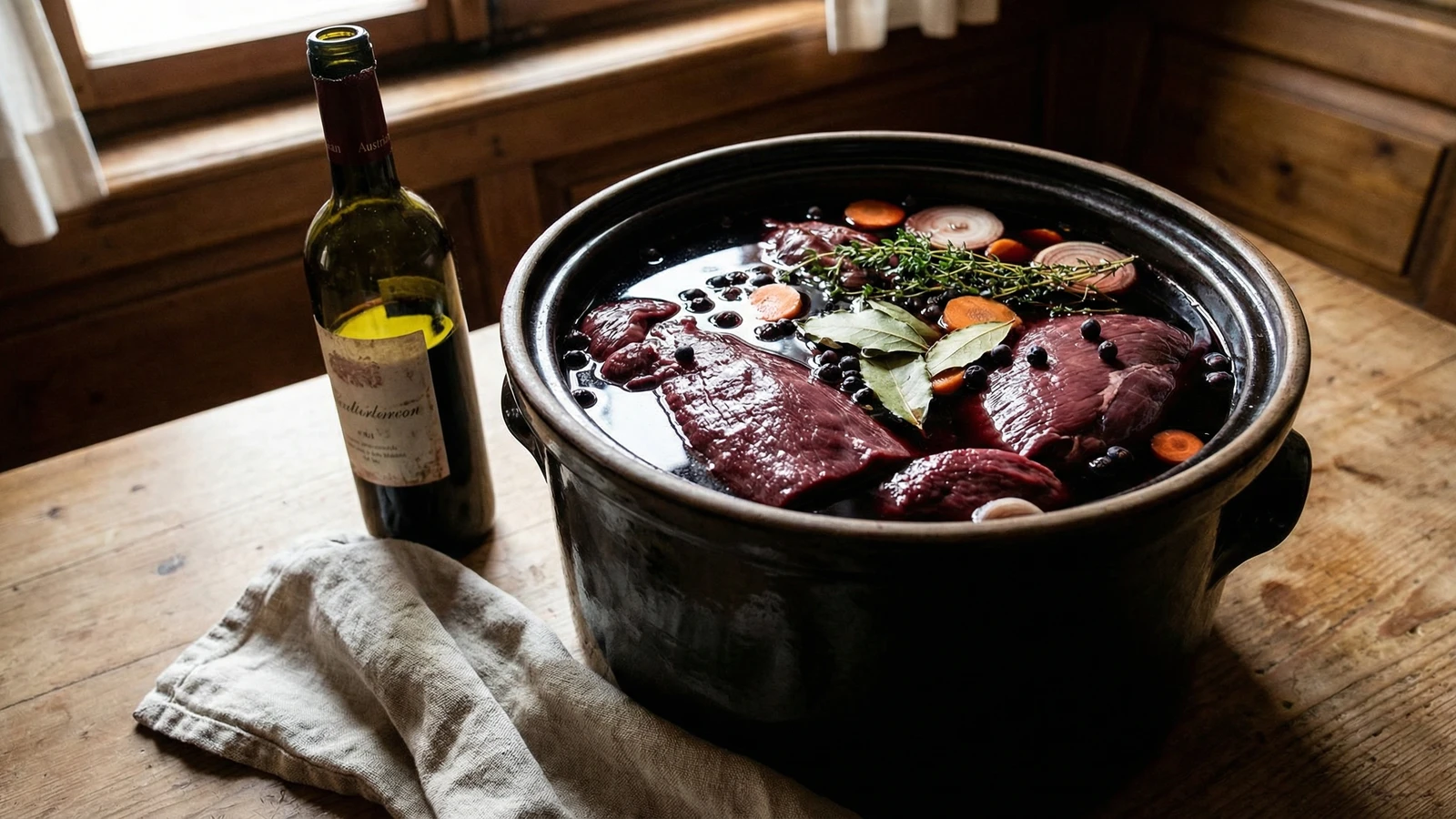
Wildbeize (Austrian Game Marinade)
Created by Chef Elsa
A wine-dark Austrian marinade of juniper, allspice, and bay leaves that tenderizes venison and wild boar over days of patient waiting, then becomes the foundation for the richest game sauce you'll ever make.
Every autumn in Salzburg, the Grunmarkt shifts. The summer stone fruit disappears and suddenly there's game everywhere. Whole haunches of Reh (roe deer) hanging in the butcher stalls, wild boar from the Salzkammergut, hares from the Alpine foothills. The air gets colder, the food gets darker, and the smell of Wildbeize drifting out of restaurant kitchens is as much a signal of the season as the first frost on the Untersberg.
Wildbeize is not a recipe in the way most people think of recipes. It's a preparation, a commitment. You combine red wine, vinegar, root vegetables, and a handful of spices that smell like the Austrian woods (juniper, allspice, bay, cloves) and you simmer them into something greater than the sum of their parts. Then you wait. Two days for a tender loin. Three or four for a tough shoulder. The acid and the wine work slowly, softening the dense fibers of wild meat, mellowing the strong gamey flavor that puts some people off, and leaving behind something deeply savory and perfumed.
Gretel always said that the Beize is where the sauce begins. She was right. Once the meat comes out, you strain that liquid and reduce it, and it becomes the most beautiful dark, glossy, juniper-scented sauce. Nothing from a packet or a cube comes close. This is good Austrian home cooking at its most elemental: simple ingredients, proper technique, and time doing most of the work for you.
Beizen, the practice of marinating game in an acidic wine mixture, has been central to Austrian and Central European hunting cuisine since at least the medieval period, when wild game was a primary protein source in the Alpine regions. The technique served a practical purpose before refrigeration: the acid in wine and vinegar inhibited bacterial growth and extended the usable life of a kill. Austrian regional variations reflect local wine production. Styria and Burgenland favor their own robust reds, while in Salzburg and Upper Austria, where wine is scarcer, older recipes sometimes substitute beer or even buttermilk. The classic Wildbeize as we know it today, built on red wine with juniper and allspice, was codified in Austrian cookery books by the 18th century and remains the standard preparation in Gasthaus kitchens during game season.
The technique, the tradition, and the story behind every dish.
Discover Culinary AdvisorIngredients
dry red wine (Blaufränkisch or Zweigelt)
Quantity
500ml
red wine vinegar
Quantity
250ml
cold water
Quantity
250ml
carrot
Quantity
1 large
peeled and roughly sliced
onion
Quantity
1 medium
halved and sliced
celery stalk
Quantity
1
roughly chopped
parsnip
Quantity
1 small
peeled and sliced
juniper berries
Quantity
6
lightly crushed
whole allspice berries
Quantity
6
whole black peppercorns
Quantity
8
bay leaves
Quantity
3
whole cloves
Quantity
3
cinnamon stick
Quantity
1 small
fresh thyme
Quantity
4 sprigs
fresh parsley
Quantity
3 sprigs
lemon zest
Quantity
1 strip (about 5cm)
pith removed
salt
Quantity
1 teaspoon
granulated sugar
Quantity
1 tablespoon
| Ingredient | Quantity |
|---|---|
| dry red wine (Blaufränkisch or Zweigelt) | 500ml |
| red wine vinegar | 250ml |
| cold water | 250ml |
| carrotpeeled and roughly sliced | 1 large |
| onionhalved and sliced | 1 medium |
| celery stalkroughly chopped | 1 |
| parsnippeeled and sliced | 1 small |
| juniper berrieslightly crushed | 6 |
| whole allspice berries | 6 |
| whole black peppercorns | 8 |
| bay leaves | 3 |
| whole cloves | 3 |
| cinnamon stick | 1 small |
| fresh thyme | 4 sprigs |
| fresh parsley | 3 sprigs |
| lemon zestpith removed | 1 strip (about 5cm) |
| salt | 1 teaspoon |
| granulated sugar | 1 tablespoon |
Equipment Needed
- •Heavy-bottomed saucepan (2-3 liters)
- •Large non-reactive container with lid (glass, ceramic, or food-safe plastic)
- •Fine-mesh sieve
Instructions
- 1
Prepare the aromatics
Crush the juniper berries lightly with the flat side of a heavy knife. You don't want powder. You want them cracked open so their resinous, piney fragrance releases slowly into the liquid over days. Do the same with the allspice and peppercorns, just a firm press to split them. Leave the cloves, cinnamon, and bay leaves whole.
Smell your juniper berries before you use them. Good ones smell like a cold walk through a pine forest. Stale ones smell like nothing. If they're dusty and silent, buy new ones. - 2
Cook the vegetables
Put the sliced carrot, onion, celery, and parsnip into a heavy-bottomed pot with no fat. Set it over medium heat and let the vegetables dry-toast for three to four minutes, stirring once or twice. You're not trying to brown them deeply, just coax a little sweetness out. The onion should be translucent at the edges, the carrot starting to soften.
- 3
Build the Beize
Add the wine, vinegar, and water to the pot. Drop in the crushed juniper, allspice, peppercorns, cloves, cinnamon stick, bay leaves, thyme, parsley, lemon zest, salt, and sugar. Stir once to dissolve the sugar. Bring the liquid to a gentle simmer and let it cook, uncovered, for twenty minutes. The kitchen will smell like a Styrian hunting lodge in November. That sharp, aromatic, wine-dark smell is exactly right.
Simmering the marinade does two things. It melds the flavors so they work as one, and it burns off the harsh edge of the raw vinegar. Skipping this step gives you a marinade that tastes like separate ingredients floating in sour wine. - 4
Cool completely
Remove the pot from the heat and let the Beize cool to room temperature. This is not optional. If you pour warm marinade over raw game, you start cooking the surface of the meat before the acid and aromatics have a chance to penetrate. Patience here means tenderness later. Let it sit until it's truly cool, at least an hour.
Speed this up by setting the pot in a sink of cold water if you're short on time. Stir it occasionally. Twenty minutes in an ice bath does the same work as an hour on the counter. - 5
Marinate the game
Place your game meat in a deep, non-reactive container: glass, ceramic, or food-safe plastic. Never aluminum, which reacts with the acid and gives the meat a metallic taste. Pour the cooled Beize over the meat, vegetables and all. The liquid should cover the meat completely. If it doesn't, turn the meat twice a day. Cover tightly and refrigerate for two to four days. Venison loin needs two days. A wild boar shoulder or a whole hare benefits from three or four. The meat will darken, and the texture will soften as the wine and vinegar slowly break down the tough connective fibers.
- 6
Use the Beize
When you're ready to cook, remove the meat and pat it completely dry with paper towels. Strain the marinade through a fine sieve and keep the liquid. Discard the spent vegetables and spices. The strained Beize is the foundation for your sauce: reduce it by half in a saucepan, then use it to deglaze your roasting pan or braise your game. It becomes the best gravy you've ever made, rich with wine and juniper and all those days of slow, patient work.
Chef Tips
- •Use an Austrian red if you can find one. Blaufränkisch or Zweigelt have the right balance of fruit and acidity for game. If you can't, any dry, medium-bodied red wine works. Don't use anything you wouldn't drink, but don't waste your best bottle either. The spices will do most of the talking.
- •The ratio of wine to vinegar matters. Too much vinegar and the meat turns sour and the texture goes stringy. Too little and the marinade can't do its tenderizing work. The recipe gives you two parts wine to one part vinegar to one part water. Trust it.
- •Don't throw away the strained Beize after marinating. Reduce it by half in a saucepan, mount it with a tablespoon of cold butter at the end, and you have the traditional Austrian Wildsauce. It's what makes a roasted venison loin into something people remember for years.
- •Game season in Austria runs roughly September through January. If you're buying game outside that window, it's likely farmed, which is perfectly fine but will need less marinating time. Two days is enough for farmed venison. Wild game that has actually run through the woods has denser muscle and benefits from the full three to four days.
Advance Preparation
- •The cooked and cooled Beize can be stored in the refrigerator for up to five days before use. The flavors deepen as it sits.
- •Once the meat is marinating, plan your cooking day for two to four days ahead. Mark it on the calendar. The Beize does the work while you wait.
- •Strained marinade liquid can be frozen for up to three months. Defrost it when game season comes around again and you'll have the sauce base ready.
Frequently Asked Questions
Nutrition Information
1 serving (about 175g)
Where cooking meets culture.
Culinary mentorship, cultural storytelling, and the editorial depth that makes cooking meaningful.
Explore Culinary Advisor