Culinary Advisor
A cooking platform built around craft, culture, and the stories behind what we eat.
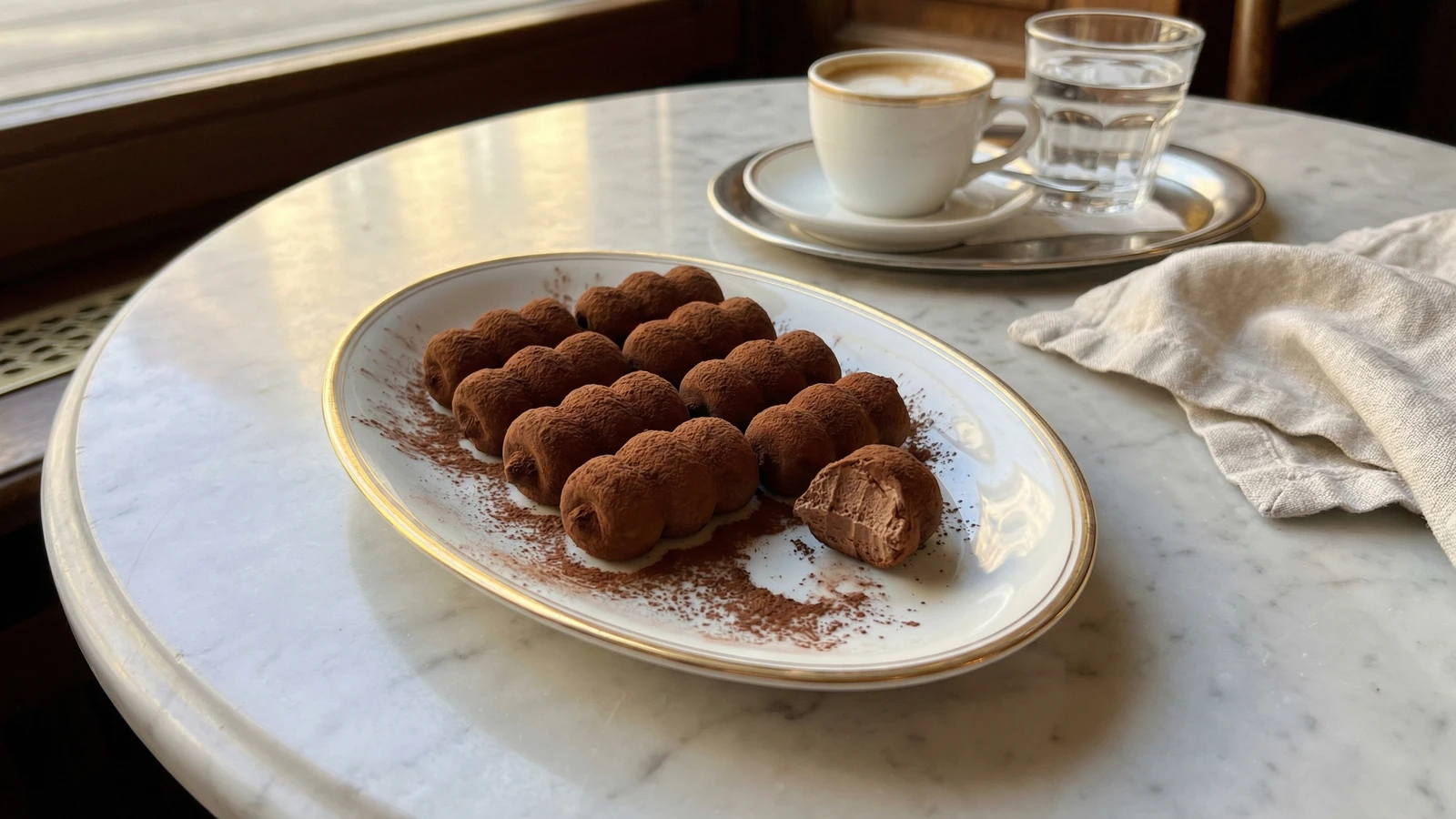
Wiener Schokoladentrüffel (Viennese Chocolate Truffles)
Created by Chef Elsa
Whipped Viennese ganache piped into soft mounds and dusted in dark cocoa. Lighter than any truffle you've had before, because the Viennese don't do heavy when they can do it light.
Ilearned to make these standing at the counter in my grandmother Eva's kitchen in Kent, watching Gretel Beer whip a bowl of ganache with a balloon whisk until her arm shook. She wouldn't let me use the electric mixer. 'You need to feel when it changes,' she told me. She was right. There's a moment when the ganache goes from dense and heavy to something almost mousse-like, lighter in color, airy on the spoon. That's the moment that makes Viennese truffles different from every other chocolate truffle in the world.
Most truffles are simply rolled ganache, dense little spheres coated in cocoa or tempered chocolate. The Viennese Konditorei tradition does something else entirely. The ganache is chilled, then beaten until it holds soft peaks, piped into small mounds, and dusted with the best cocoa you can find. The texture when you bite into one is closer to a chocolate cloud than a chocolate ball. It dissolves against the warmth of your mouth before you've properly chewed. Gretel always said the secrets of Viennese cuisine live in these small details, the extra step that seems unnecessary until you taste the difference.
The ingredients are simple. Good chocolate, cream, butter, a splash of Austrian rum, Vanillezucker. That's it. Five things. Which means every one of them matters. Cheap chocolate will announce itself the moment you take a bite, and no amount of technique can hide it. This is the kind of recipe that rewards you for buying the best you can afford and then doing very little to it, very well.
Vienna's Konditorei tradition of handmade chocolate confections flourished in the 19th century alongside the city's Kaffeehaus culture, where truffles and petit fours were served with afternoon coffee as a matter of course. Austrian Konditoren developed the whipped ganache technique to distinguish their truffles from the denser French style, prizing lightness as a hallmark of Viennese pastry work. The use of Inländerrum, a distinctly Austrian spirit originally created as a domestic substitute for imported Caribbean rum, gives these truffles their unmistakable local character.
The technique, the tradition, and the story behind every dish.
Discover Culinary AdvisorIngredients
dark chocolate (70% cocoa)
Quantity
250g
finely chopped
Schlagobers (heavy cream)
Quantity
200ml
unsalted butter
Quantity
30g
at room temperature
rum (Stroh 80 or Inländerrum)
Quantity
1 tablespoon
vanilla sugar (Vanillezucker)
Quantity
1 teaspoon
fine sea salt
Quantity
pinch
Dutch-process cocoa powder
Quantity
50g
for dusting
| Ingredient | Quantity |
|---|---|
| dark chocolate (70% cocoa)finely chopped | 250g |
| Schlagobers (heavy cream) | 200ml |
| unsalted butterat room temperature | 30g |
| rum (Stroh 80 or Inländerrum) | 1 tablespoon |
| vanilla sugar (Vanillezucker) | 1 teaspoon |
| fine sea salt | pinch |
| Dutch-process cocoa powderfor dusting | 50g |
Equipment Needed
- •Small saucepan
- •Heatproof mixing bowl
- •Hand mixer or stand mixer with whisk attachment
- •Piping bag with large round or star tip
- •Baking sheet lined with parchment paper
- •Fine-mesh sieve for dusting cocoa
Instructions
- 1
Heat the cream
Pour the cream into a small saucepan and heat it gently over medium-low. You want it just barely simmering, with tiny bubbles forming around the edges. Don't let it boil. Boiled cream changes flavor and can break your ganache before you've even started. Pull it off the heat the moment you see those first small bubbles rise.
- 2
Make the ganache
Place the finely chopped chocolate in a heatproof bowl. Pour the hot cream over it in one go, right into the center. Wait sixty seconds. Don't touch it. The heat needs a moment to penetrate the chocolate. Now stir from the center outward in slow, tight circles with a spatula. The mixture will look broken and grainy for a minute. Keep stirring. It will come together into a smooth, glossy emulsion. This is your ganache, and the glossiness tells you the cocoa butter and cream have properly combined.
If the ganache splits and looks oily, add a tablespoon of cold cream and stir vigorously. The cold cream shocks it back into emulsion. Don't panic. It happens even to Konditoren. - 3
Add butter and flavoring
Once the ganache is smooth and has cooled to about body temperature (touch the side of the bowl, it should feel barely warm), add the soft butter, rum, Vanillezucker, and salt. Stir until the butter melts in completely. The butter gives the truffles that silky, melt-on-your-tongue quality that separates Konditorei work from homemade chocolate balls. The rum is Inländerrum if you can find it, which is what every Austrian pastry kitchen uses. Stroh 80 works beautifully too. The Vanillezucker rounds the whole thing out.
The butter must be at room temperature. Cold butter won't incorporate smoothly and hot ganache will melt it too fast, making the mixture greasy instead of silky. - 4
Chill the ganache
Press a sheet of cling film directly onto the surface of the ganache to prevent a skin from forming. Refrigerate for at least two hours, until it's firm enough to hold its shape when scooped but not rock-hard. If you skip the cling film, a dry crust forms on top and you'll have gritty flecks running through your truffles.
- 5
Whip the ganache
This is the step that makes Viennese truffles what they are. Take the chilled ganache and beat it with a hand mixer or a stand mixer fitted with the whisk attachment. Start on low, then increase to medium speed. Beat for two to three minutes until the color lightens from dark brown to a soft, mousy brown and the texture becomes airy and holds soft peaks. You're incorporating air into the chocolate the same way you'd whip cream. The ganache should look like chocolate mousse. If it's still dense and dark, keep going. If it goes grainy, it's too cold. Let it soften for five minutes and try again.
Gretel always said the Viennese don't do anything heavy when they can do it light. This is what she meant. Whipping the ganache transforms a dense chocolate mass into something that dissolves on your tongue. - 6
Pipe the truffles
Transfer the whipped ganache to a piping bag fitted with a large round or star tip. Pipe mounds about three centimeters across onto a baking sheet lined with parchment paper. Work quickly. The warmth of your hands through the bag starts softening the ganache, so don't squeeze and hesitate. Confident, steady pressure, a quick twist at the top to break the flow. If you don't have a piping bag, use two teaspoons to scoop and shape rough rounds. The piped shape is traditional Konditorei style, but rustic mounds taste exactly the same.
Run the piping bag under cold water for a moment before filling it. A cool bag gives you more working time before the ganache softens. - 7
Chill and set
Refrigerate the piped truffles for thirty minutes until they firm up and hold their shape when touched. They should feel set on the outside but still give slightly when you press gently. Don't leave them overnight uncovered or they'll absorb fridge odors and taste like last night's dinner.
- 8
Dust in cocoa
Sift the cocoa powder into a wide, shallow bowl. Working in batches, drop three or four truffles into the cocoa and roll them gently until completely coated. Lift each one out and tap off the excess. The cocoa coating should be even and velvety, not caked on thick. Use Dutch-process cocoa, not natural. It's darker, smoother, and less acidic, which is exactly what you want against the sweet ganache. Arrange the finished truffles on a clean plate or in paper petit four cases. They're ready.
Chef Tips
- •Buy the best chocolate you can afford. At 70% cocoa, the chocolate is doing most of the talking and there is nowhere for a cheap bar to hide. I use Zotter from Styria in my restaurant. If you can't find Austrian chocolate, any good European couverture at 70% will serve you well.
- •Inländerrum is the traditional Austrian choice and it has a distinct flavor you won't get from Caribbean rum. It's sweeter, more caramel-forward, and it's what every Konditorei in Vienna uses. Stroh 80 is the brand you'll find most easily outside Austria. A tablespoon is enough. You want a whisper of rum, not a shout.
- •These truffles keep for a week in the fridge in an airtight container, but pull them out twenty minutes before serving. Cold ganache is muted. At room temperature, the chocolate flavor opens up and the texture is at its silkiest. If you serve them straight from the fridge, you're only tasting half the truffle.
- •Dust with cocoa just before serving if you can. Cocoa absorbs moisture over time and can look patchy after a day or two. A fresh dusting takes ten seconds and makes them look like they just came out of a Konditorei.
Advance Preparation
- •The ganache can be made, chilled, and whipped up to two days ahead. Store it covered in the fridge and pipe when ready.
- •Piped truffles can be frozen before dusting for up to one month. Thaw in the fridge overnight, then dust with cocoa before serving.
- •For a dinner party, pipe and chill the truffles the morning of. Dust with cocoa twenty minutes before your guests arrive and leave them at room temperature on the serving plate.
Frequently Asked Questions
Nutrition Information
1 serving (about 14g)
Where cooking meets culture.
Culinary mentorship, cultural storytelling, and the editorial depth that makes cooking meaningful.
Explore Culinary Advisor