Culinary Advisor
A cooking platform built around craft, culture, and the stories behind what we eat.
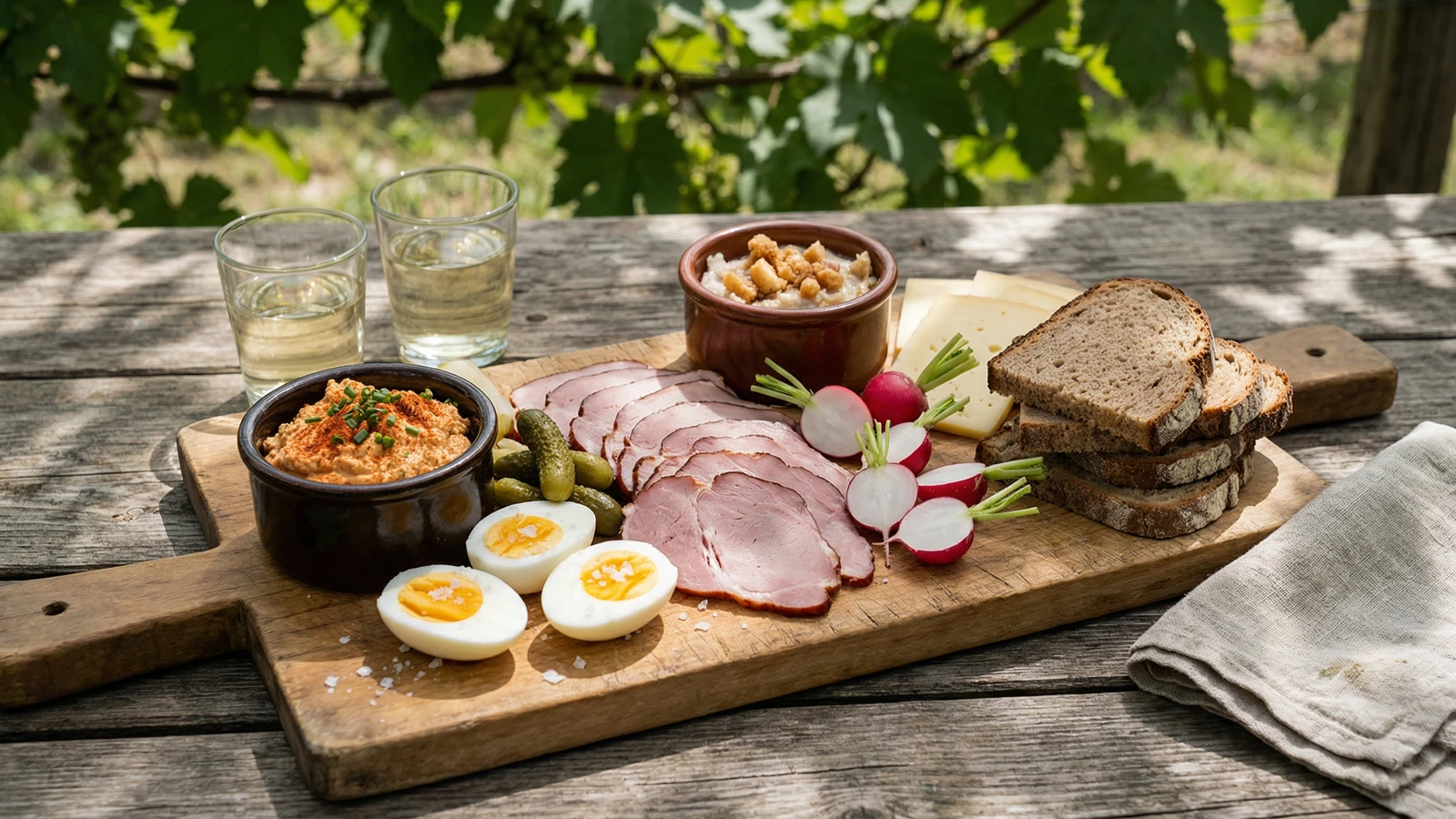
Wiener Heurigenbrettl
Created by Chef Elsa
The Viennese wine tavern board: Liptauer with sharp paprika, Grammelschmalz in an earthenware crock, thin-sliced Geselchtes, hard-boiled eggs, crunchy radishes, and sour gherkins piled onto a wooden Brettl with good dark bread.
Every Austrian wine region has its version of the Brettljause, but the one you find at a proper Heuriger in Vienna's outer districts is the one I fell in love with first. I was maybe ten, sitting in a courtyard in Grinzing with Gretel and my grandmother Eva, grape leaves casting green shadows across the table. Gretel ordered a Brettl and an Achterl of Grüner Veltliner, and when the board arrived it was so loaded with food I thought it was for the whole table. It was for her.
A Heurigenbrettl is not a recipe in the usual sense. It's a composition. Each element on the board has a reason for being there, and each one plays against the others: the sharp, paprika-red Liptauer against cool slices of hard-boiled egg. The rich, porky weight of Grammelschmalz cut by sour gherkins. Smoked Geselchtes, salty and dense, lifted by peppery radish. And underneath everything, dark sourdough bread doing what good bread does, carrying flavor without competing with it.
The only thing you actually cook here is the Liptauer, and even that is just mixing. But mixing well. Getting the ratios right, tasting as you go, trusting your palate over a measuring spoon. Gretel always said the test of a good Liptauer is whether you want to eat it straight off the knife before it reaches the bread. If you don't, you haven't added enough paprika.
This is Gemütlichkeit on a board. Wine tavern food, meant for a warm evening, an open courtyard, and people you want to sit with for a long time. You don't need a vineyard. You need good ingredients, a wooden board, and a bottle of something cold and Austrian.
The Heuriger tradition dates to a 1784 decree by Emperor Josef II granting Viennese winemakers the right to sell their own wine and serve simple cold food on their premises. The green pine branch (Buschen) hung above the door to signal the tavern was open, which is why these establishments are also called Buschenschanken in other Austrian wine regions. Vienna's Heurigen culture was inscribed on UNESCO's Intangible Cultural Heritage list in 2019, recognizing both the winemaking tradition and the communal eating culture built around these cold boards.
The technique, the tradition, and the story behind every dish.
Discover Culinary AdvisorIngredients
Topfen or full-fat quark
Quantity
250g
unsalted butter
Quantity
60g
softened to room temperature
sweet Hungarian paprika
Quantity
1 tablespoon
sharp paprika (optional)
Quantity
1 teaspoon
Dijon or medium-hot mustard
Quantity
1 tablespoon
white onion
Quantity
2 tablespoons
finely minced
capers
Quantity
1 tablespoon
drained and chopped
fresh chives
Quantity
1 tablespoon, plus extra
finely chopped
caraway seeds
Quantity
1/2 teaspoon
lightly crushed
salt and black pepper
Quantity
to taste
Grammelschmalz (pork crackling lard)
Quantity
150g
Geselchtes (Austrian smoked pork)
Quantity
250g
thinly sliced
eggs
Quantity
4 large
hard-boiled
Essiggurkerl (Austrian pickled gherkins)
Quantity
8 small
radishes
Quantity
1 bunch
halved or quartered
Emmentaler or Bergkäse
Quantity
200g
sliced
dark sourdough rye bread (Schwarzbrot)
Quantity
1 loaf
sliced
coarse salt
Quantity
for finishing
sweet paprika
Quantity
for finishing
| Ingredient | Quantity |
|---|---|
| Topfen or full-fat quark | 250g |
| unsalted buttersoftened to room temperature | 60g |
| sweet Hungarian paprika | 1 tablespoon |
| sharp paprika (optional) | 1 teaspoon |
| Dijon or medium-hot mustard | 1 tablespoon |
| white onionfinely minced | 2 tablespoons |
| capersdrained and chopped | 1 tablespoon |
| fresh chivesfinely chopped | 1 tablespoon, plus extra |
| caraway seedslightly crushed | 1/2 teaspoon |
| salt and black pepper | to taste |
| Grammelschmalz (pork crackling lard) | 150g |
| Geselchtes (Austrian smoked pork)thinly sliced | 250g |
| eggshard-boiled | 4 large |
| Essiggurkerl (Austrian pickled gherkins) | 8 small |
| radisheshalved or quartered | 1 bunch |
| Emmentaler or Bergkäsesliced | 200g |
| dark sourdough rye bread (Schwarzbrot)sliced | 1 loaf |
| coarse salt | for finishing |
| sweet paprika | for finishing |
Equipment Needed
- •Large wooden serving board (40cm or larger)
- •Small earthenware crocks or ramekins for spreads
- •Sharp slicing knife for the Geselchtes
- •Fine-mesh sieve for pressing Topfen
Instructions
- 1
Make the Liptauer
Press the Topfen through a fine sieve into a mixing bowl. This step matters. Unsieved Topfen stays lumpy and your Liptauer will have an uneven, grainy texture instead of the smooth, spreadable consistency you want. Add the softened butter and work them together with a fork until completely blended. The mixture should be creamy and pale, with no streaks of white butter visible.
Topfen is Austrian fresh curd cheese, similar to quark but slightly drier. Full-fat quark is your best substitute outside Austria. Cream cheese is too dense and fatty. Ricotta is too wet. If you can only find low-fat quark, add an extra tablespoon of butter to compensate. - 2
Season the Liptauer
Add the sweet paprika, sharp paprika if using, mustard, minced onion, capers, chives, and crushed caraway seeds. Mix thoroughly. The Liptauer should turn a warm, rusty orange from the paprika. Taste it now. It should be savory, a little sharp from the mustard and capers, with a gentle warmth from the paprika building at the back of your throat. Season with salt and pepper. Then taste again. Gretel always said Liptauer wants more paprika than you think it does. If the color doesn't make you think of autumn in Vienna, keep going.
Use good Hungarian paprika, not the dusty jar that's been sitting in your cupboard for two years. Paprika loses its flavor and color quickly once opened. If it smells like nothing when you open the tin, it will taste like nothing in your Liptauer. Buy a fresh one. - 3
Rest the Liptauer
Cover the bowl and refrigerate for at least thirty minutes, an hour is better. The flavors need time to marry. When Liptauer is freshly mixed it tastes like its individual ingredients. After resting, it tastes like one thing: Liptauer. The onion softens into the background, the caraway rounds out, and the paprika deepens. This is not a step you skip.
- 4
Boil the eggs
Place the eggs in a single layer in a saucepan. Cover with cold water by two centimeters. Bring to a boil over high heat. The moment the water reaches a full, rolling boil, cover the pan, remove it from the heat, and let the eggs sit for exactly eleven minutes. Transfer them to ice water immediately. This gives you a fully set yolk that's still slightly creamy in the very center, not chalky or gray-green around the edges. Peel when cool. Cut in halves or quarters.
Eggs that are a few days old peel much more cleanly than fresh ones. The membrane separates from the shell as eggs age. If your eggs are farm-fresh, give them three or four days in the fridge before boiling. - 5
Prepare the Grammelschmalz
If your Grammelschmalz is homemade or from a butcher, it's ready to go. Spoon it into a small earthenware crock or ramekin and let it come to cool room temperature so it's spreadable but not melting. You want it soft enough that a knife glides through it and picks up little golden Grammeln (cracklings) on the way. If you can only find plain Schweineschmalz (pork lard) without cracklings, it still belongs on the board. Spread it on dark bread, sprinkle coarse salt over the top, and you have one of the simplest, best things Austrian cooking has to offer.
Good Grammelschmalz from an Austrian butcher or deli has small, crispy pork cracklings embedded throughout. The fat should be white to pale gold, never yellow or rancid-smelling. If you're making it yourself, render pork back fat slowly with diced pork skin until the skin turns into crunchy Grammeln, then strain and stir the cracklings back in with a little salt and marjoram. - 6
Slice the Geselchtes
Slice the Geselchtes as thinly as you can manage. It should be translucent at the edges, almost like good prosciutto but smokier and denser. If your piece has a rind, leave it on. Austrians eat the rind. It's chewy and smoky and part of the experience. Fan the slices out so they're easy to pick up and lay onto bread.
Geselchtes is pork that has been cured and cold-smoked, a tradition that goes back centuries in Alpine Austria. If you can't find it, look for Schwarzgeräuchertes at a German or Austrian deli, or use a high-quality smoked ham. Supermarket deli ham is not a substitute. The smoke flavor is the whole point. - 7
Prepare the fresh elements
Halve or quarter the radishes, depending on size. Leave a bit of green stem attached if they're fresh, it looks right on the board. Drain the Essiggurkerl and cut any large ones in half lengthwise. Slice the cheese into pieces roughly the size of a playing card, thick enough to have substance on bread. Everything on this board should be easy to pick up with your fingers or balance on a slice of bread with a knife.
- 8
Assemble the Brettl
Use a large wooden board, the kind that looks like it's been used a thousand times. Place the Liptauer in a small crock or mound it on one corner, making a shallow well in the top with the back of a spoon, then fill the well with a drizzle of good paprika and a scatter of chives. Set the Grammelschmalz crock on the opposite side. Arrange the Geselchtes slices fanned out across the middle. Tuck the egg halves, gherkins, and radish pieces into the gaps. Lay the cheese slices where they fit. Pile the sliced Schwarzbrot along one edge or in a separate basket alongside. Sprinkle coarse salt over the eggs and radishes. Stand back and look at the whole thing. It should look generous, abundant, a little bit crowded. A Heurigenbrettl that looks minimalist has missed the point entirely.
Every element on this board is meant to be eaten on bread. Show your guests how: take a slice of Schwarzbrot, spread Liptauer or Grammelschmalz across it, lay a piece of Geselchtes on top, add a slice of gherkin or radish, and eat it in three bites. That's the Heuriger way.
Chef Tips
- •The bread matters more than people think. Dark Austrian sourdough rye, Schwarzbrot, has a dense, sour crumb that stands up to heavy spreads and smoked meat. Light wheat bread collapses under the weight of Grammelschmalz and turns to paste. If you can't find proper Schwarzbrot, a good German-style Vollkornbrot or a dense Scandinavian rye will work. Soft sandwich bread will not.
- •Liptauer keeps beautifully in the fridge for three days, and actually improves overnight as the flavors develop. Make it the day before your gathering and you'll taste the difference.
- •If you're serving this at a dinner party, put an Achterl of Grüner Veltliner or Gemischter Satz in everyone's hand before they sit down. A Heurigenbrettl without Austrian white wine is like a Kaffeehaus without a glass of water. Technically possible, spiritually wrong.
- •Don't refrigerate the board right up to serving. Pull everything out thirty minutes beforehand. Cold Liptauer doesn't spread. Cold Grammelschmalz is a brick. Cold Geselchtes tastes muted. Room temperature is where the flavors live.
Advance Preparation
- •Liptauer can and should be made one day ahead. Cover tightly and refrigerate. The flavors deepen overnight.
- •Eggs can be boiled and peeled up to two days ahead. Store in the fridge in a covered container.
- •Assemble the board no more than thirty minutes before serving. The radishes dry out and the bread goes stale if it sits too long. Keep the Liptauer and Grammelschmalz in their crocks until the last moment.
Frequently Asked Questions
Nutrition Information
1 serving (about 460g)
Where cooking meets culture.
Culinary mentorship, cultural storytelling, and the editorial depth that makes cooking meaningful.
Explore Culinary Advisor