Culinary Advisor
A cooking platform built around craft, culture, and the stories behind what we eat.
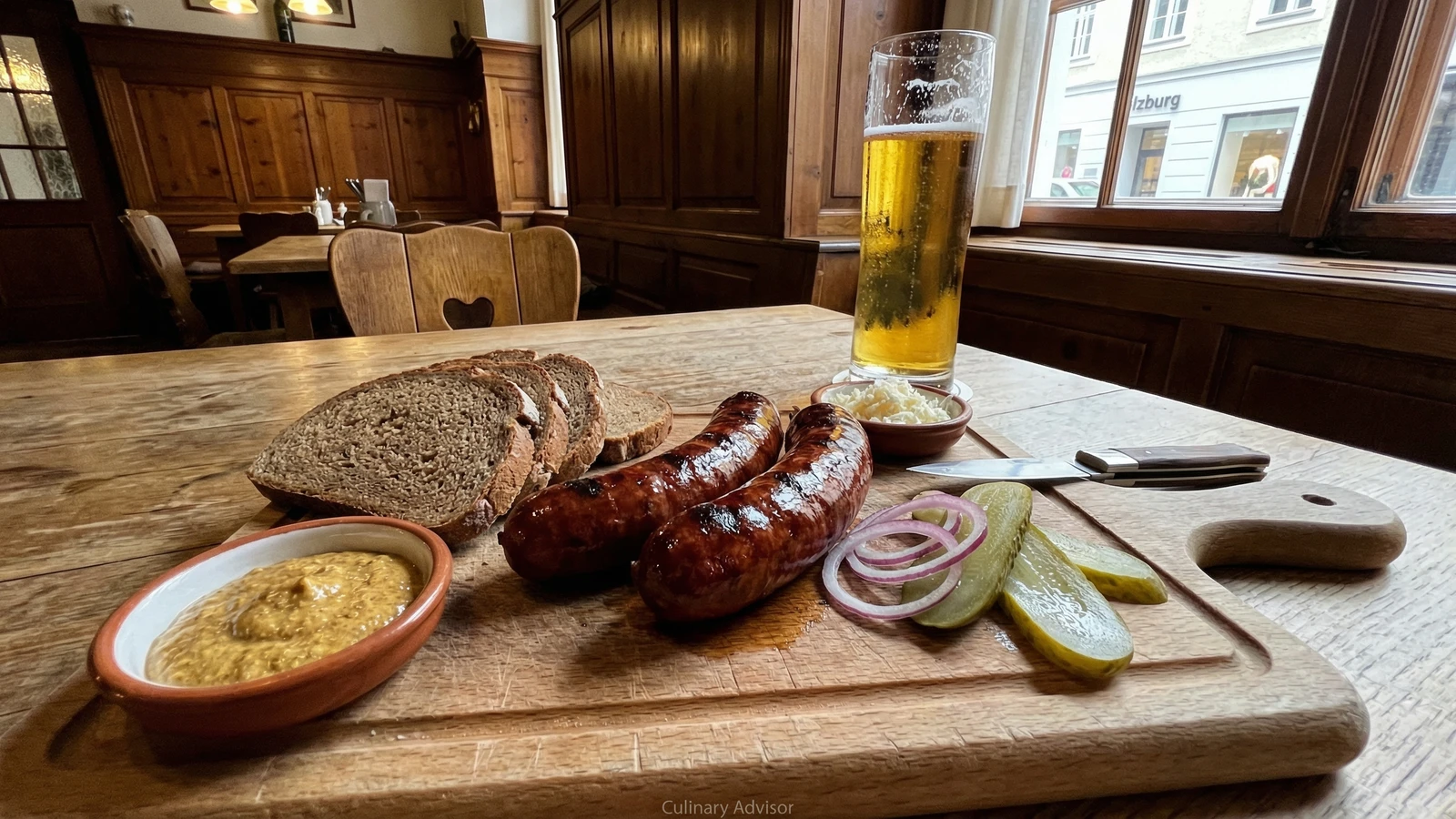
Waldviertler (Lower Austrian Smoked Sausage)
Created by Chef Elsa
Lower Austria's granite-country sausage, warmed until the taut skin snaps under your teeth, served on a board with dark Bauernbrot, sharp Kremser Senf, and freshly grated Kren.
The Waldviertel sits in the northwest corner of Lower Austria, all granite hills and dark forests and winters that don't mess about. The food up there matches the landscape: direct, honest, built to sustain. Waldviertler sausages are smoked hard over beechwood until the casing goes taut and mahogany-dark, and the meat inside takes on a flavor so deep and concentrated it barely needs anything beside it. A board. Dark bread. Sharp mustard. That's a meal.
I first had a proper Waldviertler on one of those childhood trips with Gretel and my grandmother Eva. We'd stopped at a Gasthaus somewhere between Zwettl and Waidhofen an der Thaya, the kind of place where the menu was whatever the kitchen had that day. They brought out a wooden board with two fat smoked sausages, a pot of mustard so sharp it made your eyes water, a pile of dark Bauernbrot, and a little dish of freshly grated Kren (horseradish). Gretel ate hers with the kind of quiet concentration she usually saved for pastry. That told me everything I needed to know.
This is not a complicated recipe. It's a lesson in sourcing and restraint. You find the best smoked sausage you can, you warm it gently so the casing stays intact and the fat inside just begins to loosen, and you put it on the table with the right things beside it. Austrian cooking is simple food done well, and this is as simple and as good as it gets.
The Waldviertel's smoking traditions date back centuries, born from the practical need to preserve meat through long, harsh winters in one of Austria's coldest and most remote regions. Beechwood smoking became the signature method because beech forests dominate the landscape, and the slow, cool smoke produces a distinctively intense flavor without the bitterness of softer woods. Kremser Senf, the sharp mustard traditionally paired with Waldviertler sausages, comes from the nearby Wachau town of Krems an der Donau, where mustard production has been documented since the 18th century.
The technique, the tradition, and the story behind every dish.
Discover Culinary AdvisorIngredients
Waldviertler smoked sausages
Quantity
4 (about 150g each)
dark Bauernbrot (farmhouse rye bread)
Quantity
1 loaf
thickly sliced
Kremser Senf or sharp Austrian mustard
Quantity
4 tablespoons
fresh horseradish root (Kren)
Quantity
about 80g
white wine vinegar
Quantity
1 teaspoon
sugar
Quantity
pinch
salt
Quantity
pinch
dill pickles (Salzgurken)
Quantity
4 large
white onion (optional)
Quantity
1 small
thinly sliced into rings
unsalted butter
Quantity
for the bread
| Ingredient | Quantity |
|---|---|
| Waldviertler smoked sausages | 4 (about 150g each) |
| dark Bauernbrot (farmhouse rye bread)thickly sliced | 1 loaf |
| Kremser Senf or sharp Austrian mustard | 4 tablespoons |
| fresh horseradish root (Kren) | about 80g |
| white wine vinegar | 1 teaspoon |
| sugar | pinch |
| salt | pinch |
| dill pickles (Salzgurken) | 4 large |
| white onion (optional)thinly sliced into rings | 1 small |
| unsalted butter | for the bread |
Equipment Needed
- •Wide pot or saucepan large enough to submerge 4 sausages
- •Fine grater or microplane for the horseradish
- •Wooden serving board
Instructions
- 1
Warm the sausages gently
Fill a wide pot with enough water to fully submerge the sausages. Heat the water until small bubbles form on the bottom and the surface barely trembles, around 75°C if you have a thermometer. Slide the sausages in. Keep the heat low. You are warming them through, not boiling them. A rolling boil will split the casings and you'll lose all that beautiful smoky fat into the water instead of keeping it where it belongs, inside the sausage. Let them sit in the hot water for twelve to fifteen minutes.
If you see the water starting to bubble properly, pull it off the heat for a minute. The sausages are already smoked and fully cooked. You're just bringing them to the temperature where the fat softens and the flavors open up. Patience, not heat. - 2
Grate the fresh Kren
While the sausages warm, peel your horseradish root and grate it finely. Do this close to serving time. Freshly grated Kren has a sharp, clean heat that hits the back of your nose and then disappears. Pre-grated horseradish from a jar tastes like cardboard by comparison. Toss the grated Kren with a teaspoon of white wine vinegar, a pinch of sugar, and a pinch of salt. The vinegar stabilizes the heat so it doesn't fade as fast.
Grate only what you need. Kren loses its punch within thirty minutes of being grated. If your eyes water and your sinuses clear, it's fresh enough. If nothing happens, find a better root. - 3
Prepare the board
Slice the Bauernbrot thick, about two centimeters. Good dark rye bread with a dense crumb and a hard crust is what you want. If you can find a proper Austrian Bauernbrot from a bakery, use it. If not, the darkest, densest rye bread your shop carries will do. Butter the slices. Slice the pickles lengthwise into spears. If you like raw onion with your sausage, and most Austrians do, slice the white onion into thin rings.
- 4
Serve on the board
Lift the sausages out of the water and let them rest for a minute on a clean cloth. The casings should look taut and glossy. Place them on a wooden board or a plain white plate. Put the mustard in a small dish, the fresh Kren in another. Arrange the bread, pickles, and onion rings alongside. Bring the whole board to the table. Let people build their own bites: a piece of sausage on buttered bread, a smear of mustard, a pinch of Kren, a bite of pickle to cut through the smoke. This is how Austrians eat in the Waldviertel. Mahlzeit!
Gretel always said the test of a good sausage is whether it can hold the table on its own. If you need to dress it up, the sausage isn't good enough. The accompaniments are there to sharpen and contrast, not to compensate.
Chef Tips
- •The sausage is everything here. If you can find a proper Austrian Fleischhauer (butcher) or a Central European deli that carries Waldviertler or a similar beechwood-smoked pork sausage, that's your best bet. Failing that, look for a natural-casing smoked sausage with a firm texture and a deep, honest smoke flavor. Avoid anything with liquid smoke in the ingredients list.
- •Kremser Senf is sharper and coarser than Dijon. If you can't source it, a good coarse-grain German mustard will work, but add a little extra horseradish to the plate to make up the difference. Yellow ballpark mustard is not an option.
- •Don't skip the butter on the bread. The fat carries the smoke flavor from the sausage across your palate and rounds out the sharpness of the mustard and Kren. It's not decoration. It's architecture.
- •A cold beer or, better yet, a glass of Most (Austrian apple or pear cider from the Mostviertel, the neighboring region) is the traditional drink here. The acidity cuts through the richness of the smoked pork.
Advance Preparation
- •The fresh Kren must be grated just before serving. This is not negotiable. It loses its heat and turns bitter within the hour.
- •The Bauernbrot can be sliced and the pickles prepared ahead, but keep the bread covered so the cut surfaces don't dry out.
- •Waldviertler sausages keep well in the fridge for up to two weeks unopened, or you can freeze them for up to three months. Thaw fully in the fridge before warming.
Frequently Asked Questions
Nutrition Information
1 serving (about 480g)
Where cooking meets culture.
Culinary mentorship, cultural storytelling, and the editorial depth that makes cooking meaningful.
Explore Culinary Advisor