Culinary Advisor
A cooking platform built around craft, culture, and the stories behind what we eat.
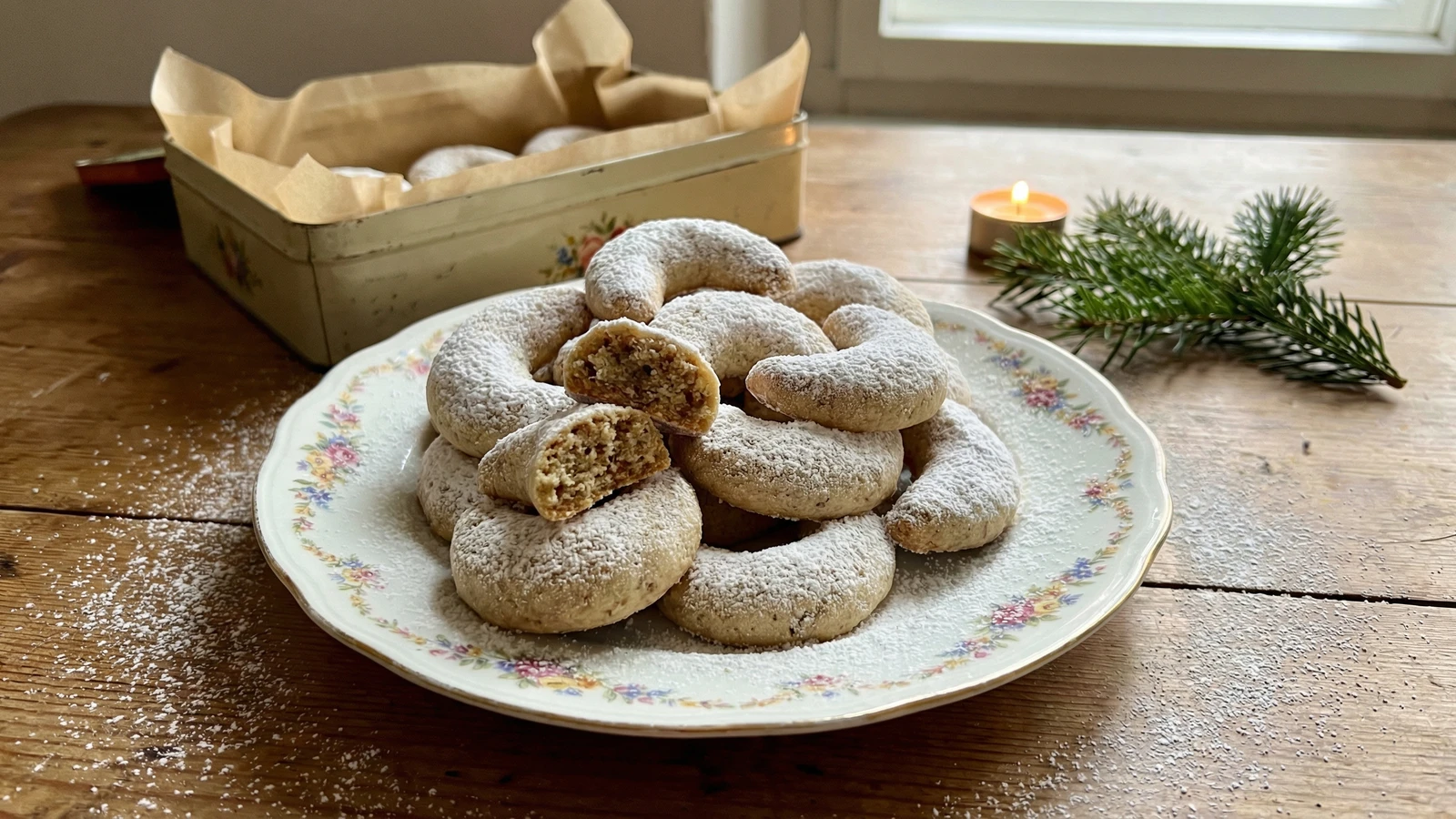
Vanillekipferl
Created by Chef Elsa
The crescent-shaped, walnut-studded Viennese cookie that rules every Austrian Adventzeit, rolled in homemade vanilla sugar while still warm from the oven and tucked into a tin to wait for Christmas.
Every December in my grandmother Eva's kitchen in Kent, the Vanillekipferl came first. Before the Lebkuchen, before the Zimtsterne, before anything else. Gretel would arrive with her own ground walnuts in a paper bag and the two of them would take over the kitchen table, shaping tiny crescents with hands that had been doing this since before I was born. The whole house smelled like butter and vanilla for two days. I'd sit on my stool rolling the warm Kipferl through a dish of vanilla sugar, the most important job in the world when you're six years old.
Vanillekipferl are, to me, the undisputed queen of the Austrian cookie tin. They look plain. They don't have chocolate or glaze or anything showy about them. What they have is a texture that no other cookie achieves: a crumble so fine and sudden that the cookie practically dissolves the moment it touches your tongue. Ground walnuts and cold butter and just enough flour to hold the whole thing together, baked pale, then rolled in vanilla sugar while they're still warm enough to melt it onto the surface. That thin, sweet, fragrant shell is what separates a proper Vanillekipferl from a dry shortbread crescent.
The technique is simple. You can learn to shape them in ten minutes. But simple is not the same as careless. The butter must be cold. The dough must rest. The Kipferl must come out of the oven before they brown. The sugar must go on while they're warm. Four rules, and every one of them matters. Follow them and you'll have a cookie tin that makes you the most popular person at every Adventzeit gathering. Gretel always said the best cook at Christmas is the one who starts early and makes Kipferl.
Vanillekipferl belong to the Weihnachtsbäckerei, the Christmas baking tradition that dominates Austrian kitchens from late November through Advent. Their crescent shape is often traced to the kipfel, a crescent-shaped pastry that Vienna claims originated after the Ottoman siege of 1683, baked to celebrate the victory and mock the Ottoman crescent. The vanilla sugar coating became standard in the 18th and 19th centuries, when vanilla arrived in Vienna as a luxury spice through the Habsburg trade networks. Today, Vanillekipferl appear on virtually every Austrian family's Christmas cookie platter, and the annual debate over walnuts versus almonds versus hazelnuts can divide households as fiercely as the Sachertorte question divides Konditorei loyalties.
The technique, the tradition, and the story behind every dish.
Discover Culinary AdvisorIngredients
plain flour
Quantity
210g
ground walnuts
Quantity
70g
salt
Quantity
pinch
unsalted butter
Quantity
140g
cold and cubed
icing sugar
Quantity
70g
sifted
Vanillezucker (vanilla sugar)
Quantity
1 packet (8g)
egg yolks
Quantity
2
icing sugar (for coating)
Quantity
100g
Vanillezucker (vanilla sugar, for coating)
Quantity
3 packets (24g)
| Ingredient | Quantity |
|---|---|
| plain flour | 210g |
| ground walnuts | 70g |
| salt | pinch |
| unsalted buttercold and cubed | 140g |
| icing sugarsifted | 70g |
| Vanillezucker (vanilla sugar) | 1 packet (8g) |
| egg yolks | 2 |
| icing sugar (for coating) | 100g |
| Vanillezucker (vanilla sugar, for coating) | 3 packets (24g) |
Equipment Needed
- •Large mixing bowl
- •Baking sheets (2)
- •Parchment paper
- •Wire cooling rack
- •Shallow dish for vanilla sugar coating
- •Cookie tin with tight-fitting lid for storage
Instructions
- 1
Combine the dry ingredients
Whisk together the flour, ground walnuts, and a pinch of salt in a large bowl. The walnuts should be finely ground, almost to a powder, but stop before they turn oily. If you grind them yourself in a food processor, pulse in short bursts and add a tablespoon of the flour from the recipe to keep them dry. The moment they clump together, you've gone too far and the oil has released. That oil will make your dough greasy instead of sandy.
Walnuts are the traditional Viennese choice, but many Austrian families use almonds or hazelnuts. Walnuts give a warmer, earthier flavor. Almonds are more delicate. Both are correct. Use what your grandmother used, or use what you love. - 2
Work in the butter
Add the cold, cubed butter to the flour and walnut mixture. Rub it in with your fingertips, quickly and lightly, until the mixture resembles coarse breadcrumbs. Cold butter is not a suggestion. It's the entire architecture of the cookie. Warm butter melts into the flour and you end up with a greasy dough that spreads in the oven instead of holding its crescent shape. If your kitchen is warm, put the cubed butter back in the fridge for ten minutes before you start. Your hands generate heat, so work fast.
- 3
Form the dough
Add the sifted icing sugar, Vanillezucker, and egg yolks. Bring the dough together with your hands, pressing and kneading gently just until it forms a smooth ball. This is a short dough, rich with fat and nuts, so it doesn't need much working. Ten or fifteen seconds of kneading at most. Overwork it and the gluten develops, which makes the baked Kipferl tough instead of crumbly. The finished dough should feel cool, slightly sandy, and hold together when you press it. Flatten it into a disc, wrap it in cling film, and refrigerate for at least one hour.
The resting time is not about convenience, it's about physics. The butter firms up again in the cold, the flour absorbs the fat and egg yolk evenly, and the dough becomes manageable. Skip the rest and the crescents will lose their shape in the oven. - 4
Shape the crescents
Preheat your oven to 170°C (340°F). Line two baking sheets with parchment paper. Take the dough from the fridge. It should feel firm but not rock-hard. If it cracks when you try to roll it, let it sit at room temperature for five minutes. Pinch off small pieces, about a heaped teaspoon each, and roll them between your palms into small logs roughly seven centimeters long, thicker in the middle and tapered at both ends. Bend each one gently into a crescent and place it on the baking sheet. Leave a little space between them. They don't spread much, but they're fragile, and you'll need room to get a spatula underneath later.
Keep your hands cool. If the dough starts sticking to your palms, rinse your hands under cold water and dry them before continuing. In my grandmother Eva's kitchen, she kept a bowl of cold water next to the worktop during Kipferl shaping. Gretel did the same. - 5
Bake until barely golden
Bake for 10 to 12 minutes. Watch them. Vanillekipferl should come out of the oven pale, with just a whisper of gold at the tips of the crescents. If they turn properly brown, they've gone too far and the delicate, melt-on-your-tongue texture is lost. They will feel soft when you touch them on the tray. That's correct. They firm up as they cool. Don't panic, and don't put them back in for another minute.
- 6
Dust with vanilla sugar
While the Kipferl bake, mix the coating: sift together the icing sugar and three packets of Vanillezucker into a shallow dish. This is where the magic happens. As soon as the Kipferl come out of the oven, let them sit on the tray for exactly two minutes. Not longer. They need to be warm, almost hot, but just firm enough to pick up without crumbling in your fingers. Roll each one gently through the vanilla sugar mixture, turning to coat every surface. The warmth of the cookie melts a thin layer of sugar onto its surface, creating that powdery, sweet shell that is the whole point of a Vanillekipferl. If you wait until they're fully cool, the sugar just sits on top and falls off when you bite.
- 7
Cool and store
Let the coated Kipferl cool completely on a wire rack. Once cool, give them a second, lighter dusting of the remaining vanilla sugar. Layer them carefully in a tin with parchment paper between the layers. They are extremely fragile. One careless moment and you have a tin of expensive crumbs. Seal the tin and leave them alone for at least two days before eating. Gretel always said Vanillekipferl need time to come into their own. The flavors settle and deepen, the texture becomes even more tender, and the vanilla permeates every crumb. On day one they're good. On day three they're extraordinary. They keep beautifully for three weeks in a sealed tin, if they last that long.
Chef Tips
- •Use real Vanillezucker made from vanilla pods buried in sugar, not the synthetic vanilla-flavored packets. The difference is night and day. If you can't find Austrian Vanillezucker, make your own: split two vanilla pods lengthwise, scrape the seeds into 200g of fine caster sugar, bury the empty pods in the jar, and wait a week. You'll have the real thing and your kitchen will smell magnificent every time you open the lid.
- •Grind your own walnuts if you can. Pre-ground nuts from the supermarket are often stale and powdery. Buy whole walnut halves and pulse them in a food processor with a tablespoon of flour from the recipe. The flour absorbs the oil and keeps them from turning into walnut butter.
- •Don't skip the two-day rest in the tin. I know it's tempting to eat them straight away. They're lovely on day one. But Vanillekipferl on day three are a different cookie entirely. The vanilla sugar saturates, the walnut flavor blooms, and the crumble turns impossibly fine. Gretel always baked hers a full week before Christmas and kept the tin on a high shelf so nobody could raid it early.
- •If one breaks while you're rolling it in sugar, eat it immediately. That's the baker's privilege and nobody can take it from you.
Advance Preparation
- •The dough can be made up to two days ahead and refrigerated, tightly wrapped. Let it sit at room temperature for ten minutes before shaping.
- •Shaped, unbaked crescents can be frozen on a baking sheet, then transferred to a freezer bag. Bake from frozen, adding one to two minutes to the baking time.
- •Baked and coated Vanillekipferl keep for three weeks in a sealed tin stored in a cool place. They improve with age. Bake them at least two to three days before you plan to serve them.
Frequently Asked Questions
Nutrition Information
1 serving (about 12g)
Where cooking meets culture.
Culinary mentorship, cultural storytelling, and the editorial depth that makes cooking meaningful.
Explore Culinary Advisor