Culinary Advisor
A cooking platform built around craft, culture, and the stories behind what we eat.
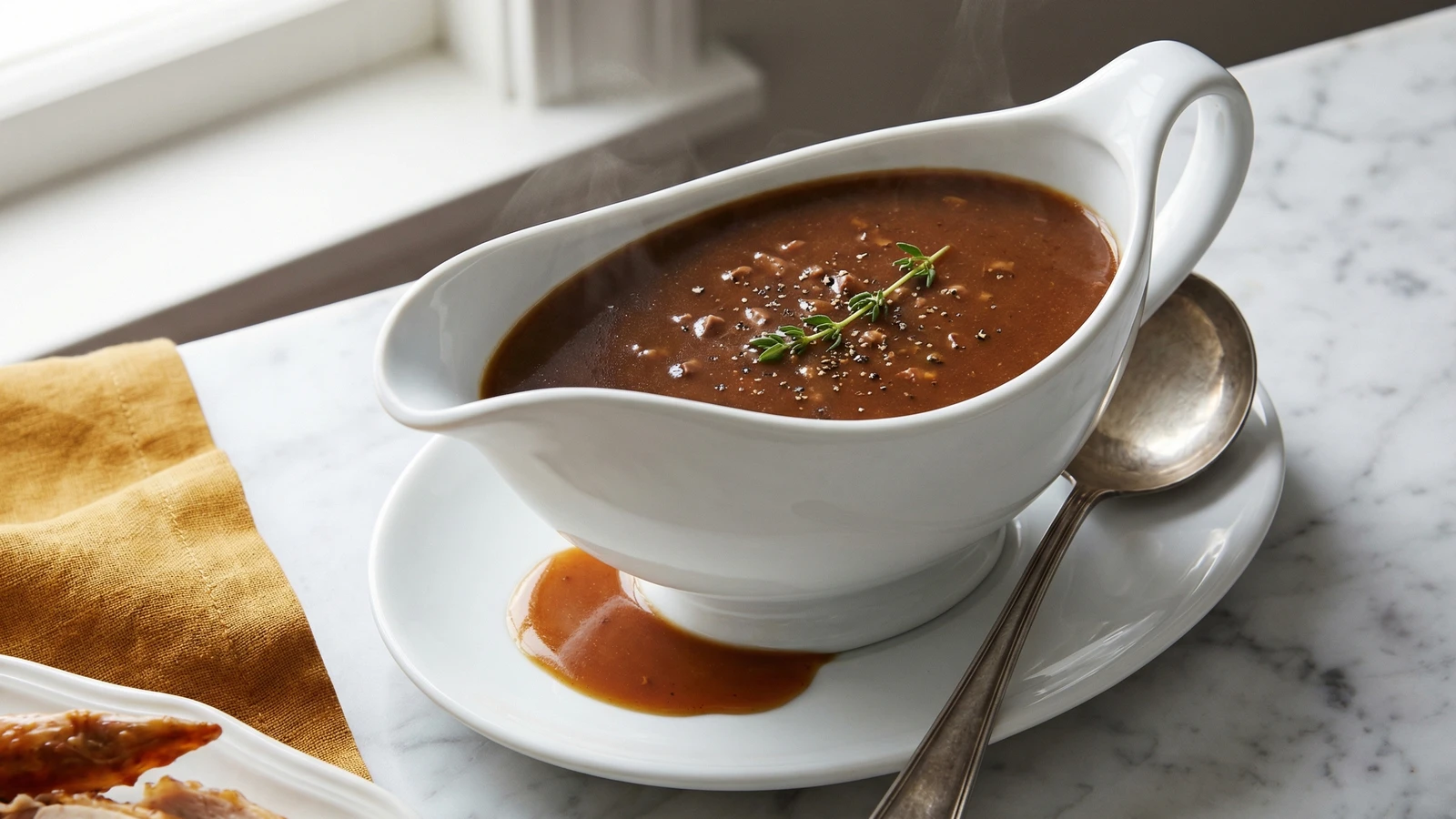
Turkey Giblet Gravy
Created by
A deeply savory gravy built from homemade giblet stock and honest pan drippings, the kind that turns dry white meat into something worth fighting over and makes the mashed potatoes disappear first.
No Thanksgiving table is complete without proper gravy. Not the stuff from a jar. Not the powder mixed with water. Real gravy, built from the parts most cooks throw away and the drippings most cooks burn. This is where the flavor lives.
The giblets tucked inside your turkey represent an opportunity. The neck, heart, and gizzard simmer into a stock so rich it barely needs help. The liver, if you choose to use it, adds depth that borders on mysterious. Our grandmothers understood this. They wasted nothing and their gravies showed it.
I've watched too many Thanksgiving cooks panic at the last minute, trying to stretch pale drippings with water while the turkey gets cold. The solution is simple: make your stock ahead. Two days before, three days before, whenever you have twenty minutes to get it simmering. Then on the day itself, you're just building a roux, deglazing the roasting pan, and bringing everything together. The turkey rests. The gravy comes together. Nobody panics.
This recipe yields enough for a proper crowd with some left over for sandwiches the next day. Because leftover turkey without gravy is just sad.
The technique, the tradition, and the story behind every dish.
Discover Culinary AdvisorIngredients
turkey giblets
Quantity
1 packet
neck, heart, gizzard, liver optional
cold water
Quantity
6 cups
yellow onion
Quantity
1 medium
quartered
celery stalks with leaves
Quantity
2
roughly chopped
carrot
Quantity
1
roughly chopped
fresh thyme
Quantity
4 sprigs
fresh sage
Quantity
2 sprigs
bay leaf
Quantity
1
whole black peppercorns
Quantity
8
turkey pan drippings
Quantity
1/2 cup
fat and juices combined
all-purpose flour
Quantity
1/2 cup
dry white wine or dry sherry
Quantity
1/2 cup
kosher salt
Quantity
1 teaspoon
plus more to taste
freshly ground black pepper
Quantity
1/2 teaspoon
unsalted butter (optional)
Quantity
2 tablespoons
for finishing
| Ingredient | Quantity |
|---|---|
| turkey gibletsneck, heart, gizzard, liver optional | 1 packet |
| cold water | 6 cups |
| yellow onionquartered | 1 medium |
| celery stalks with leavesroughly chopped | 2 |
| carrotroughly chopped | 1 |
| fresh thyme | 4 sprigs |
| fresh sage | 2 sprigs |
| bay leaf | 1 |
| whole black peppercorns | 8 |
| turkey pan drippingsfat and juices combined | 1/2 cup |
| all-purpose flour | 1/2 cup |
| dry white wine or dry sherry | 1/2 cup |
| kosher saltplus more to taste | 1 teaspoon |
| freshly ground black pepper | 1/2 teaspoon |
| unsalted butter (optional)for finishing | 2 tablespoons |
Equipment Needed
- •Medium saucepan (3-4 quart) for stock
- •Large saucepan (4 quart) for gravy
- •Fine-mesh strainer
- •Fat separator or glass measuring cup
- •Sturdy whisk
- •Wooden spoon for deglazing
- •Warmed gravy boat for serving
Instructions
- 1
Prepare the giblets
Remove the giblet packet from your turkey cavity. Rinse the neck, heart, and gizzard under cold water. If using the liver, set it aside separately as it cooks much faster and can turn the stock bitter if simmered too long. Pat everything dry with paper towels.
The liver question divides families. Some love its mineral richness, others find it overwhelming. If uncertain, leave it out entirely or add just half, finely minced, at the very end. - 2
Build the stock base
Place the neck, heart, and gizzard in a medium saucepan. Add the quartered onion, celery, carrot, thyme, sage, bay leaf, and peppercorns. Pour in the cold water. The liquid should cover everything by about an inch. If it doesn't, add a bit more water.
- 3
Simmer the stock
Bring to a boil over high heat, then immediately reduce to a gentle simmer. You want lazy bubbles breaking the surface, not a rolling boil. Skim any foam that rises in the first few minutes. Let it simmer uncovered for 1 1/2 to 2 hours. The stock should reduce by about one third and turn a rich amber color. The kitchen will smell like Thanksgiving.
If using the liver, add it during the last 20 minutes only. Longer cooking makes it grainy and bitter. - 4
Strain and reserve
Set a fine-mesh strainer over a large measuring cup or bowl. Pour the stock through, pressing gently on the solids to extract every drop of flavor. Discard the vegetables and aromatics. Pull any meat from the neck and finely chop the heart, gizzard, and liver if using. Reserve the chopped giblets separately. You should have about 4 cups of stock. If you have less, add water or low-sodium chicken broth to reach 4 cups.
- 5
Collect the pan drippings
When your turkey comes out of the oven, transfer it to a carving board and tent loosely with foil. Pour all the drippings from the roasting pan into a fat separator or glass measuring cup. Let it sit for a few minutes so the fat rises to the top. You need about 1/2 cup of the fat and all of the dark juices beneath it. If you're short on fat, supplement with butter.
No fat separator? Pour drippings into a cup, add a few ice cubes. The fat will congeal around them and you can lift it off. - 6
Deglaze the roasting pan
Place your roasting pan across two burners over medium heat. Pour in the wine. It will sizzle and steam dramatically. Use a wooden spoon to scrape up every brown bit stuck to the bottom. These fond bits are concentrated flavor. Scrape aggressively. Let the wine reduce by half, about 2 minutes. Pour this liquid into your giblet stock.
- 7
Make the roux
Pour the reserved fat into a large saucepan over medium heat. When it shimmers, whisk in the flour all at once. Keep whisking constantly. The roux will bubble and foam. Cook it for 2 to 3 minutes, whisking the whole time, until it turns the color of peanut butter and smells nutty. Don't rush this step. Raw flour tastes like wallpaper paste.
A blonde roux provides thickening power. A darker roux adds more flavor but thickens less. For gravy, aim for the color of light caramel. - 8
Add the stock gradually
Remove the pan from heat for a moment. Pour in about 1 cup of the warm giblet stock while whisking vigorously. The mixture will seize and thicken immediately. Keep whisking until smooth. Return to medium heat and add another cup, whisking constantly. Continue adding stock one cup at a time, whisking smooth between additions. This prevents lumps better than dumping it all in at once.
- 9
Simmer and season
Once all the stock is incorporated, bring the gravy to a gentle simmer. Cook for 8 to 10 minutes, stirring occasionally, until it thickens enough to coat the back of a spoon. Drag your finger across the coated spoon. If the line holds without the gravy running back together, you're there. Season with the salt and pepper. Taste and adjust. Gravy should be assertively seasoned since it's carrying the bland parts of the meal.
- 10
Finish and serve
Stir in the reserved chopped giblets. If you want a more refined gravy, strain it instead and serve the giblets on the side for those who want them. For extra richness and sheen, swirl in the cold butter just before serving. Pour into a warmed gravy boat. Serve immediately, or keep warm over very low heat, stirring occasionally, for up to 30 minutes.
Chef Tips
- •The giblet stock is the foundation of everything. Make it two or three days ahead and refrigerate. Any fat that solidifies on top can be scraped off and used to supplement your pan drippings if you're running short.
- •If your turkey is brined, go easy on the salt in the gravy. Taste before you season. You can always add more, but you can't take it back.
- •For a deeper color without changing the flavor, add half a teaspoon of soy sauce or a splash of Kitchen Bouquet. This is particularly helpful if your turkey drippings are pale.
- •Keep a kettle of hot water or warm stock nearby as you serve. Gravy thickens as it sits in the boat. A splash of hot liquid and a quick whisk brings it back.
- •Save any extra gravy in mason jars. It freezes beautifully for up to three months. Reheat gently with a splash of stock, whisking to restore the texture.
Advance Preparation
- •Giblet stock can be made up to 3 days ahead. Cool completely, refrigerate in an airtight container, and skim any solidified fat before using.
- •Chopped giblet meat can be refrigerated separately for up to 3 days.
- •The roux can be made up to 2 days ahead and refrigerated. Rewarm gently before adding stock.
- •Finished gravy can be made up to 2 hours before serving and held over very low heat. Add stock as needed to maintain consistency.
- •For large gatherings, make a double batch of stock. Having extra means no panic if you need more gravy.
Frequently Asked Questions
Nutrition Information
1 serving (about 85g)
Where cooking meets culture.
Culinary mentorship, cultural storytelling, and the editorial depth that makes cooking meaningful.
Explore Culinary Advisor