Culinary Advisor
A cooking platform built around craft, culture, and the stories behind what we eat.
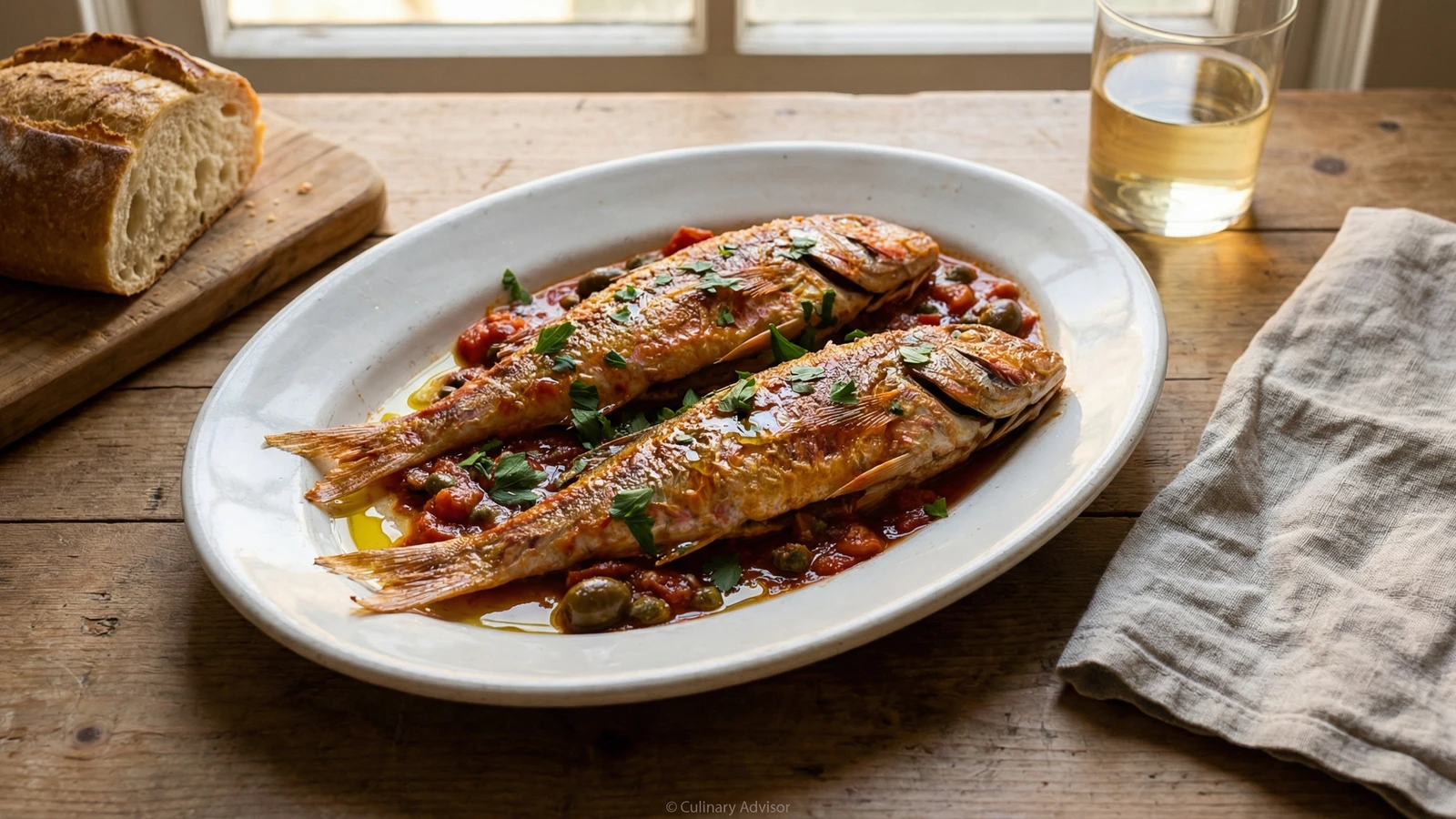
Triglie alla Livornese
Created by Chef Graziella
Red mullet fried until the skin crackles, then finished in the tomato sauce that made Livorno's fishermen famous. The technique is everything: crisp fish, silky sauce, the two meeting only at the last moment.
Livorno is not a pretty city. It was bombed heavily in the war and rebuilt without sentiment. But its cooks never forgot how to handle fish. The port has fed Tuscany's coast for centuries, and this dish is what happens when fishermen come home hungry and their wives have tomatoes ripening on the windowsill.
The fish must be fried first, separately, until the skin turns golden and crisp. Then, and only then, does it meet the sauce. Americans want to dump everything in a pan together and call it cooking. This is why their fish turns to mush. The sequence matters. The technique matters. What you keep out of the sauce (cream, butter, excessive garlic) matters as much as what you put in.
Red mullet are small fish with delicate flesh and assertive flavor. They can stand up to tomato and garlic in a way that more timid fish cannot. If you cannot find true red mullet, small whole snapper or porgy will serve, though the flavor will be different. Do not substitute fillets. The bones give body to the dish, and eating whole fish forces you to slow down and pay attention. This is how Italians eat.
Livorno rose to prominence in the 16th century when the Medici declared it a free port, attracting merchants, sailors, and refugees from across the Mediterranean. The city's cooking absorbed influences from Sephardic Jews, Greeks, Armenians, and North Africans, but the preparation alla Livornese (fish in tomato sauce with garlic) became distinctly Tuscan. It remains the most famous dish of this working port city.
The technique, the tradition, and the story behind every dish.
Discover Culinary AdvisorIngredients
whole red mullet
Quantity
8 (about 6 ounces each)
scaled and gutted, heads left on
all-purpose flour
Quantity
1/2 cup
for dredging
extra virgin olive oil
Quantity
1/2 cup
garlic cloves
Quantity
3
peeled and lightly crushed
San Marzano tomatoes
Quantity
1 can (14 ounces)
crushed by hand
dry white wine
Quantity
1/2 cup
red pepper flakes
Quantity
1/4 teaspoon
fresh flat-leaf parsley
Quantity
1/3 cup
chopped
kosher salt
Quantity
to taste
black pepper
Quantity
to taste
freshly ground
| Ingredient | Quantity |
|---|---|
| whole red mulletscaled and gutted, heads left on | 8 (about 6 ounces each) |
| all-purpose flourfor dredging | 1/2 cup |
| extra virgin olive oil | 1/2 cup |
| garlic clovespeeled and lightly crushed | 3 |
| San Marzano tomatoescrushed by hand | 1 can (14 ounces) |
| dry white wine | 1/2 cup |
| red pepper flakes | 1/4 teaspoon |
| fresh flat-leaf parsleychopped | 1/3 cup |
| kosher salt | to taste |
| black pepperfreshly ground | to taste |
Equipment Needed
- •Large 12-inch skillet with lid (not nonstick, which will not crisp properly)
- •Fish spatula or thin metal spatula
- •Warm serving platter
Instructions
- 1
Prepare the fish
Rinse the mullet under cold water and pat completely dry with paper towels. A wet fish will not crisp. Season the cavity and exterior with salt and pepper. Spread the flour on a plate and dredge each fish lightly, shaking off the excess. The coating should be thin, nearly invisible. You want protection, not armor.
- 2
Fry the fish
Heat the olive oil in a large skillet over medium-high heat until it shimmers and a pinch of flour sizzles immediately on contact. Working in batches to avoid crowding, fry the fish until golden and crisp on the first side, about 3 minutes. Turn carefully with a spatula and fry the second side until equally golden, another 2 to 3 minutes. The flesh near the bone should be just opaque. Transfer to a warm plate. Do not stack them or the bottom fish will steam and lose its crispness.
Crowding the pan drops the oil temperature and creates steam instead of crispness. Better to work in two batches than to ruin all your fish at once. - 3
Build the sauce
Pour off all but 3 tablespoons of the frying oil. Return the pan to medium heat. Add the crushed garlic cloves and cook, stirring, until they turn pale gold and become fragrant, about 1 minute. The garlic must not brown. Remove and discard the garlic. It has given what it has to give.
Crushed garlic infuses oil gently. A garlic press would create acrid mush that overwhelms the delicate fish. This is the difference between seasoning and assault. - 4
Add tomatoes and wine
Add the red pepper flakes and let them sizzle for 10 seconds. Pour in the white wine and let it bubble vigorously until reduced by half, scraping up any browned bits from the fish. Add the crushed tomatoes with their juices and half the parsley. Season with salt. Bring to a simmer and cook until the sauce thickens slightly and the raw tomato taste disappears, 8 to 10 minutes. The sauce should coat a spoon but still flow freely.
- 5
Finish in the sauce
Reduce heat to medium-low. Nestle the fried fish into the sauce in a single layer. Spoon some sauce over each fish. Cover the pan and cook gently for 3 to 4 minutes, just until the fish is heated through and has absorbed the flavors of the sauce. The fish should not fall apart. If it does, you have cooked it too long.
- 6
Serve immediately
Transfer the fish to a warm serving platter or individual plates. Spoon the sauce around and over the fish. Scatter the remaining parsley on top. Serve at once. This dish does not wait. Have your family seated before you plate. Have bread ready to soak up the sauce, because they will want every drop.
Chef Tips
- •Ask your fishmonger to scale and gut the mullet but leave the heads on. The head contains fat and collagen that enrich the dish, and it proves to your guests that they are eating real fish, not something from a factory.
- •The sauce should have a faint heat from the pepper flakes, not a burn. Livornese cooking is assertive but not aggressive. A quarter teaspoon is sufficient. More is showing off.
- •If the fish skin sticks to the pan, the oil was not hot enough or the fish was not dry. Wait longer next time. The fish will release when it is ready. Patience solves most problems in the kitchen.
- •Serve this with nothing but bread. The sauce is the side dish. A salad afterward, if you must. Pasta alongside is an American invention.
Advance Preparation
- •The sauce can be made several hours ahead and reheated. The fish must be fried and added to the sauce just before serving. There is no way around this.
- •Clean and dry the fish up to four hours ahead. Refrigerate uncovered on a plate. Bring to room temperature for 20 minutes before flouring and frying.
Frequently Asked Questions
Nutrition Information
1 serving (about 300g)
Where cooking meets culture.
Culinary mentorship, cultural storytelling, and the editorial depth that makes cooking meaningful.
Explore Culinary Advisor