Culinary Advisor
A cooking platform built around craft, culture, and the stories behind what we eat.
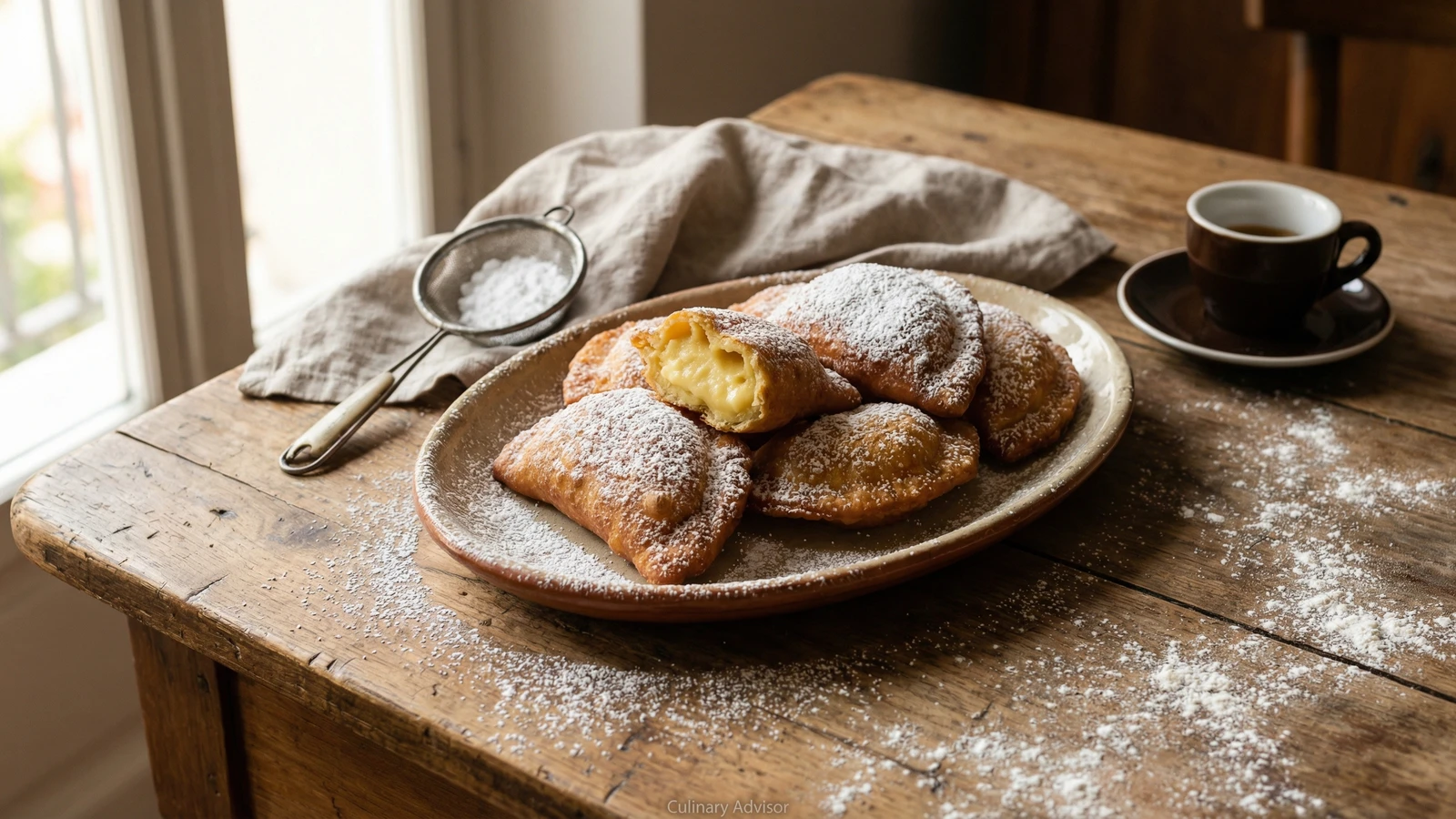
Tortelli Dolci di Piacenza
Created by Chef Graziella
Golden pillows of sweet egg pasta encasing vanilla cream perfumed with anise liqueur, fried until blistered and crisp, then buried under powdered sugar. Piacenza's gift to Carnival.
Every region of Emilia-Romagna claims its Carnival sweet. Bologna has the tortelli stuffed with mostarda. Modena fries ribbons called sfrappole. But Piacenza, the westernmost province where Emilia meets Lombardy, makes these: small squares of sweet pasta filled with crema pasticcera and perfumed with Sassolino, the anise liqueur of the neighboring hills.
The dough must be thin. Not so thin that it tears when you seal it around the cream, but thin enough that it fries crisp in seconds rather than turning leaden. This requires the same touch you would bring to fresh tagliatelle. The cream must be cold, completely cold, or it will seep through the seams and spit in the hot oil. There are no shortcuts here.
Sassolino is the traditional flavoring, an anise-scented spirit from the town of Sassuolo. If you cannot find it, substitute Sambuca or another anise liqueur. Do not omit it. The anise lifts the richness of the cream and gives these tortelli their particular character. Without it, you have made a pleasant fried pastry. With it, you have made something worth remembering.
Tortelli dolci appear in Piacenza's culinary records from at least the 18th century, when wealthy families served them during Carnival's final indulgent days before Lenten fasting began. The use of Sassolino, a liqueur first distilled in neighboring Sassuolo around 1804, became the defining mark that distinguishes Piacenza's version from similar Carnival fritters found throughout Emilia-Romagna.
The technique, the tradition, and the story behind every dish.
Discover Culinary AdvisorIngredients
whole milk
Quantity
2 cups
large egg yolks
Quantity
4
granulated sugar (for cream)
Quantity
2/3 cup
cornstarch
Quantity
1/4 cup
pure vanilla extract
Quantity
1 teaspoon
lemon zest
Quantity
from 1 lemon
finely grated
Sassolino liqueur
Quantity
3 tablespoons total
tipo 00 flour
Quantity
2 cups, plus more for rolling
large eggs
Quantity
3
granulated sugar (for dough)
Quantity
3 tablespoons
unsalted butter
Quantity
2 tablespoons
softened
fine sea salt
Quantity
pinch
vegetable oil or refined lard
Quantity
for deep frying
confectioners' sugar
Quantity
for dusting
| Ingredient | Quantity |
|---|---|
| whole milk | 2 cups |
| large egg yolks | 4 |
| granulated sugar (for cream) | 2/3 cup |
| cornstarch | 1/4 cup |
| pure vanilla extract | 1 teaspoon |
| lemon zestfinely grated | from 1 lemon |
| Sassolino liqueur | 3 tablespoons total |
| tipo 00 flour | 2 cups, plus more for rolling |
| large eggs | 3 |
| granulated sugar (for dough) | 3 tablespoons |
| unsalted buttersoftened | 2 tablespoons |
| fine sea salt | pinch |
| vegetable oil or refined lard | for deep frying |
| confectioners' sugar | for dusting |
Equipment Needed
- •Pasta machine or long rolling pin
- •Heavy pot for deep frying (at least 4-quart capacity)
- •Deep-fry thermometer
- •Slotted spoon or spider strainer
- •Pastry brush
- •3-inch square cutter or sharp knife
Instructions
- 1
Make the pastry cream
In a medium saucepan, heat the milk over medium heat until it steams and small bubbles form at the edges. Do not let it boil. While the milk heats, whisk the egg yolks and sugar in a bowl until pale and thick, about 2 minutes. Whisk in the cornstarch until no lumps remain. Slowly pour the hot milk into the yolk mixture while whisking constantly to temper the eggs. Return everything to the saucepan.
Tempering is essential. If you dump hot milk into cold yolks, you will have sweet scrambled eggs. Pour in a thin stream while whisking without pause. - 2
Cook the cream
Cook the mixture over medium heat, whisking constantly, until it thickens dramatically and begins to bubble, 3 to 4 minutes. It will seem too thick. This is correct. Continue whisking for one full minute after it bubbles to cook out the starch taste. Remove from heat and stir in the vanilla, lemon zest, and 2 tablespoons Sassolino.
- 3
Chill the cream thoroughly
Transfer the cream to a shallow dish and press plastic wrap directly against the surface to prevent a skin from forming. Refrigerate until completely cold, at least 2 hours. The cream must be cold and firm, or it will leak from the tortelli and cause dangerous spattering in the hot oil.
You can make the cream the day before. Cold cream pipes more easily and seals better. Patience here prevents disaster later. - 4
Make the dough
Mound the flour on a wooden board or clean work surface. Make a well in the center. Add the eggs, sugar, softened butter, 1 tablespoon Sassolino, and salt to the well. Using a fork, beat the eggs while gradually drawing flour from the inner walls of the well. When the mixture becomes too thick to stir, use your hands to bring the dough together.
- 5
Knead until smooth
Knead the dough vigorously for 8 to 10 minutes, pushing with the heel of your hand, folding, and turning. The dough should become smooth, supple, and slightly tacky but not sticky. If it sticks to your hands, dust with flour. If it cracks and refuses to come together, wet your hands and continue. Wrap in plastic and rest at room temperature for 30 minutes.
- 6
Roll the dough thin
Divide the rested dough into four pieces. Work with one piece at a time, keeping the others covered. Roll the dough through a pasta machine, starting at the widest setting and progressing to the second-thinnest setting. If rolling by hand, roll each piece into a sheet about 1/16 inch thick. The dough should be thin enough to see your hand through, but sturdy enough to handle.
The dough is sweeter and softer than savory pasta, which makes it more fragile. Dust generously with flour between passes through the machine. - 7
Cut and fill the tortelli
Cut the pasta sheets into 3-inch squares. Place a rounded teaspoon of cold pastry cream in the center of each square. Do not overfill. Dip your finger in water and moisten two adjacent edges of the square. Fold the dough diagonally to form a triangle, pressing firmly around the filling to seal and expel any air. Air pockets will cause the tortelli to burst in the oil.
- 8
Seal completely
Press the edges with the tines of a fork to ensure a tight seal. The crimped edge also provides texture when fried. Arrange the filled tortelli on a flour-dusted baking sheet in a single layer. They can sit at room temperature for up to 30 minutes before frying, but no longer.
- 9
Heat the oil
Pour oil into a deep, heavy pot to a depth of 3 inches. Heat to 350°F. Use a thermometer. If the oil is too cool, the tortelli absorb grease and turn sodden. If too hot, the exterior burns before the dough cooks through. Maintain the temperature throughout frying, adjusting the heat as needed.
Lard was traditional, and if you can find refined lard, it produces a lighter, crisper result. Vegetable oil works adequately. Never use olive oil for deep frying. - 10
Fry until golden
Fry the tortelli in batches of 4 or 5, taking care not to crowd the pot. They will sink briefly, then float. Fry for 2 to 3 minutes, turning once, until deeply golden and blistered on both sides. The dough should look almost like puff pastry, with small bubbles across the surface. Lift with a slotted spoon and drain on paper towels.
- 11
Dust and serve
While still warm, dust the tortelli generously with confectioners' sugar. Be generous. The sugar should coat them like snow. Serve within an hour of frying. The exterior will soften as they sit. These are not pastries that wait for you.
Chef Tips
- •Sassolino is worth seeking out from Italian specialty importers. It has a distinct anise flavor that differs from Sambuca, though Sambuca is an acceptable substitute. Do not use licorice-forward spirits like absinthe.
- •The traditional fat for frying these in Piacenza was strutto, rendered pork lard. It produces an exceptionally crisp, light crust that vegetable oil cannot quite match. If you have access to good lard, use it.
- •If the cream seems too loose after chilling, whisk it briefly to smooth it out. It should hold a shape when piped or spooned but not be stiff like buttercream.
- •Some families in Piacenza add a spoonful of cocoa to half the cream, filling half the batch with vanilla and half with chocolate. This is traditional for variety at Carnival tables.
Advance Preparation
- •The pastry cream should be made at least 2 hours ahead and can be refrigerated for up to 2 days. Whisk briefly before using if it has separated slightly.
- •The dough can be made up to 4 hours ahead and refrigerated, wrapped tightly. Bring to room temperature before rolling.
- •Filled tortelli can wait on a flour-dusted sheet for up to 30 minutes before frying. Beyond that, the cream may soften the dough and cause leaks.
- •Fried tortelli are best eaten within 2 hours. They do not store well. Plan to fry them close to serving time.
Frequently Asked Questions
Nutrition Information
1 serving (about 30g)
Where cooking meets culture.
Culinary mentorship, cultural storytelling, and the editorial depth that makes cooking meaningful.
Explore Culinary Advisor