Culinary Advisor
A cooking platform built around craft, culture, and the stories behind what we eat.
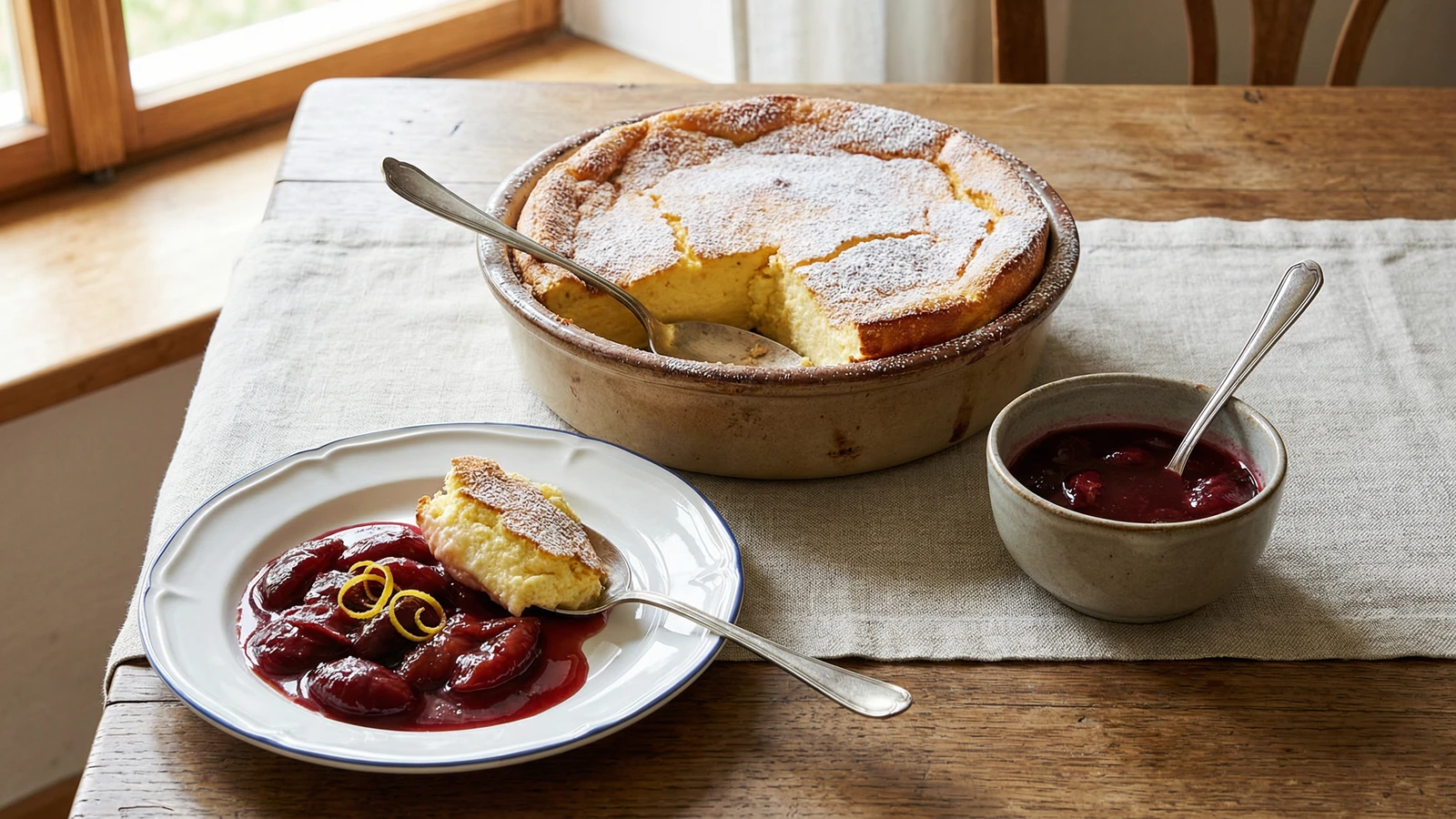
Topfenauflauf mit Zwetschkenröster
Created by Chef Elsa
A pillowy baked Topfen soufflé, golden on top and trembling inside, spooned warm from the dish with a generous ladle of spiced Zwetschkenröster that stains the cream dark and beautiful.
In my grandmother Eva's kitchen in Kent, Gretel Beer kept a small dish of Topfen in the fridge the way other people keep butter. It went into everything. Strudel fillings, Knödel, Palatschinken, and on Sunday afternoons, into a soufflé so light it barely held together on the spoon. Gretel would beat the egg whites until they stood in stiff peaks, fold them into the Topfen mixture with a patience I didn't appreciate until years later, and slide the whole thing into the oven. Twenty minutes of watching through the glass door. The moment it puffed golden and started to tremble when you tapped the side, she'd pull it out and dust it with powdered sugar while it was still breathing.
Topfenauflauf is one of the great Mehlspeisen, and Mehlspeisen are the heart of Austrian cuisine. Not an afterthought, not a nice little dessert chapter at the back of the book. The heart. This one sits somewhere between a soufflé and a baked pudding. The outside goes golden and just firm enough to hold its shape. The inside stays soft, almost custard-like, with that clean, slightly tangy flavor that only Topfen gives you. It's not cheesecake. It's not a soufflé in the French sense. It's its own thing, and it's wonderful.
The Zwetschkenröster is not optional. You need that warm, spiced plum compote to cut through the richness of the Topfen and give every spoonful somewhere to go. The two belong together the way coffee belongs with a glass of water. One without the other is incomplete.
Topfenauflauf belongs to the vast Austrian tradition of warm Mehlspeisen, flour-based dishes that evolved in monastery and farmhouse kitchens across the Habsburg lands. Topfen, a fresh acid-set curd cheese similar to quark, has been central to Austrian cooking since at least the medieval period, when dairy-rich desserts served as main courses during Catholic fasting days when meat was forbidden. Zwetschkenröster, the slow-stewed plum compote, draws on Austria's deep tradition of fruit preserving, particularly from Lower Austria and the Wachau, where Zwetschken orchards have supplied kitchens for centuries.
The technique, the tradition, and the story behind every dish.
Discover Culinary AdvisorIngredients
Topfen (quark, full-fat)
Quantity
500g
well-drained
unsalted butter
Quantity
80g
softened
eggs
Quantity
4 large
separated
caster sugar
Quantity
80g
Vanillezucker (vanilla sugar)
Quantity
1 packet (8g)
unwaxed lemon
Quantity
1
zested
salt
Quantity
pinch
fine semolina (Grieß)
Quantity
40g
Sauerrahm (sour cream)
Quantity
2 tablespoons
butter
Quantity
for greasing dish
fine breadcrumbs
Quantity
for coating dish
powdered sugar
Quantity
for dusting
Zwetschken (Italian prune plums)
Quantity
500g
halved and stoned
granulated sugar (for Röster)
Quantity
80g
cinnamon stick
Quantity
1
whole cloves
Quantity
3
dry red wine
Quantity
100ml
lemon zest (for Röster)
Quantity
from half a lemon
lemon juice
Quantity
1 tablespoon
| Ingredient | Quantity |
|---|---|
| Topfen (quark, full-fat)well-drained | 500g |
| unsalted buttersoftened | 80g |
| eggsseparated | 4 large |
| caster sugar | 80g |
| Vanillezucker (vanilla sugar) | 1 packet (8g) |
| unwaxed lemonzested | 1 |
| salt | pinch |
| fine semolina (Grieß) | 40g |
| Sauerrahm (sour cream) | 2 tablespoons |
| butter | for greasing dish |
| fine breadcrumbs | for coating dish |
| powdered sugar | for dusting |
| Zwetschken (Italian prune plums)halved and stoned | 500g |
| granulated sugar (for Röster) | 80g |
| cinnamon stick | 1 |
| whole cloves | 3 |
| dry red wine | 100ml |
| lemon zest (for Röster) | from half a lemon |
| lemon juice | 1 tablespoon |
Equipment Needed
- •1.5-liter ovenproof ceramic baking dish
- •Hand mixer or stand mixer with whisk attachment
- •Wide saucepan for Zwetschkenröster
- •Large flexible spatula for folding
- •Fine-mesh sieve (for draining Topfen if needed)
Instructions
- 1
Make the Zwetschkenröster
Place the halved Zwetschken cut-side down in a wide saucepan. Add the granulated sugar, cinnamon stick, cloves, red wine, lemon zest, and lemon juice. Bring to a gentle simmer over medium-low heat. The plums will release their juice within a few minutes and the kitchen will fill with the smell of warm spiced fruit and wine. Cook uncovered for twelve to fifteen minutes, stirring once or twice, until the plums have collapsed into a thick, jammy compote but still hold some shape. You don't want baby food. You want pieces. Fish out the cinnamon stick and cloves, then set aside. The Röster thickens further as it cools.
Zwetschken are Italian prune plums, the small, oval, dark-skinned ones. They hold their shape better than round plums and have a tartness that balances the sugar perfectly. If you can't find them, use damsons or the darkest, firmest plums at the market. Avoid anything too ripe or watery. - 2
Prepare the baking dish
Preheat your oven to 180°C (160°C fan). Butter a 1.5-liter ovenproof dish generously, getting into the corners and up the sides. Scatter fine breadcrumbs over the butter, tilting and rotating the dish until every surface is coated. Tap out the excess. This coating does two things: it prevents sticking, and it gives the Auflauf a thin, golden, slightly crunchy shell that contrasts with the soft interior. Don't skip it.
- 3
Cream the butter and yolks
Beat the softened butter with a hand mixer until pale and fluffy, about two minutes. Add the caster sugar and Vanillezucker and beat again until the mixture is light and creamy. Add the egg yolks one at a time, beating well after each one. The mixture should be smooth, thick, and the color of pale gold. Take your time here. The air you're beating in now is what gives the Auflauf its lift alongside the egg whites.
Use real Vanillezucker, not vanilla extract. Austrian baking depends on it. You can make your own by burying two split vanilla pods in a jar of caster sugar for a week. It keeps for months and you'll reach for it constantly. - 4
Add the Topfen mixture
Add the Topfen and Sauerrahm to the butter-yolk mixture and stir until just combined. Don't beat it aggressively or the Topfen will turn thin and lose its body. Fold in the semolina and lemon zest. The semolina absorbs moisture as the Auflauf bakes, giving it structure without making it heavy. It also needs about ten minutes to hydrate in the batter, so let the mixture rest while you deal with the egg whites.
Your Topfen must be well-drained. If it's wet, wrap it in a clean tea towel and squeeze out the excess moisture over the sink. Wet Topfen means a soggy Auflauf that won't set properly. Gretel always said the Topfen should feel like cool clay in your hand, not like yogurt. - 5
Beat the egg whites
In a clean, grease-free bowl, beat the four egg whites with a pinch of salt until they hold firm, glossy peaks. This takes about three minutes with a hand mixer. Stop the moment they look like shaving cream and hold a stiff point when you lift the whisk. If you go further, they'll turn grainy and dry, and they won't fold smoothly. Overbeaten whites are the most common reason a Topfenauflauf turns dense instead of airy.
- 6
Fold and fill
Stir one large spoonful of beaten egg white into the Topfen mixture. This loosens the batter so the remaining whites can fold in without losing all their air. Now add the rest of the whites in two additions, folding gently with a large spatula or metal spoon. Cut down through the center, sweep along the bottom, and bring it up over the top. Rotate the bowl a quarter turn and repeat. You should still see a few streaks of white when you stop. If the batter is perfectly uniform, you've folded too much. Pour it into the prepared dish and smooth the top gently.
- 7
Bake the Auflauf
Place the dish on the middle rack of the oven and bake for thirty-five to forty minutes. The top should turn deep golden and puff up above the rim of the dish. The center should tremble slightly when you tap the side, like a custard that's almost but not quite set. If you insert a skewer into the center, it should come out with a few moist crumbs, not wet batter. Pull it at that point. The Auflauf keeps cooking from residual heat for a few minutes after you take it out, and the difference between barely set and overcooked is about five minutes in this oven.
Don't open the oven door for the first twenty-five minutes. The Auflauf is rising on egg whites and trapped heat. A blast of cold air collapses it. After twenty-five minutes you can peek, but be quick about it. - 8
Dust and serve warm
Dust the top generously with powdered sugar the moment it comes out. The sugar melts slightly on the hot surface and forms a thin, sweet skin. Bring the dish to the table while it's still puffed and golden, because like all soufflé-style Mehlspeisen, it will begin to sink within minutes. That's not a failure. That's physics. Spoon it out warm and place a generous ladle of Zwetschkenröster alongside each portion. The dark, spiced plum against the pale, trembling Topfen is one of the most beautiful things Austrian cooking puts on a plate. Mahlzeit!
Chef Tips
- •Buy your eggs fresh and use them at room temperature. Room-temperature whites whip to a greater volume than cold ones, and since the Auflauf rises on those whites, volume matters. Take them out of the fridge an hour before you start.
- •If you can't find Topfen, use the best full-fat quark you can source. In a pinch, you can substitute ricotta that has been drained overnight in a sieve lined with muslin, but the flavor won't be quite the same. Topfen has a clean tanginess that ricotta doesn't fully replicate. Cream cheese is not a substitute. Don't do it.
- •The Zwetschkenröster is better the next day. The flavors deepen overnight in the fridge. Make it ahead and reheat gently while the Auflauf bakes. It should be warm when it meets the soufflé, not hot, not cold.
- •Serve the Auflauf in the dish you baked it in. Don't try to unmold it. This is home cooking at its most honest, spooned straight from a warm ceramic dish to the plate. Trying to turn it out onto a platter invites disaster and impresses no one.
Advance Preparation
- •Zwetschkenröster can be made up to three days ahead and refrigerated in a sealed jar. Reheat gently on the stove before serving.
- •The Topfenauflauf itself must be baked and served immediately. You can prepare the Topfen-yolk base up to one hour ahead and refrigerate, but the egg whites must be beaten and folded in just before baking. A rested batter with deflated whites produces a flat, dense result.
- •If your Topfen is wet, drain it overnight in the fridge wrapped in a tea towel set in a sieve over a bowl. This step alone makes the difference between a soufflé that holds and one that weeps.
Frequently Asked Questions
Nutrition Information
1 serving (about 245g)
Where cooking meets culture.
Culinary mentorship, cultural storytelling, and the editorial depth that makes cooking meaningful.
Explore Culinary Advisor