Culinary Advisor
A cooking platform built around craft, culture, and the stories behind what we eat.
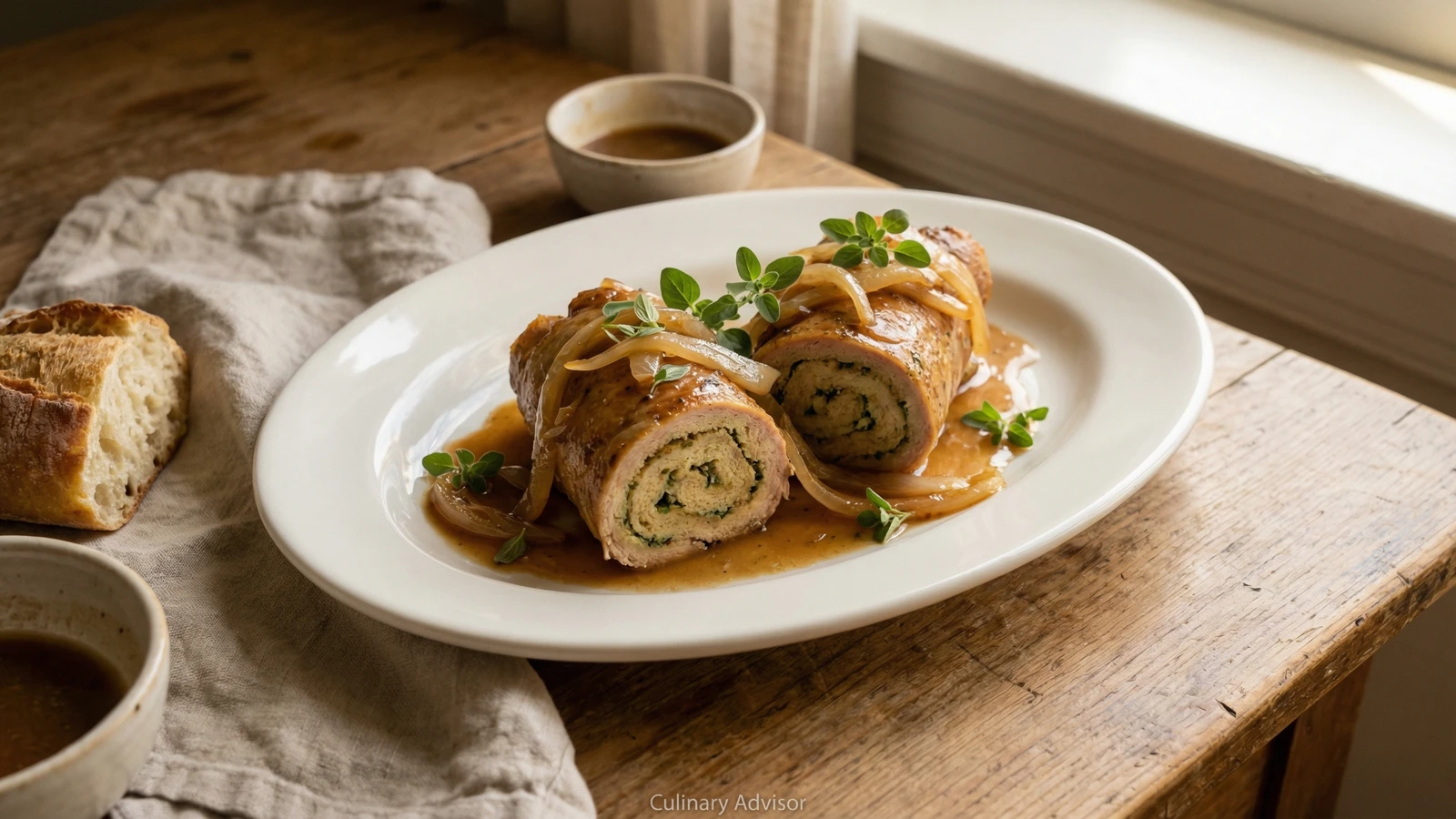
Tomaxelle alla Genovese
Created by Chef Graziella
Genoese veal rolls stuffed with bread, cheese, and marjoram, then braised in white wine until tender. A dish that proves frugality and elegance are not opposites.
Tomaxelle are what Genoese home cooks have made for generations when yesterday's roast needs to become today's dinner. The name comes from the Ligurian dialect, and like so much of Ligurian cooking, the dish reflects a culture that wastes nothing and transforms humble ingredients into something worthy of a Sunday table.
The filling is simple: bread soaked in milk, Parmigiano, egg, and marjoram. Marjoram is the herb of Liguria, gentler than oregano, sweeter, more refined. It appears in pesto, in focaccia, in stuffed vegetables, and here. If you cannot find fresh marjoram, use half the amount of dried. Do not substitute oregano. They are not the same.
The braising must be patient. Veal toughens under harsh treatment and becomes silky under gentle heat. The wine reduces, the onions melt into the sauce, and what began as a frugal solution to using leftover meat becomes something your guests will request again.
Tomaxelle belong to the tradition of Genoese involtini, which emerged from the necessity of stretching expensive meat to feed large families. In the 18th and 19th centuries, Ligurian cooks would save the less presentable cuts from a roast, pound them thin, stuff them with whatever the pantry offered, and braise them into tenderness. The dish remains a fixture of Genoese home cooking, though it has largely disappeared from restaurant menus in favor of flashier preparations.
The technique, the tradition, and the story behind every dish.
Discover Culinary AdvisorIngredients
thin veal cutlets
Quantity
8 (about 1 1/2 pounds)
pounded to 1/8-inch thickness
day-old bread
Quantity
4 ounces
crusts removed
whole milk
Quantity
1/2 cup
Parmigiano-Reggiano
Quantity
2 ounces
freshly grated
large egg
Quantity
1
lightly beaten
fresh marjoram leaves
Quantity
2 tablespoons
chopped fine
garlic
Quantity
1 small clove
minced to a paste
nutmeg
Quantity
1/4 teaspoon
freshly grated
kosher salt
Quantity
to taste
white pepper
Quantity
to taste
freshly ground
extra virgin olive oil
Quantity
3 tablespoons
unsalted butter
Quantity
2 tablespoons
yellow onion
Quantity
1 small
sliced thin
dry white wine
Quantity
1 cup
chicken or veal broth
Quantity
1 cup
kitchen twine
Quantity
for tying
| Ingredient | Quantity |
|---|---|
| thin veal cutletspounded to 1/8-inch thickness | 8 (about 1 1/2 pounds) |
| day-old breadcrusts removed | 4 ounces |
| whole milk | 1/2 cup |
| Parmigiano-Reggianofreshly grated | 2 ounces |
| large egglightly beaten | 1 |
| fresh marjoram leaveschopped fine | 2 tablespoons |
| garlicminced to a paste | 1 small clove |
| nutmegfreshly grated | 1/4 teaspoon |
| kosher salt | to taste |
| white pepperfreshly ground | to taste |
| extra virgin olive oil | 3 tablespoons |
| unsalted butter | 2 tablespoons |
| yellow onionsliced thin | 1 small |
| dry white wine | 1 cup |
| chicken or veal broth | 1 cup |
| kitchen twine | for tying |
Equipment Needed
- •Heavy 12-inch braising pan or Dutch oven
- •Meat mallet
- •Kitchen twine
Instructions
- 1
Prepare the filling
Tear the bread into small pieces and place in a bowl. Pour the milk over and let it soak for 10 minutes. The bread should absorb the milk completely. Squeeze out any excess liquid with your hands. The bread should be moist but not dripping. Place the soaked bread in a clean bowl.
Day-old bread is essential. Fresh bread becomes gummy. The bread provides body to the filling without heaviness. - 2
Complete the filling
Add the grated Parmigiano, beaten egg, marjoram, garlic paste, and nutmeg to the soaked bread. Season with a generous pinch of salt and white pepper. Mix thoroughly with your hands until the filling is homogeneous. It should hold together when squeezed but remain soft. Taste it. Adjust the seasoning now, not later.
- 3
Pound and season the veal
Place each cutlet between sheets of plastic wrap. Using a meat mallet, pound gently from the center outward until uniformly thin, about 1/8 inch. The cutlets should be roughly rectangular, about 4 by 6 inches. Season both sides lightly with salt and white pepper.
Pound with care. Thin is good. Torn is not. If the cutlet develops holes, you have been too aggressive. The meat must remain intact to hold the filling. - 4
Fill and roll
Lay a cutlet flat on your work surface. Place about 2 tablespoons of filling in a line along the short end, leaving a half-inch border on three sides. Fold the sides inward over the filling, then roll tightly from the filled end. The roll should be compact, about 3 inches long. Tie securely with kitchen twine at both ends and once in the middle. Repeat with remaining cutlets.
- 5
Brown the rolls
In a heavy braising pan or Dutch oven that will hold all the rolls in a single layer, heat the olive oil and butter over medium-high heat until the butter foam subsides. Add the rolls and brown on all sides, turning gently with tongs, about 8 minutes total. The exterior should be golden, not pale. Remove the rolls to a plate.
- 6
Build the braising liquid
Reduce heat to medium. Add the sliced onion to the pan and cook, stirring occasionally, until soft and golden, about 8 minutes. Pour in the wine and scrape up any browned bits from the bottom. Let the wine simmer until reduced by half, about 3 minutes. Add the broth and bring to a gentle simmer.
- 7
Braise the tomaxelle
Return the rolls to the pan, nestling them into the liquid. The liquid should come about halfway up the sides of the rolls. Cover the pan and reduce heat to low. Braise gently for 45 minutes to 1 hour, turning the rolls once at the halfway point. The veal should be completely tender when pierced with a thin knife.
The braise must be gentle. Vigorous bubbling toughens veal. You want the laziest simmer, a bubble rising here and there. - 8
Finish and serve
Transfer the rolls to a warm serving platter and remove the twine. If the braising liquid seems thin, increase heat and reduce it until it coats a spoon lightly. Taste and adjust seasoning. Spoon the sauce and onions over the rolls. Serve immediately, two rolls per person, with crusty bread to capture the sauce.
Chef Tips
- •Ask your butcher for veal cutlets from the leg, cut thin. If they are too thick, you can pound them yourself, but starting with thin cutlets saves effort and produces more even results.
- •The traditional filling sometimes includes sweetbreads or calf's brain for richness. This version omits them for accessibility, but if you have access to quality offal and the inclination, a small amount adds depth.
- •Ligurian white wines like Vermentino or Pigato are traditional for the braise. Their mineral quality complements the delicate veal. A dry Soave or Pinot Grigio will also serve.
- •Tomaxelle reheat well. Make them a day ahead, refrigerate in their sauce, and warm gently before serving. The flavors deepen overnight.
Advance Preparation
- •The filling can be made several hours ahead and refrigerated. Bring to room temperature before using.
- •The rolls can be filled and tied up to 4 hours ahead, covered and refrigerated. Brown them cold; they hold their shape better.
- •The completed dish keeps refrigerated for 3 days. Reheat gently in the sauce, adding a splash of broth if it has thickened too much.
Frequently Asked Questions
Nutrition Information
1 serving (about 275g)
Where cooking meets culture.
Culinary mentorship, cultural storytelling, and the editorial depth that makes cooking meaningful.
Explore Culinary Advisor