Culinary Advisor
A cooking platform built around craft, culture, and the stories behind what we eat.
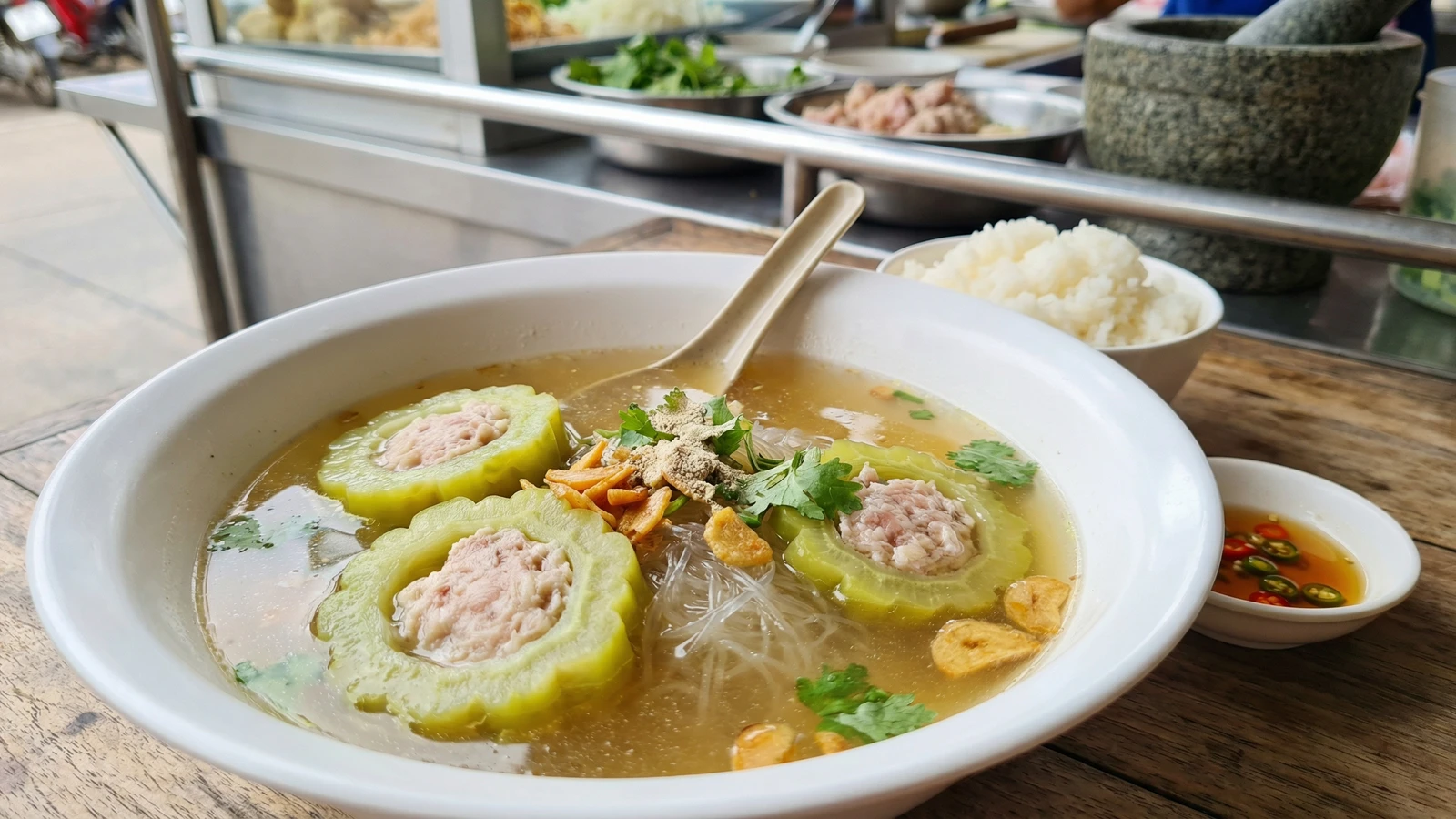
Stuffed Bitter Melon Soup (Tom Jued Mara)
Created by
Central Thai clear soup where bitterness is the point, not the problem. Pork-stuffed mara simmered in stock seasoned only with garlic, white pepper, and fish sauce. Home cooking at its most honest.
Tom jued is the quiet discipline of Thai cooking. No paste. No coconut. No chili. Just broth, done right.
Ajarn always said that the kreung tam is the foundation of Thai cuisine, and it is, for everything except the soup families. Tom yam breaks the rule with whole aromatics. Tom jued breaks it even further: no aromatics at all. No lemongrass, no galangal, no kaffir lime leaf. Just clean pork stock, garlic, white pepper, and fish sauce. That's it. If your broth can't stand on its own with only those four things, your stock isn't good enough. Tom jued exposes weak cooking. There's nowhere to hide.
The bitter melon is the whole lesson here. Most people outside Thailand treat bitterness like a mistake, something to mask or remove. Soak it in salt water, blanch it twice, do whatever it takes to kill the flavor. Thai cooking says no. Bitterness is intentional. Mara (มะระ) is eaten because it's bitter, not in spite of it. The Thais and the Chinese have known for centuries that bitter foods cool the body, aid digestion, and balance richness. You stuff the mara with seasoned pork so the sweetness of the meat plays against the bitterness of the gourd. That contrast IS the dish. If you remove the bitterness, you've removed the point.
The filling is where you'll find a ghost of the kreung tam. Cilantro root (rak phak chi), garlic, and white pepper, pounded together. Three of the nine essential ingredients Ajarn identifies, working as a seasoning base inside the pork. Even when Thai cooking appears simple, the system is still there. It's just whispering instead of shouting.
Tom jued (ต้มจืด, literally "bland soup") is the everyday clear soup of Central Thai home kitchens, heavily influenced by Teochew Chinese immigrants who settled in Bangkok from the 18th century onward. Bitter melon (Momordica charantia) arrived in Southeast Asia from its origins in South and East Asia centuries ago and became embedded in Thai-Chinese medicinal food culture, where bitter flavors are valued for their cooling properties. The stuffed-melon-in-clear-broth format is a direct descendant of Teochew soup traditions adapted with Thai seasoning principles, making tom jued mara one of the clearest examples of Thai-Chinese culinary integration in the Central Thai kitchen.
The technique, the tradition, and the story behind every dish.
Discover Culinary AdvisorIngredients
bitter melon (mara)
Quantity
2 medium, about 400g total
cut into 2-inch rings, seeds and pith removed
minced pork
Quantity
300g
cilantro roots (rak phak chi)
Quantity
3
finely chopped
garlic
Quantity
6 cloves
3 minced for filling, 3 smashed for broth
white peppercorns (prik thai khao)
Quantity
1 teaspoon
divided: 1/2 teaspoon ground for filling, 1/2 teaspoon cracked for broth
fish sauce (nam pla)
Quantity
2 tablespoons, plus more to taste
light soy sauce (si ew khao)
Quantity
1 tablespoon
pork stock or chicken stock
Quantity
5 cups
glass noodles (wun sen)
Quantity
30g
soaked in warm water until soft, cut into short lengths
fried garlic (kratiam jiaw) (optional)
Quantity
2 tablespoons
fried garlic oil (optional)
Quantity
1 tablespoon
fresh cilantro leaves (phak chi)
Quantity
for garnish
granulated sugar
Quantity
pinch
| Ingredient | Quantity |
|---|---|
| bitter melon (mara)cut into 2-inch rings, seeds and pith removed | 2 medium, about 400g total |
| minced pork | 300g |
| cilantro roots (rak phak chi)finely chopped | 3 |
| garlic3 minced for filling, 3 smashed for broth | 6 cloves |
| white peppercorns (prik thai khao)divided: 1/2 teaspoon ground for filling, 1/2 teaspoon cracked for broth | 1 teaspoon |
| fish sauce (nam pla) | 2 tablespoons, plus more to taste |
| light soy sauce (si ew khao) | 1 tablespoon |
| pork stock or chicken stock | 5 cups |
| glass noodles (wun sen)soaked in warm water until soft, cut into short lengths | 30g |
| fried garlic (kratiam jiaw) (optional) | 2 tablespoons |
| fried garlic oil (optional) | 1 tablespoon |
| fresh cilantro leaves (phak chi) | for garnish |
| granulated sugar | pinch |
Equipment Needed
- •Granite mortar and pestle (krok) for the seasoning paste
- •Medium stockpot or clay pot
- •Small spoon for deseeding bitter melon
Instructions
- 1
Prepare the bitter melon
Cut the bitter melons crosswise into rings, about 2 inches thick. Use a small spoon to scoop out the seeds and white pith from the center of each ring, creating a hollow tube. You'll stuff the pork into this cavity. Don't scrape too aggressively. Leave the inner wall intact or the rings will split during cooking. A little pith left behind is fine. It's bitter too. That's the point.
Some cooks blanch the bitter melon first or soak it in salted water to reduce bitterness. I don't. If you wanted mild, you'd use a different gourd. The bitterness is why this dish exists. Trust it. - 2
Pound the seasoning base
In a mortar, pound the cilantro roots, 3 cloves of garlic, and half a teaspoon of white peppercorns into a rough paste. Not smooth. Just broken down enough that the flavors will distribute evenly through the pork. This takes thirty seconds. The smell should be sharp, peppery, with that earthy green note from the cilantro root. That's the kreung tam heritage showing up in the simplest possible form: three ingredients, one mortar, thirty seconds.
Cilantro root is not cilantro stems. The root has a concentrated, earthy flavor that stems can't replicate. If you can't find roots, use the lower stems with some root still attached, but know it's a compromise. - 3
Mix the pork filling
Combine the minced pork with the pounded paste, 1 tablespoon of the fish sauce, and a pinch of sugar. Mix with your hands until everything is evenly distributed. The mixture should be slightly sticky and cohesive. Don't overwork it or the pork will turn dense and rubbery when cooked. You want it to hold together inside the melon but still have a tender bite.
- 4
Stuff the melon
Pack the pork mixture firmly into each bitter melon ring, pressing it in with your thumb. Fill each ring so the pork is slightly mounded on both sides. It will shrink as it cooks, so overfill slightly. The pork should be compact enough that it won't fall out when the rings go into the broth. If a piece does break free, don't panic. It becomes a meatball. The soup still works.
- 5
Build the broth
Bring the stock to a gentle boil. Smash the remaining 3 garlic cloves with the flat of your knife and add them to the pot with the remaining cracked white pepper. Let it simmer for 2 minutes. The broth should taste clean, garlicky, and peppery before anything else goes in. Season with the remaining tablespoon of fish sauce and the light soy sauce. Taste. The broth should be savory and slightly under-seasoned at this point, because the pork will release its own seasoning as it cooks.
Your stock makes or breaks tom jued. If you're using store-bought, go for the best quality you can find and taste it before adding fish sauce. Some brands are already salty. Adjust accordingly. - 6
Simmer the stuffed melon
Lower the stuffed bitter melon rings into the simmering broth gently. Don't drop them. Reduce the heat so the broth barely trembles, just the occasional bubble breaking the surface. A rolling boil will shake the pork out of the melon. Simmer for 12 to 15 minutes. The bitter melon should be tender enough that a chopstick slides through with slight resistance but hasn't gone soft and collapsed. The pork should be cooked through, no pink in the center.
- 7
Add glass noodles and season
Drop in the soaked glass noodles for the last 2 minutes. They just need to heat through and absorb some broth. Taste the soup now. This is the critical moment. Fish sauce for salt. A tiny pinch of sugar if the bitterness needs a counterpoint, but don't overdo it. The soup should taste clean, savory, gently bitter, with white pepper warmth in the finish. If it tastes flat, it needs more fish sauce. If it tastes one-note, a half teaspoon of sugar will open it up. Ajarn always said: taste, adjust, taste again.
- 8
Serve the soup
Ladle into bowls, making sure each serving gets 2 or 3 stuffed melon rings, a tangle of glass noodles, and plenty of broth. Drizzle with fried garlic oil. Scatter fried garlic chips and torn cilantro leaves on top. Serve with steamed jasmine rice on the side. This is a weeknight soup. It doesn't need anything else. The broth, the bitter melon, the pork. Three things doing their jobs. That's the principle of tom jued: clarity.
Chef Tips
- •The stock is everything in tom jued. This isn't a soup where aromatics or paste can cover a weak broth. If you have time, make a simple pork bone stock: blanch pork ribs or neck bones, rinse, then simmer with water for 1 to 2 hours with a few smashed garlic cloves and white peppercorns. Strain. That's your foundation. The Chinese-Thai grandmothers who perfected this soup wouldn't dream of using water.
- •Bitter melon comes in two common varieties: the smooth, pale green Chinese type and the darker, knobbier Indian type. For tom jued, use the Chinese variety (the one you see in Bangkok markets). It's milder, with a more even bitterness that plays well with the gentle broth. The Indian type is more aggressive and better suited to stir-fries where strong seasoning can match it.
- •White pepper, not black pepper. This isn't interchangeable. White pepper (prik thai khao) has a sharper, more earthy heat without the fruity aromatics of black pepper. It's the defining spice of Thai clear soups and Chinese-Thai cooking. Ajarn always said: black pepper is European. White pepper is ours.
- •If you have leftover pork filling, roll it into small meatballs and drop them into the broth alongside the stuffed melon. Thai home cooks do this all the time. Nothing wasted. The meatballs cook in 5 minutes and give the soup extra body.
Advance Preparation
- •Pork stock can be made a day or two ahead and refrigerated. The flavor improves overnight. Skim any solidified fat from the surface before reheating.
- •Bitter melon can be cut and deseeded up to a few hours ahead. Store the rings in cold water in the refrigerator.
- •The pork filling can be mixed a few hours ahead and kept refrigerated, but stuff the melon rings just before cooking. If the pork sits inside the raw melon too long, the moisture makes the filling looser.
- •The finished soup reheats well the next day. The bitter melon softens slightly but the flavors deepen. This is one of the few Thai soups that actually improves with reheating.
Frequently Asked Questions
Nutrition Information
1 serving (about 460g)
Where cooking meets culture.
Culinary mentorship, cultural storytelling, and the editorial depth that makes cooking meaningful.
Explore Culinary Advisor