Culinary Advisor
A cooking platform built around craft, culture, and the stories behind what we eat.
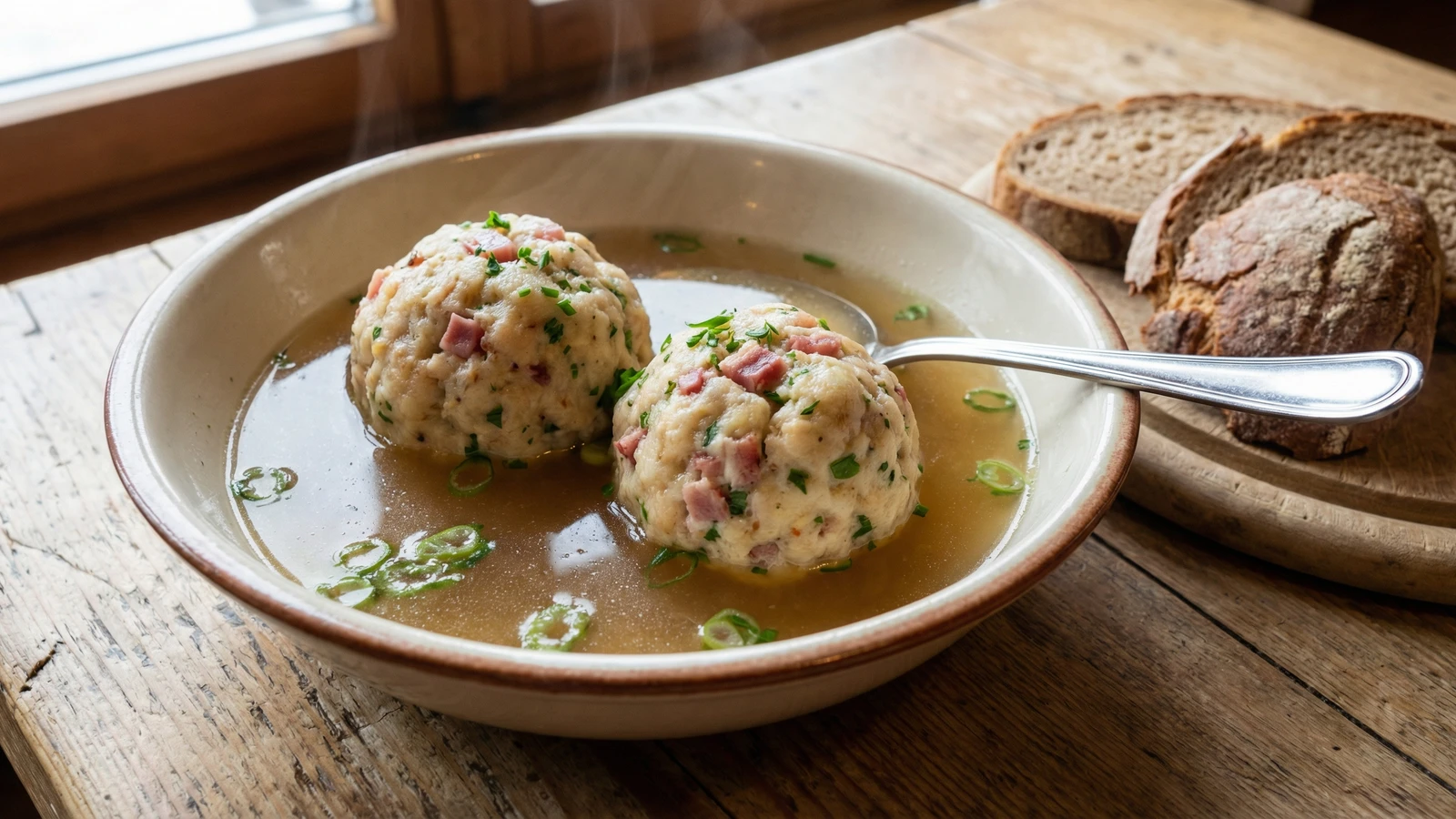
Tiroler Speckknödelsuppe
Created by Chef Elsa
Hearty Tyrolean bread dumplings loaded with smoked Speck and parsley, simmered in clear golden beef broth. The soup that warms every Almhütte in the Austrian Alps.
The first time I ate Speckknödelsuppe I was ten years old, sitting on a wooden bench outside a mountain hut above Innsbruck. Gretel had walked us up there, my grandmother Eva complaining about the path the whole way, and when we sat down the Sennerin brought out bowls of clear broth with two enormous dumplings floating in each one. I remember the smell before I remember the taste. Smoked Speck, warm bread, beef broth, the cold mountain air mixing with all of it. I ate both dumplings and half of Eva's.
Speckknödelsuppe is Tyrolean cooking at its most honest. You take stale bread, which every Austrian kitchen has because nobody throws bread away, and you turn it into something that could keep a farmer working through a frozen afternoon. The Speck does the heavy lifting. Tiroler Speck is not bacon. It's dry-cured and cold-smoked over beechwood for months, with a deep, complex flavor that regular smoked pork can't touch. When you sauté it with onion and fold it into the bread mixture, those dumplings carry the whole mountain in them.
The technique is simple but it punishes you if you rush. The bread needs to soak. The mixture needs to rest. The water needs to simmer, not boil. Every step is about patience, and every shortcut shows up in the bowl. Gretel always said that Knödel tell the truth about the cook. A good Knödel holds together in the broth, stays tender inside, and tastes like someone cared. A bad one falls apart or turns into a cannonball, and everyone at the table knows exactly what went wrong.
Knödel are older than Austria itself. Bread dumplings appear in Tyrolean monastery records as far back as the 12th century, originally a way to use stale bread in a region where wasting food in winter could be the difference between survival and hunger. The addition of Speck reflects Tyrol's centuries-old tradition of curing and smoking pork in farmhouse cellars, where the Alpine climate provided ideal conditions. Tiroler Speck earned Protected Geographical Indication status from the EU in 1996, recognizing a curing method that has remained essentially unchanged for over 500 years.
The technique, the tradition, and the story behind every dish.
Discover Culinary AdvisorIngredients
stale white bread or Semmeln
Quantity
250g
cut into 1cm cubes
whole milk
Quantity
200ml
lukewarm
Tiroler Speck
Quantity
150g
finely diced
onion
Quantity
1 medium
finely diced
unsalted butter
Quantity
1 tablespoon
eggs
Quantity
2 large
plain flour
Quantity
3 tablespoons
fresh flat-leaf parsley
Quantity
2 tablespoons
finely chopped
salt and black pepper
Quantity
to taste
nutmeg
Quantity
pinch
freshly grated
beef broth
Quantity
1.5 liters
fresh chives
Quantity
for garnish
finely cut
| Ingredient | Quantity |
|---|---|
| stale white bread or Semmelncut into 1cm cubes | 250g |
| whole milklukewarm | 200ml |
| Tiroler Speckfinely diced | 150g |
| onionfinely diced | 1 medium |
| unsalted butter | 1 tablespoon |
| eggs | 2 large |
| plain flour | 3 tablespoons |
| fresh flat-leaf parsleyfinely chopped | 2 tablespoons |
| salt and black pepper | to taste |
| nutmegfreshly grated | pinch |
| beef broth | 1.5 liters |
| fresh chivesfinely cut | for garnish |
Equipment Needed
- •Large mixing bowl
- •Small frying pan (20cm)
- •Wide pot for simmering (at least 4-liter capacity)
- •Slotted spoon
Instructions
- 1
Soak the bread
Place the bread cubes in a large mixing bowl and pour the lukewarm milk over them. Toss gently so every piece gets wet. The bread must be genuinely stale, at least a day old, ideally two. Fresh bread absorbs too much liquid and turns the dumplings heavy and gluey. Stale bread holds its structure while softening just enough to bind. Let it sit for fifteen minutes. When you come back, the cubes should be soft but not dissolved. If there's a pool of milk at the bottom, your bread was too fresh. Squeeze out the excess gently with your hands.
If your bread isn't stale enough, spread the cubes on a baking sheet and leave them out uncovered overnight. Or dry them in a low oven at 100°C for ten minutes. You want them firm enough to resist the milk a little. - 2
Fry the Speck and onion
Melt the butter in a small pan over medium heat. Add the diced Speck and cook for two to three minutes until the fat begins to render and the edges turn golden. Add the onion and cook together for another three minutes until the onion is translucent and soft, not browned. You want sweetness from the onion, not caramelization. The Speck should smell intensely smoky and the kitchen should smell like a Tyrolean farmhouse. Take the pan off the heat and let the mixture cool for five minutes before adding it to the bread. Hot Speck will cook the eggs the moment they touch, and you'll end up with scrambled egg through your Knödel mixture.
Tiroler Speck is worth finding. It's dry-cured and cold-smoked, with a deeper, more complex flavor than regular bacon or pancetta. Look for it at good delis or Austrian food shops online. If you truly can't find it, a good smoked ham hock or quality Schwarzwälder Schinken will get you closer than streaky bacon. - 3
Mix the Knödel dough
Add the cooled Speck and onion to the soaked bread. Crack in the eggs. Add the flour, parsley, a good pinch of salt, a few grinds of black pepper, and the nutmeg. Mix everything together with your hands. You want a cohesive mass that holds together when you squeeze it, but isn't a paste. It should feel like wet stuffing, not like cake batter. If it's too dry and crumbly, add a splash more milk. If it's too wet and won't hold a shape, add another tablespoon of flour. Go slowly. The right consistency is somewhere between a firm meatball and a soft bread roll.
Go easy on the salt. The Speck is already salty and the beef broth will be too. You can always correct the seasoning later, but you can't take salt back out of a Knödel. - 4
Rest the mixture
Cover the bowl and let it rest for twenty minutes at room temperature. This is not optional. The flour needs time to hydrate and the bread needs time to absorb the egg. If you skip this step and start shaping immediately, the dumplings will be loose and fragile. After resting, the mixture will feel firmer and more cohesive. It holds together better. It forgives you more.
Gretel always said to rest the Knödel mixture while you set the table. By the time everyone sits down, the dumplings are ready to shape. - 5
Shape the dumplings
Wet your hands with cold water. Take a generous handful of the mixture, about the size of a tennis ball, and roll it between your palms until it forms a smooth, compact sphere. Don't squeeze too hard or pack it like a snowball. You want the surface sealed but the inside should stay a little loose so the dumpling stays tender when it cooks. You should get six to eight dumplings from this amount. Line them up on a lightly floured board as you go.
Test one dumpling first. Drop it into a small pot of simmering salted water and cook it for fifteen minutes. Cut it open. If it holds together and the inside is cooked through without being dense, your mixture is right. If it falls apart, add a little more flour and another egg to the remaining mixture. Better to lose one dumpling than a whole pot. - 6
Simmer the Knödel in broth
Bring the beef broth to a gentle simmer in a wide pot. The surface should barely tremble, just a few lazy bubbles rising now and then. Lower the dumplings in carefully, one at a time, using a slotted spoon. Don't crowd them. They need room to float. Simmer for fifteen to eighteen minutes without letting the broth reach a rolling boil. Boiling water will tear the dumplings apart. A gentle simmer cooks them evenly and keeps them whole. They're done when they float confidently and feel firm on the outside but give slightly when you press them with a spoon.
- 7
Serve the soup
Ladle the clear broth into warm bowls. Lift two dumplings into each bowl with a slotted spoon. Scatter fresh chives across the top. The broth should be golden and clear, the Knödel round and proud, the chives bright green against both. That's it. Nothing else. This is good Austrian home cooking and it doesn't need a single thing more. Mahlzeit!
Chef Tips
- •The quality of your broth matters more than anything else in this soup. If you don't have time to make your own, buy the best you can find and taste it before you cook. If it's flat and watery, your soup will be flat and watery no matter how good the Knödel are. A few years ago I wrote out my grandmother's broth recipe for a customer who asked. She came back the next week and said it changed everything. She was right.
- •Cut the Speck into small, even dice, no bigger than a pea. Large chunks throw off the texture of the dumpling and create pockets that don't bind properly. You want the Speck distributed through every bite, not hiding in clumps.
- •Leftover Speckknödel are extraordinary sliced and fried in butter the next day. Cut them into thick rounds, get your pan hot with a good knob of butter, and fry until golden on both sides. Serve them with a green salad dressed in Styrian pumpkin seed oil. That's a whole second meal from last night's soup.
- •Don't use smoked bacon as a substitute unless you have no other choice. Bacon is wet-cured and has a completely different texture when cooked. Speck is dry-cured and holds its shape in the dumpling. The flavor difference is significant.
Advance Preparation
- •The Knödel mixture can be made up to four hours ahead and refrigerated. It actually shapes more easily when cold. Take it out ten minutes before rolling.
- •Shaped, uncooked dumplings can be frozen on a floured tray and transferred to a bag once solid. Cook them straight from frozen, adding three to four minutes to the simmering time.
- •The broth can be made up to three days ahead and refrigerated. Reheat gently before adding the dumplings.
Frequently Asked Questions
Nutrition Information
1 serving (about 500g)
Where cooking meets culture.
Culinary mentorship, cultural storytelling, and the editorial depth that makes cooking meaningful.
Explore Culinary Advisor