Culinary Advisor
A cooking platform built around craft, culture, and the stories behind what we eat.
Tiroler Schüttelbrot
Created by Chef Elsa
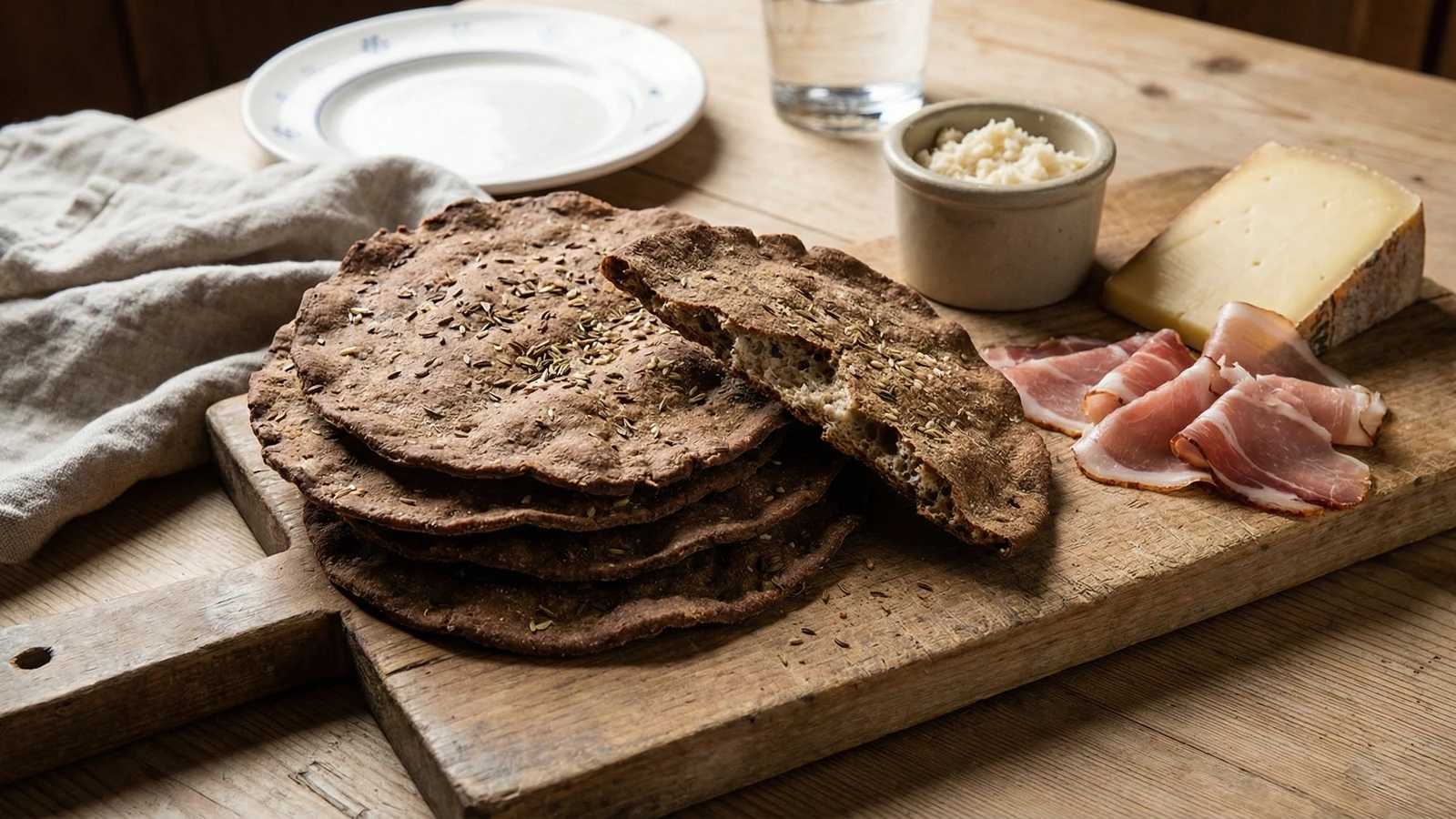
Tyrolean rye dough shaken flat into brittle, paper-thin rounds spiced with caraway and fenugreek, the Alpine bread that kept mountain families fed through long winters and still belongs on every Brettljause.
The first time I ate Schüttelbrot the way it's meant to be eaten, I was eleven years old, sitting on a wooden bench outside a Gasthaus somewhere above Innsbruck. Gretel had ordered a Brettljause for the table: thick slices of Tiroler Speck, a wedge of mountain cheese, pickled gherkins, horseradish, and a stack of these dark, brittle rounds that shattered when you broke them. I picked one up and it cracked in half before I got it to my mouth. Gretel laughed and said that's how you know it's good. If it bends, something went wrong.
Schüttelbrot is Tyrol's bread. Not Vienna's, not Salzburg's. Tyrol's. The name comes from schütteln, to shake. You take a stiff rye dough spiced with caraway and Bockshornklee (fenugreek), pull off a piece, and shake it back and forth between your floured hands or on a wooden board until it stretches into a thin, uneven round. Then you bake it in fierce heat until it dries right through. The result is something halfway between a cracker and a flatbread, dark with rye, fragrant with spice, and so dry it will sit in your pantry for three months without changing.
This was survival bread. Tyrolean mountain farmers baked it in autumn and stored it in dry lofts through the winter, breaking off pieces to eat with whatever they had. Speck, cheese, a smear of Schmalz. It wasn't fancy. It was practical and delicious, which in Austrian cooking often amounts to the same thing. Making it at home is simpler than you'd think. The dough is forgiving, the shaping is more fun than fussy, and your kitchen will smell like a Tyrolean bakery for the rest of the day.
Schüttelbrot has been baked in Tyrol since at least the 15th century, developed as a long-storage bread for Alpine farming communities that needed food to last through mountain winters when fresh baking was impractical. The characteristic use of Bockshornklee (fenugreek) and Kümmel (caraway) wasn't just for flavor: both spices were believed to aid digestion and preserve the bread. In 2014, Tiroler Schüttelbrot was registered as a Traditional Speciality Guaranteed (TSG) product within the European Union, protecting both its name and its traditional production method.
The technique, the tradition, and the story behind every dish.
Discover Culinary AdvisorIngredients
dark rye flour (Roggenmehl)
Quantity
300g
plain wheat flour
Quantity
100g
dried yeast
Quantity
7g
salt
Quantity
1 teaspoon
granulated sugar
Quantity
1 teaspoon
lukewarm water
Quantity
200ml
whole caraway seeds (Kümmel)
Quantity
2 tablespoons
dried fenugreek leaves (Bockshornklee/Brotklee)
Quantity
1 tablespoon
fennel seeds
Quantity
1 teaspoon
ground coriander
Quantity
1/2 teaspoon
rye flour
Quantity
for dusting and shaking
| Ingredient | Quantity |
|---|---|
| dark rye flour (Roggenmehl) | 300g |
| plain wheat flour | 100g |
| dried yeast | 7g |
| salt | 1 teaspoon |
| granulated sugar | 1 teaspoon |
| lukewarm water | 200ml |
| whole caraway seeds (Kümmel) | 2 tablespoons |
| dried fenugreek leaves (Bockshornklee/Brotklee) | 1 tablespoon |
| fennel seeds | 1 teaspoon |
| ground coriander | 1/2 teaspoon |
| rye flour | for dusting and shaking |
Equipment Needed
- •Large mixing bowl
- •Mortar and pestle (or heavy knife for crushing spices)
- •Baking sheet or pizza stone
- •Parchment paper
- •Wire cooling rack
- •Fork for docking
Instructions
- 1
Toast the spices
Put the caraway seeds and fennel seeds in a dry pan over medium heat. Shake them around for about two minutes, until you can smell them from across the kitchen and they just start to darken. Toasting wakes the essential oils up. Raw caraway is sharp and one-dimensional. Toasted caraway is warm and round, the way it should taste in bread. Let them cool for a minute, then crush them roughly in a mortar or under the flat of a knife. You want them broken, not powdered. The texture matters in the finished bread.
If you can find Brotklee (bread clover, which is dried fenugreek leaves) at an Austrian or Middle Eastern grocery, use it. It has a faintly sweet, hay-like flavor that defines the taste of Tyrolean bread. No substitute quite matches it. - 2
Mix the dough
In a large bowl, combine the rye flour and wheat flour. Dissolve the yeast and sugar in the lukewarm water and let it sit five minutes until it starts to foam. Make a well in the flour, pour in the yeast mixture, and add the salt, crushed caraway and fennel, the fenugreek leaves, and the coriander. Stir with a wooden spoon until it comes together into a shaggy, stiff dough, then turn it out and knead for five to six minutes. Rye dough doesn't develop gluten the way wheat does, so don't expect a smooth, elastic ball. It will feel dense, slightly sticky, and a bit rough. That's correct. If it looks like a perfect bread dough, you've added too much wheat flour.
Rye flour absorbs water more slowly than wheat. If the dough seems too dry in the first minute of kneading, wet your hands and keep working. Give it time before adding more water. - 3
Let the dough rise
Shape the dough into a rough ball, return it to the bowl, and cover with a damp tea towel. Let it rise in a warm spot for about ninety minutes. Rye doughs rise more slowly and less dramatically than wheat doughs. Don't expect it to double. You're looking for maybe fifty percent increase and a slightly puffy, relaxed feeling when you press it. The flavor develops during this time as the rye ferments. Rushing it costs you flavor you won't get back.
- 4
Divide and shape
Preheat your oven to 220°C (425°F) with a baking sheet or pizza stone inside. Line a second baking sheet with parchment. Turn the dough out onto a well-floured surface and divide it into twelve roughly equal pieces, each about the size of a golf ball. The pieces don't need to be precise. Tyrolean farmers were not weighing dough on scales.
- 5
Shake the flatbreads
This is the step that gives Schüttelbrot its name. Dust your hands generously with rye flour. Take one piece of dough and press it flat, then pass it back and forth between your hands, patting and shaking it, letting gravity do the stretching. Rotate it as you go. You're aiming for a rough round about 15 to 18 centimeters across and no thicker than three or four millimeters. It won't be perfectly circular. Good. It shouldn't be. The uneven edges and varying thickness are part of what makes each piece crisp differently in the oven. If you find the shaking difficult, use a rolling pin on a floured board and roll them thin, then give them a few shakes to loosen the shape. Place each round on the parchment-lined sheet.
Keep your hands and the dough well floured with rye flour. Rye is sticky. The flour is your friend here. If the dough starts clinging to your palms, stop and re-flour before it tears. - 6
Dock the dough
Using a fork, prick each round all over. Fifteen to twenty pokes per flatbread. This isn't decoration. The holes let trapped air and moisture escape during baking. Without them, the bread puffs up in uneven bubbles and won't dry through properly. You need it dry to the center for it to store. Every hole is doing structural work.
- 7
Bake the first round
Slide as many rounds as will fit without touching onto the hot baking sheet or stone in the oven. Bake for eight to ten minutes, then reduce the heat to 180°C (350°F) and bake another six to eight minutes. Watch them. The bread should turn a deep, mottled brown, darker at the thin edges. Pull them when they feel firm and dry across the entire surface. They will still have the faintest give in the center. That disappears as they cool. If you wait until they feel completely rigid in the oven, you've gone too far and they'll taste bitter.
If your oven runs hot or you're using a pizza stone, check at seven minutes. The difference between perfectly crisp and burnt is narrow with a bread this thin. - 8
Cool and crisp completely
Transfer the baked rounds to a wire rack immediately. They need air circulating on all sides to dry completely. As they cool, they'll go from firm to brittle. After twenty minutes, pick one up and snap it. It should break cleanly with a sharp crack. If it bends or tears, it's not dry enough. Put it back in the oven at 150°C for five more minutes. Repeat with remaining dough, bringing the oven back to 220°C for each new batch.
- 9
Serve or store
Once completely cool and brittle, your Schüttelbrot is ready. Break a round in half, lay it on a board with good Speck, mountain cheese, pickles, and horseradish for a proper Tiroler Brettljause. Or stack the rounds in a paper bag or bread box and store them in a dry place. They'll keep for two to three months without losing a thing. This is bread built to last. Mahlzeit!
Chef Tips
- •The spice blend is what separates ordinary rye crackers from real Schüttelbrot. Bockshornklee (fenugreek) is the signature. If you can't find the dried leaves, use half a teaspoon of fenugreek seeds, lightly toasted and crushed. It's not identical but it gets you close.
- •If you have access to a sourdough starter, replace the yeast with 80g of active rye sourdough starter and reduce the water to 150ml. The flavor will be deeper and more complex, closer to what Tyrolean bakeries produce. The rise will take longer, closer to three hours, but it's worth every minute.
- •Schüttelbrot must be stored dry. Wrap the cooled rounds in paper, never plastic. Plastic traps moisture and softens the bread, which undoes everything the baking accomplished. A linen bread bag or a paper sack in a cool, dry cupboard is ideal.
- •Serve Schüttelbrot the Tyrolean way: on a wooden board (a Brettl) alongside thinly sliced Tiroler Speck, Graukäse or Bergkäse, pickled gherkins, fresh horseradish, and a glass of Tyrolean wine or cold beer. This is a Brettljause, the Alpine snack board. It's one of the most satisfying things you can put in front of people.
Advance Preparation
- •Schüttelbrot is the ultimate make-ahead bread. Once fully cooled and brittle, it stores in a dry place for two to three months. Bake a full batch on a weekend and you'll have bread for weeks.
- •The dough can be made and divided into portions, then refrigerated overnight. Bring to room temperature for thirty minutes before shaking and baking. The slow cold rise adds flavor.
- •Toasted and crushed spices can be prepared up to a week ahead and stored in a sealed jar.
Frequently Asked Questions
Nutrition Information
1 flatbread (about 40g)
Where cooking meets culture.
Culinary mentorship, cultural storytelling, and the editorial depth that makes cooking meaningful.
Explore Culinary Advisor