Culinary Advisor
A cooking platform built around craft, culture, and the stories behind what we eat.
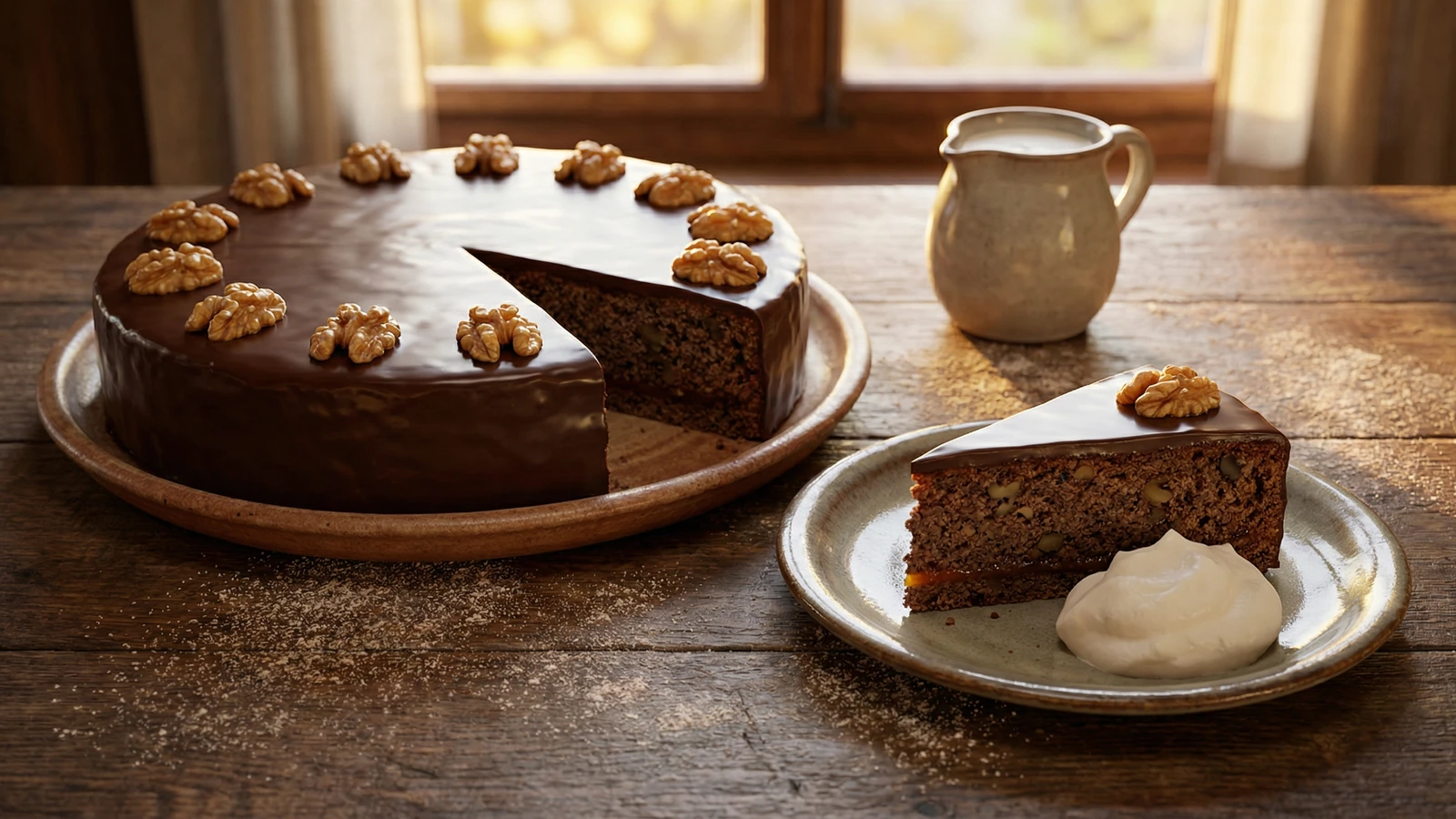
Tiroler Nußtorte (Tyrolean Walnut Cake)
Created by Chef Elsa
A dark, earthy walnut cake from the Tyrolean Alps, built on buckwheat flour and mountain walnuts, spread with Marillenmarmelade and finished with a bittersweet chocolate glaze that cracks when you press a fork through it.
The first time I tasted a proper Nußtorte in Tyrol, I was maybe ten. We'd stopped at a Gasthaus somewhere between Innsbruck and the Brenner Pass, one of those places with a wood-paneled Stube and geraniums on every windowsill, and Gretel ordered a slice for the table. It was nothing like the Torten I knew from Eva's kitchen. Darker. Denser. The crumb had a colour like wet autumn earth and a grain to it that felt almost savoury against your teeth. That was the buckwheat. I didn't know it then. I know it now.
Tyrolean baking is mountain baking. Buckwheat grows where wheat won't, at altitude, in thin soil, through short summers. The Tyroleans didn't use it because it was fashionable. They used it because it was what the land gave them. Mixed with ground walnuts and bound with eggs, it produces a cake that has more in common with the forest floor than with a Viennese Konditorei display case, and I mean that as the highest compliment.
The technique is a classic Viennese separated-egg sponge, the same principle behind a hundred Austrian Torten. You beat the yolks with sugar until pale and thick, fold in the nuts and flour, then lift everything with stiff egg whites. But the buckwheat changes the rules. It has no gluten, so the cake won't rise the way a wheat sponge does. It stays low and close-crumbed, almost fudgy in the centre. You spread it with a thin layer of Marillenmarmelade, the apricot's sharpness cutting through the earthy richness, then pour a dark chocolate glaze over the top and let it set. The result is a Torte that belongs to the mountains. Honest, dense, and better than anything trying harder to impress you.
Buckwheat cultivation in the Austrian Alps dates to at least the 15th century, when it became a staple grain for Tyrolean and Carinthian farmers working land too high and steep for conventional wheat. The Tyrolean dialect word 'Hadn' for buckwheat gave its name to the Hadntorte, a close relative of this Nußtorte, and both cakes reflect a baking tradition that predates the refined flour and sugar economy of the Viennese Konditorei by centuries. These were harvest cakes, made when the walnuts came down from the trees in October and the buckwheat had been milled, and their dense, dark character is a direct consequence of mountain agriculture, not a stylistic choice.
The technique, the tradition, and the story behind every dish.
Discover Culinary AdvisorIngredients
eggs
Quantity
6 large
separated
caster sugar
Quantity
150g
Vanillezucker (vanilla sugar)
Quantity
1 packet (8g)
salt
Quantity
pinch
lemon
Quantity
1
zested
dark rum
Quantity
1 tablespoon
walnuts
Quantity
200g
finely ground
buckwheat flour (Buchweizenmehl)
Quantity
80g
fine dry breadcrumbs
Quantity
30g
Marillenmarmelade (apricot jam)
Quantity
4 tablespoons
warmed and sieved
dark chocolate (minimum 60% cocoa)
Quantity
150g
unsalted butter
Quantity
80g
honey
Quantity
1 tablespoon
walnut halves
Quantity
8-10
for decoration
Schlagobers (whipped cream)
Quantity
for serving
softly whipped, unsweetened
| Ingredient | Quantity |
|---|---|
| eggsseparated | 6 large |
| caster sugar | 150g |
| Vanillezucker (vanilla sugar) | 1 packet (8g) |
| salt | pinch |
| lemonzested | 1 |
| dark rum | 1 tablespoon |
| walnutsfinely ground | 200g |
| buckwheat flour (Buchweizenmehl) | 80g |
| fine dry breadcrumbs | 30g |
| Marillenmarmelade (apricot jam)warmed and sieved | 4 tablespoons |
| dark chocolate (minimum 60% cocoa) | 150g |
| unsalted butter | 80g |
| honey | 1 tablespoon |
| walnut halvesfor decoration | 8-10 |
| Schlagobers (whipped cream)softly whipped, unsweetened | for serving |
Equipment Needed
- •24cm springform tin
- •Food processor or nut grinder
- •Electric hand mixer or stand mixer
- •Large flexible spatula for folding
- •Offset spatula for glazing
- •Wire cooling rack
- •Fine-mesh sieve for jam
Instructions
- 1
Prepare the tin and oven
Heat your oven to 170°C (340°F). Butter a 24cm springform tin and line the base with baking parchment. Dust the sides lightly with buckwheat flour, tapping out the excess. Buckwheat batter likes to stick, so don't skip this step.
A springform tin is not optional here. This cake is too dense and fragile when warm to flip out of a fixed-base tin. You need to release the sides cleanly. - 2
Grind the walnuts
Pulse the walnuts in a food processor until they're finely ground but still have a little texture. Stop before they turn into paste. You want something like coarse sand, not walnut butter. If you see oil pooling at the edges, you've gone too far. Toss the ground walnuts with the buckwheat flour and breadcrumbs in a bowl and set aside.
Pulse in short bursts, five or six at a time, and shake the processor between rounds. The oils in walnuts release fast and the line between ground and paste is about three seconds. - 3
Beat the yolks
In a large bowl, beat the egg yolks with the sugar and Vanillezucker until thick, pale, and doubled in volume. This takes a good five minutes with an electric mixer. You're building the structure of the cake right here, so don't cut it short. When you lift the beaters, the mixture should fall in a thick ribbon that holds its shape for a few seconds before sinking back. Add the lemon zest and rum and beat briefly to combine.
- 4
Fold in the dry ingredients
Tip the walnut and buckwheat mixture into the yolk batter. Fold gently with a large spatula, working from the bottom up and turning the bowl as you go. The batter will feel heavy and dense. That's correct. Buckwheat has no gluten to trap air, so this cake relies entirely on the egg whites for lift. Don't rush this, but don't over-fold either. Twenty to twenty-five strokes should do it. A few streaks of flour are fine for now.
- 5
Whip the egg whites
In a clean, dry bowl, beat the egg whites with a pinch of salt until they hold stiff, glossy peaks. If your bowl has any trace of fat or yolk in it, the whites won't whip. Start on medium speed until frothy, then increase to high. You're done when the peaks stand straight up and the surface looks like satin.
Gretel always said the bowl should be so clean you could eat from it. Wipe it with lemon juice and a paper towel before you start if you're not sure. - 6
Fold in the whites
Stir one third of the egg whites into the batter to lighten it. Be bold with this first addition. It sacrifices some volume to loosen the heavy walnut mixture so you can fold in the rest without knocking all the air out. Now fold in the remaining whites in two additions, gently but with purpose. Use the same bottom-to-top motion, turning the bowl a quarter turn each time. Stop the moment you can't see white streaks. Every extra fold costs you rise.
- 7
Bake the cake
Pour the batter into the prepared tin and smooth the top gently with your spatula. Don't press down. Place it in the centre of the oven and bake for 45 to 50 minutes. The cake is done when a skewer inserted in the centre comes out with just a few moist crumbs clinging to it. Not wet batter, not bone dry. The top will be dark brown, almost mahogany. That's the buckwheat. Don't panic. It's not burnt.
Don't open the oven door for the first thirty minutes. This cake is fragile while it sets, and a blast of cold air can collapse the centre. After thirty minutes, check through the glass if you can. - 8
Cool the cake completely
Let the cake cool in the tin for fifteen minutes, then release the springform ring and transfer to a wire rack. It will sink slightly in the centre as it cools. This is normal for a nut torte with no wheat flour holding it up. Let it cool completely before you touch it with jam or glaze. Patience. A warm cake will melt the chocolate and you'll have a puddle instead of a glaze.
- 9
Apply the Marillenmarmelade
Warm the apricot jam in a small saucepan until it loosens, then push it through a sieve to remove any lumps. Brush a thin, even layer over the top and sides of the cooled cake. This is called an Aprikotieren in the Konditorei tradition, and it does two things: it gives the chocolate something to grip, and it slips a layer of sharp, fruity brightness between the earthy cake and the dark glaze. Without it, the whole thing would taste one-dimensional.
- 10
Make the chocolate glaze
Break the chocolate into small pieces and place it in a heatproof bowl with the butter and honey. Set the bowl over a pot of barely simmering water, making sure the base doesn't touch the water. Stir gently until everything melts into a smooth, glossy mixture. Take it off the heat and let it cool for five minutes. You want it thick enough to coat the back of a spoon but still pourable. If it's too hot it will run right off the cake. If it's too cool it will set in lumps before you can spread it.
- 11
Glaze the Torte
Set the cake on a wire rack over a baking tray to catch the drips. Pour the chocolate glaze over the centre of the cake in one steady motion and let gravity pull it down the sides. Use an offset spatula to guide it gently if needed, but work fast and touch it as little as possible. Every pass of the spatula dulls the finish. You want this glaze smooth and mirror-dark. Press walnut halves around the top edge while the glaze is still tacky, spacing them evenly. Let the whole thing set at room temperature for at least thirty minutes.
- 12
Serve the Torte
Slice with a sharp knife dipped in hot water and wiped clean between cuts. The crumb will be dark, dense, and slightly fudgy in the centre. Serve each slice with a generous spoonful of softly whipped Schlagobers on the side, never on top. The cream is there to lighten each bite, not to hide the cake. Mahlzeit!
Chef Tips
- •Buy your walnuts from somewhere that sells them quickly. Walnuts go rancid faster than any other nut because of their high oil content. Taste one before you start. If it's bitter or musty, the whole Torte will carry that flavour and nothing can save it. Good walnuts taste clean, sweet, and faintly tannic.
- •Buckwheat flour has a short shelf life. Buy it in small quantities from a health food shop or mill, not from a bag that's been sitting on a supermarket shelf for months. It should smell nutty and slightly earthy. If it smells like cardboard, it's past its best.
- •The honey in the glaze is not for sweetness. It keeps the chocolate flexible after it sets, so the glaze cracks cleanly under a fork instead of shattering into shards all over the plate. Don't leave it out.
- •This Torte actually improves overnight. The crumb firms up, the flavours marry, and the buckwheat's earthiness rounds out. Bake it the day before you plan to serve it and store it at cool room temperature under a cake dome.
Advance Preparation
- •The cake layers can be baked one day ahead, wrapped tightly in cling film, and stored at room temperature. The texture actually improves overnight as the crumb sets and the buckwheat flavour deepens.
- •The finished glazed Torte keeps well for three to four days at cool room temperature. Refrigeration firms the glaze and dulls the flavour. Bring to room temperature for thirty minutes before serving if you must chill it.
- •Walnuts can be ground up to a week ahead and stored in a sealed container in the freezer. Bring to room temperature before using.
Frequently Asked Questions
Nutrition Information
1 serving (about 130g)
Where cooking meets culture.
Culinary mentorship, cultural storytelling, and the editorial depth that makes cooking meaningful.
Explore Culinary Advisor