Culinary Advisor
A cooking platform built around craft, culture, and the stories behind what we eat.
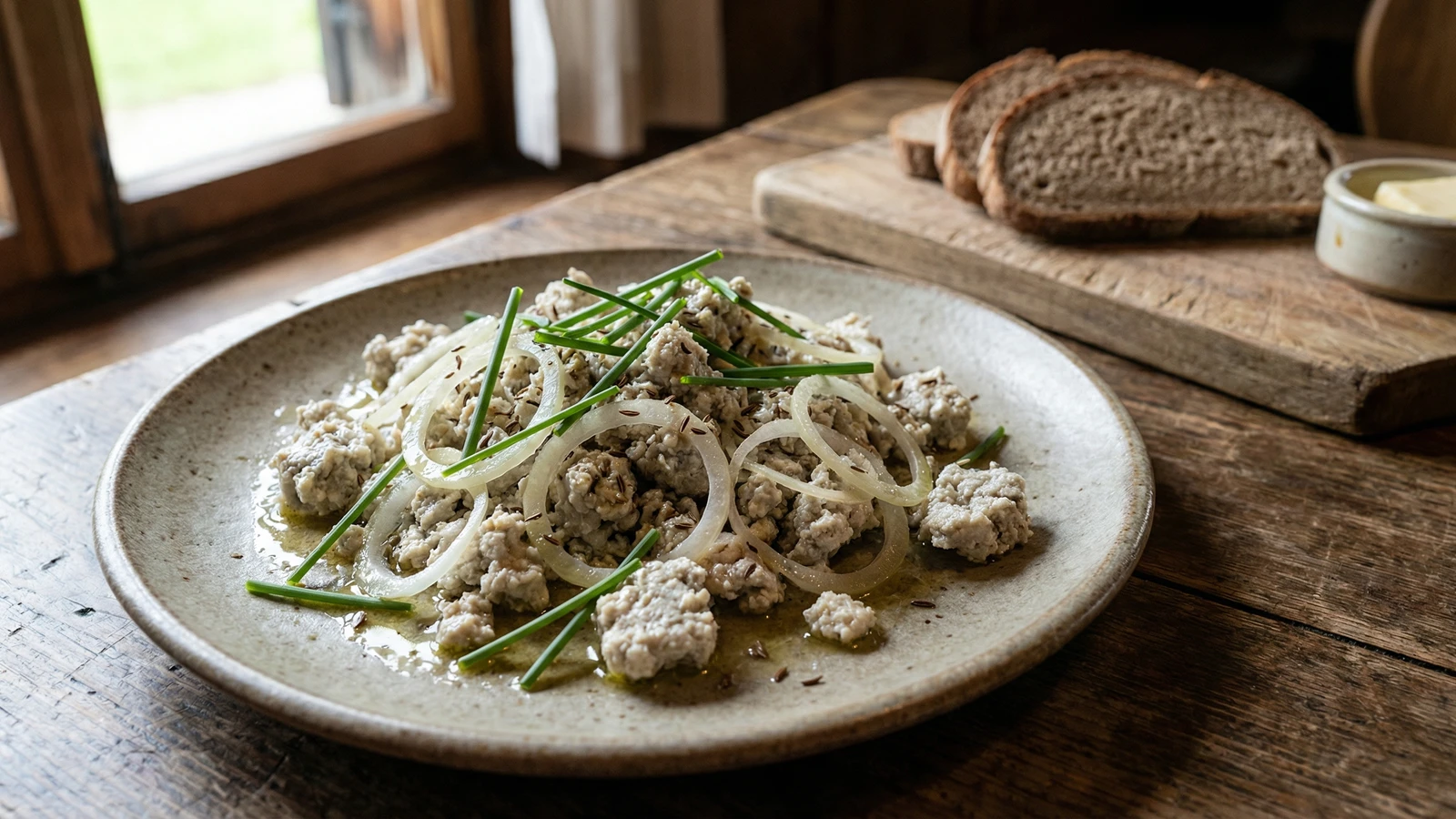
Tiroler Graukäsesalat
Created by Chef Elsa
Crumbled Tyrolean grey cheese marinated with sharp vinegar, raw onion rings, and a slick of good oil. Alpine peasant food that hits harder than anything on a Haubenlokal menu.
The first time I tasted Graukäsesalat I was maybe ten, on one of those summer trips to Austria with Gretel and my grandmother Eva. We'd stopped at a Jausenstation somewhere above the Zillertal, one of those wooden huts perched on a mountainside where the menu is whatever the farmer's wife made that morning. The cheese arrived on a small plate, crumbled and glistening with vinegar, raw onion rings curled on top. It smelled like something alive. Gretel took one look at my face and laughed. "Eat it," she said. "You'll understand."
She was right. Graukäse is not a polite cheese. It's sour, sharp, and intensely pungent, with a crumbly texture that falls apart under your fork. The vinegar marinade tames it just enough. The onion rings give it bite. A good pour of oil rounds everything out. You eat it with thick slices of dark Bauernbrot and maybe some butter, and you sit there on a wooden bench looking at mountains and wondering why anyone bothers with complicated food when something this simple can stop you mid-sentence.
This is good Austrian home cooking at its most elemental. Four or five ingredients, no heat required, and everything depends on the quality of what's in front of you. If the cheese is right, the salad is right. If you try to make this with something mild and creamy from a supermarket, you'll end up with a different dish entirely. Graukäse is the point. Everything else is there to let it speak.
Graukäse is one of the oldest cheeses in the Alps, dating back to at least the medieval period when Tyrolean farmers made it from the skimmed sour milk left after butter production. With less than two percent fat, it was sustenance food for people who couldn't afford to waste the cream. Zillertal Graukäse received EU Protected Geographical Indication status in 2013, recognizing that genuine production remains tied to the Zillertal valley, where small dairies still make it by hand using raw milk and no rennet. The grey-green rind that gives the cheese its name develops naturally during aging, and no two wheels look exactly alike.
The technique, the tradition, and the story behind every dish.
Discover Culinary AdvisorIngredients
Graukäse (Tyrolean grey cheese)
Quantity
300g
rind removed
white onion
Quantity
1 medium
sliced into thin rings
Apfelessig (apple cider vinegar)
Quantity
4 tablespoons
sunflower oil or mild rapeseed oil
Quantity
3 tablespoons
caraway seeds
Quantity
1 teaspoon
lightly crushed
black pepper
Quantity
to taste
freshly ground
flaky salt
Quantity
to taste
fresh chives
Quantity
small bunch
cut into short lengths
dark Bauernbrot (farmhouse bread)
Quantity
for serving
butter (optional)
Quantity
for serving
| Ingredient | Quantity |
|---|---|
| Graukäse (Tyrolean grey cheese)rind removed | 300g |
| white onionsliced into thin rings | 1 medium |
| Apfelessig (apple cider vinegar) | 4 tablespoons |
| sunflower oil or mild rapeseed oil | 3 tablespoons |
| caraway seedslightly crushed | 1 teaspoon |
| black pepperfreshly ground | to taste |
| flaky salt | to taste |
| fresh chivescut into short lengths | small bunch |
| dark Bauernbrot (farmhouse bread) | for serving |
| butter (optional) | for serving |
Equipment Needed
- •Wide shallow bowl for marinating
- •Small sharp knife for rind removal
- •Mortar and pestle or heavy knife for crushing caraway
Instructions
- 1
Prepare the cheese
Trim away the grey-green rind from the Graukäse. It's edible but tough and can taste bitter, so peel it off with a small knife. Break or crumble the cheese into rough, uneven pieces about the size of a walnut. Don't try to dice it neatly. Graukäse has a dry, crumbly texture that wants to fall apart on its own terms. Let it. Some pieces will be chunky, others will break into coarse rubble. Both are good.
Graukäse varies enormously from wheel to wheel. Younger cheese will be chalky and mild. Aged Graukäse turns translucent and hits you with a smell that clears the room. For this salad, look for something in between: firm enough to crumble, pungent enough to hold its own against the vinegar. - 2
Slice the onion
Peel the onion and slice it into thin rings. Thin means you can almost see through them. The onion is raw in this salad and it needs to be delicate, not crunchy planks that overpower the cheese. Separate the rings with your fingers and scatter them over the crumbled cheese in a wide shallow bowl.
- 3
Make the marinade
Whisk together the Apfelessig and oil in a small bowl. The ratio matters: this is a vinegar-forward dressing, not a vinaigrette. The acidity cuts through the richness of the cheese and the sharpness of the onion. If you balance it the other way, with more oil than vinegar, you'll lose the bright, clean contrast that makes this salad work. Add the lightly crushed caraway seeds and a generous grind of black pepper. Taste it. It should be sharp enough to make you blink.
Crush the caraway seeds lightly with the flat of a knife or in a mortar. You want them cracked open to release their warm, anise-like flavor, not ground to powder. Whole seeds are too hard and roll off the cheese. Powder disappears. Lightly crushed is the sweet spot. - 4
Marinate the salad
Pour the dressing over the cheese and onion rings. Toss gently with your hands or two forks, making sure the vinegar reaches every piece. Cover the bowl and let it sit at room temperature for at least thirty minutes. The cheese will absorb the vinegar and soften slightly at the edges. The onion rings will relax and lose their raw bite. This is not optional. Graukäse eaten straight is an act of courage. Graukäse after thirty minutes in vinegar is a salad.
You can marinate this for up to two hours at room temperature and it only gets better. Beyond that, refrigerate it and bring it back to room temperature before serving. Cold mutes the flavor of the cheese and stiffens the oil. - 5
Season and serve
Taste the salad and adjust. A pinch of flaky salt if it needs it, another splash of vinegar if the cheese has drunk it all up. Scatter the chives over the top. Serve at room temperature on a simple plate with thick slices of dark Bauernbrot and good butter alongside. This is a salad you eat with bread in your other hand, tearing off pieces to scoop up the cheese and soak up the vinegar pooling on the plate. Mahlzeit!
Chef Tips
- •Sourcing Graukäse outside Tyrol is the only real challenge in this recipe. If you're outside Austria, look for it at Austrian specialty importers or well-stocked cheese shops. There is no perfect substitute. Harzer Käse or Handkäse from Germany comes closest in texture and pungency, but it's a different cheese with a different character. If you use a substitute, you'll make a good sour cheese salad. You won't make Graukäsesalat.
- •Use Apfelessig, a good Austrian or German apple cider vinegar. Distilled white vinegar is too harsh. Balsamic is completely wrong, don't even think about it. If you can find Hesperidenessig, the citrus-infused vinegar from Vienna, try a tablespoon of it blended with the Apfelessig for brightness.
- •Graukäse has almost no fat. That's why the oil in the dressing is essential: it gives the salad the richness the cheese itself doesn't have. Use a neutral oil with a clean flavor. This is not the place for Steirisches Kürbiskernöl or extra virgin olive oil. Those flavors would wrestle the cheese instead of supporting it.
- •Serve this at room temperature. Always. Cold Graukäse tastes like nothing. It needs warmth to release its full, honest aroma. If anyone at the table looks nervous, tell them that's how you know the cheese is good.
Advance Preparation
- •The salad can be marinated up to six hours ahead and refrigerated, but must be brought back to room temperature thirty minutes before serving. Cold kills the aroma and texture.
- •Slice the onion rings and make the dressing up to a day ahead. Keep them separate and combine with the cheese when you're ready to start the marinating time.
Frequently Asked Questions
Nutrition Information
1 serving (about 140g)
Where cooking meets culture.
Culinary mentorship, cultural storytelling, and the editorial depth that makes cooking meaningful.
Explore Culinary Advisor