Culinary Advisor
A cooking platform built around craft, culture, and the stories behind what we eat.
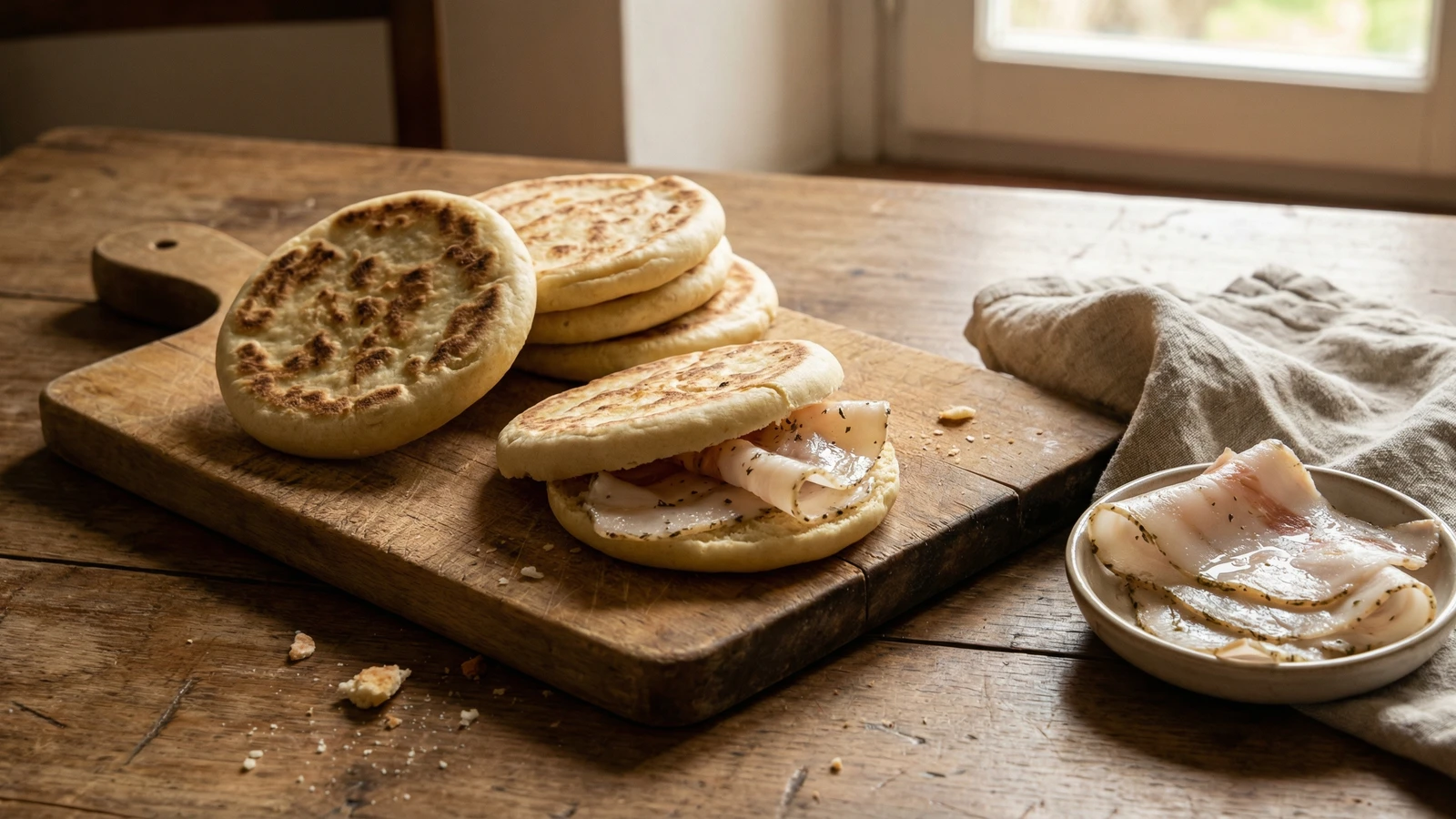
Tigelle con Lardo di Colonnata
Created by Chef Graziella
Warm griddle breads from the Modenese mountains, split open and filled with the ethereal cured lard of Colonnata. Two mountain traditions meet in a single bite.
In the Apennine mountains above Modena, farm wives have made tigelle for centuries. Small, round, slightly puffed griddle breads, cooked between terracotta discs in the hearth ashes. They called them crescentine, after the crescent moon shape of other local flatbreads, though tigelle are perfectly round. The name comes from the molds themselves: tigelle, little tiles.
The filling changes with the season and what the family has on hand. Pesto modenese, a paste of lard, rosemary, and garlic. Cured meats. Soft cheeses. But nothing marries more perfectly with the warm bread than Lardo di Colonnata, that miraculous cured fatback from the marble quarries of Tuscany.
This is a dish of two mountains meeting. The bread from one range, the lardo from another. Both speak the same language of restraint, of taking humble ingredients and treating them with such care that they become extraordinary. The warmth of the bread softens the lardo just enough. The fat melts onto your tongue. The rosemary and the faint mineral quality from the marble curing basins linger. You understand, in that moment, why Italians treat pig fat with the reverence others reserve for truffles.
Tigelle date to at least the Middle Ages in the Modenese Apennines, where families cooked them in terracotta molds called tigelliere, heated directly in fireplace embers. Lardo di Colonnata, from the marble-quarrying village near Carrara, has been cured in carved marble conche since Roman times. The marble's unique porosity and mineral content create an aging environment that cannot be replicated elsewhere.
The technique, the tradition, and the story behind every dish.
Discover Culinary AdvisorIngredients
all-purpose flour
Quantity
500g (about 4 cups)
plus more for dusting
active dry yeast
Quantity
7g (1 packet)
warm whole milk
Quantity
250ml (1 cup)
lard or unsalted butter
Quantity
50g (3 1/2 tablespoons)
softened
fine sea salt
Quantity
1 teaspoon
baking soda
Quantity
1/2 teaspoon
Lardo di Colonnata
Quantity
200g
sliced paper-thin
| Ingredient | Quantity |
|---|---|
| all-purpose flourplus more for dusting | 500g (about 4 cups) |
| active dry yeast | 7g (1 packet) |
| warm whole milk | 250ml (1 cup) |
| lard or unsalted buttersoftened | 50g (3 1/2 tablespoons) |
| fine sea salt | 1 teaspoon |
| baking soda | 1/2 teaspoon |
| Lardo di Colonnatasliced paper-thin | 200g |
Equipment Needed
- •Large cast iron skillet or griddle
- •3-inch (7-8 cm) round biscuit cutter
- •Rolling pin
- •Clean kitchen towels
Instructions
- 1
Activate the yeast
Warm the milk until it feels like bathwater against your wrist, no hotter than 110°F. Sprinkle the yeast over the surface and let it stand for 10 minutes. It should become foamy and smell like bread. If nothing happens, your yeast is dead. Discard it and start again with fresh yeast.
- 2
Make the dough
In a large bowl, combine the flour, salt, and baking soda. Make a well in the center. Add the softened lard and the activated yeast mixture. Stir with a wooden spoon until a shaggy dough forms. Turn it onto a floured surface and knead for 8 to 10 minutes. The dough should become smooth, soft, and spring back when pressed with your finger.
Traditional tigelle use lard in the dough, which gives them their characteristic tender crumb. Butter works if you prefer, but the texture will be slightly different. Do not use olive oil here. - 3
Let the dough rise
Shape the dough into a ball and place it in a lightly oiled bowl. Cover with a clean kitchen towel and let it rise in a warm place until doubled in size, about 1 1/2 to 2 hours. The dough is ready when a finger pressed into it leaves an indentation that slowly springs back.
- 4
Shape the tigelle
Turn the risen dough onto a lightly floured surface. Roll it to a thickness of about 1/2 inch (1 cm). Using a 3-inch (7-8 cm) round cutter, cut out discs. Gather the scraps, let them rest for 5 minutes, and roll again. You should have approximately 24 rounds. Place them on parchment-lined baking sheets, cover with a towel, and let rest for 20 minutes.
The resting period after cutting is not optional. It relaxes the gluten so the tigelle cook evenly and remain tender. - 5
Cook the tigelle
Heat a cast iron skillet or griddle over medium heat. The surface should be hot but not smoking. Working in batches, cook the tigelle for 3 to 4 minutes per side. They should develop golden-brown spots and puff slightly in the center. Press gently with a spatula if they balloon too much. The finished tigelle should sound hollow when tapped.
Traditional tigelliere are terracotta molds heated over coals. A well-seasoned cast iron skillet produces excellent results. Do not grease the pan. The fat in the dough is sufficient. - 6
Fill and serve immediately
Split each tigella horizontally while still warm, using a sharp knife or simply pulling it apart. The steam escaping from the center is your signal that the timing is correct. Lay a slice or two of Lardo di Colonnata inside. The warmth of the bread will soften the lardo just enough that its fat becomes silky and begins to release the perfume of rosemary and the mountains. Close the tigella and serve immediately. These do not wait.
Chef Tips
- •Seek out authentic Lardo di Colonnata with its IGP (Protected Geographical Indication) certification. The curing in Carrara marble basins gives it a complexity that ordinary lardo cannot match. It should be sliced so thin you can nearly see through it.
- •If you cannot find Lardo di Colonnata, good-quality Italian lardo cured with rosemary is an acceptable substitute. What is not acceptable is American-style fatback, which is uncured and will taste of nothing.
- •The tigelle must be warm when you fill them. Room temperature bread will not soften the lardo. Work quickly, in batches if necessary, filling each tigella as it comes off the griddle.
- •In Modena, tigelle are sometimes served with a variety of fillings: soft stracchino cheese, prosciutto, or pesto modenese. Set out several options and let guests fill their own.
Advance Preparation
- •The dough can be made up to 24 hours ahead and refrigerated after the first rise. Bring to room temperature for 1 hour before shaping.
- •Cooked tigelle can be held for up to 2 hours, wrapped in a clean towel to stay soft. Rewarm briefly in a dry skillet before serving.
- •Lardo di Colonnata should be sliced paper-thin just before serving. If sliced too far ahead, the edges dry and curl.
Frequently Asked Questions
Nutrition Information
1 serving (about 120g)
Where cooking meets culture.
Culinary mentorship, cultural storytelling, and the editorial depth that makes cooking meaningful.
Explore Culinary Advisor