Culinary Advisor
A cooking platform built around craft, culture, and the stories behind what we eat.
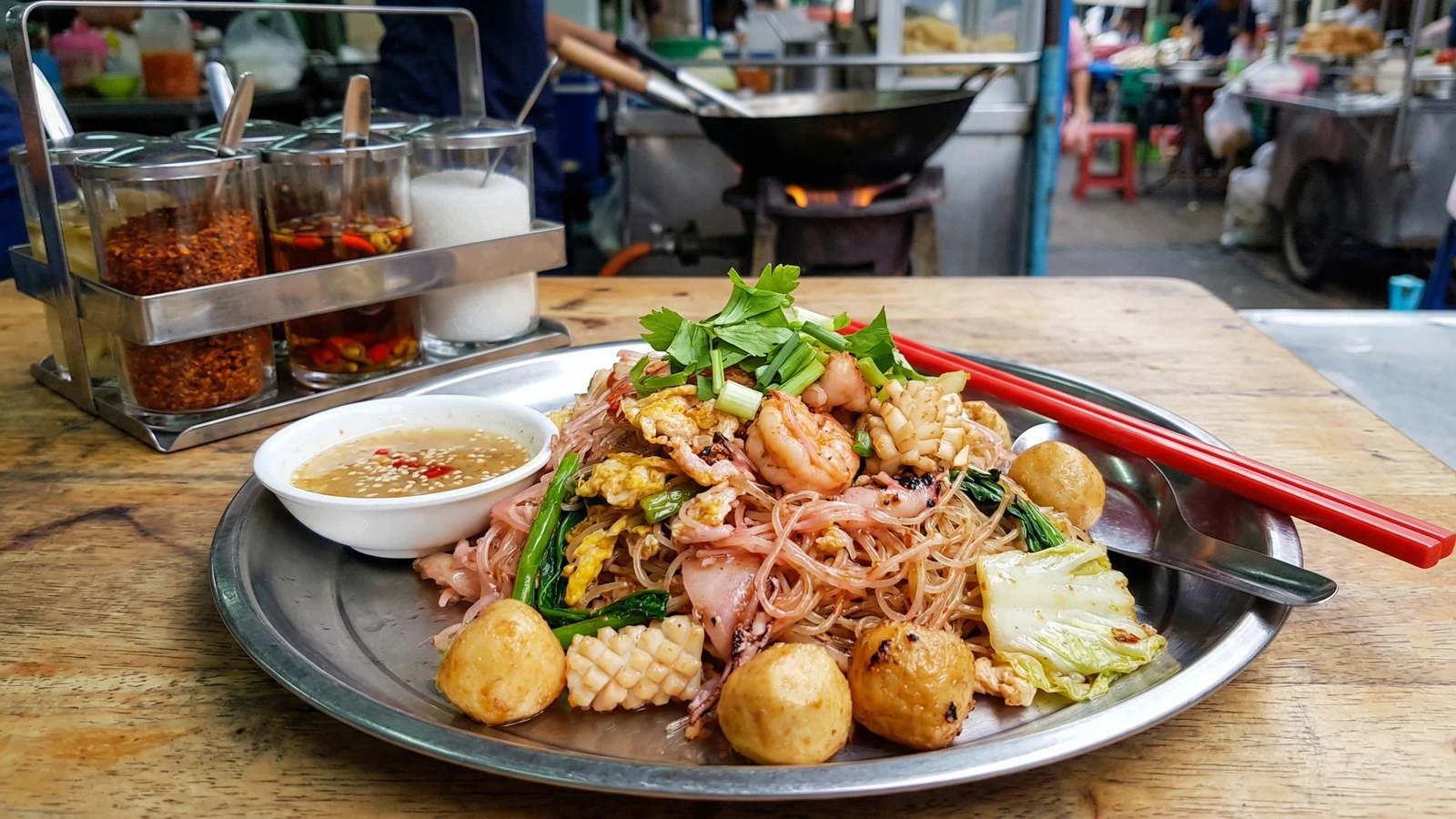
Thai Street Sukiyaki (Suki Haeng)
Created by
A Japanese name, Chinese wok technique, and a Thai soul living in the nam jim suki alongside it. Fermented tofu for salt, lime for sour, chili for heat. The system absorbs and transforms.
Suki is a stolen dish. I say that with respect, because stealing dishes and making them better is what Thai food has always done.
Japanese sukiyaki came to Bangkok sometime in the mid-twentieth century. Chinese-Thai cooks looked at the delicate tabletop hot pot, stripped out the ceremony, threw glass noodles and seafood into a screaming wok, and doused it in fermented tofu sauce. That's the Thai move: take the concept, apply the technique, add the condiment. Now it's ours. Every suki cart on Yaowarat is proof that Thai cuisine isn't a museum. It's a living system that eats other cuisines for breakfast and spits out something better.
The stir-fry itself is a Chinese-Thai technique play. Hot wok, fast hands, glass noodles (wun sen) that go from perfect to mush in ten seconds if you lose focus. But what makes suki Thai isn't the wok work. It's the nam jim suki, the dipping sauce, sitting right there in a little cup next to your plate. Fermented tofu (tao hoo yee) for salty, funky depth. Lime for sour. Chili for heat. Sugar to round the edges. The four pillars, showing up exactly where they always do: in the condiment. The stir-fry is the vehicle. The nam jim is the soul.
Ajarn always said Thai cuisine doesn't reject foreign influence. It absorbs it, applies the principles, and makes it something distinctly Thai. Suki is that principle in action. At a Fai Thai workshop, this is the dish I use to teach adaptation within the system. The rules don't change just because the dish crossed a border. Fish sauce shows up in the dipping sauce. Lime juice shows up. Chilies show up. The system holds, no matter where the original idea came from.
Thai suki evolved from Japanese sukiyaki introduced to Bangkok in the 1940s-50s, transformed by Chinese-Thai cooks (primarily Teochew immigrants in Yaowarat) into a wok-fried noodle dish. MK Suki, founded in 1962, popularized the hot pot version (suki nam) as a family restaurant format, but street vendors created suki haeng (dry suki) for speed and portability, stir-frying the same ingredients with fermented tofu sauce (tao hoo yee), a Teochew Chinese staple that became the signature Thai suki flavor. The dish's name is one of the few Japanese loanwords in Thai street food vocabulary.
The technique, the tradition, and the story behind every dish.
Discover Culinary AdvisorIngredients
glass noodles (wun sen)
Quantity
100g
soaked in room-temperature water for 10 minutes, drained
shrimp (goong)
Quantity
150g
peeled
squid (pla muek)
Quantity
100g
cleaned and scored
fish balls (luk chin pla)
Quantity
6
halved
eggs
Quantity
2
garlic
Quantity
4 cloves
roughly chopped
napa cabbage (phak kat khao)
Quantity
1 cup
roughly chopped
morning glory (phak bung)
Quantity
1 cup
cut into 2-inch pieces
Chinese celery (khuen chai)
Quantity
3 stalks
cut into 1-inch pieces
green onions (ton hom)
Quantity
2
cut into 1-inch pieces
vegetable oil
Quantity
2 tablespoons
fermented tofu (tao hoo yee)
Quantity
1 tablespoon
mashed
light soy sauce (si ew khao)
Quantity
1 tablespoon
oyster sauce
Quantity
1 tablespoon
sesame oil (nam man nga)
Quantity
1 teaspoon
sugar
Quantity
1 teaspoon
white pepper (prik thai khao)
Quantity
1/2 teaspoon
fermented tofu (tao hoo yee), for nam jim
Quantity
2 tablespoons
lime juice (nam manao), for nam jim
Quantity
3 tablespoons (about 2 limes)
bird's eye chilies (prik khi nu), for nam jim
Quantity
3
minced
garlic, for nam jim
Quantity
3 cloves
minced
sugar, for nam jim
Quantity
1 tablespoon
toasted white sesame seeds (nga khao), for nam jim
Quantity
1 teaspoon
coriander root (rak phak chi), for nam jim (optional)
Quantity
1
minced
| Ingredient | Quantity |
|---|---|
| glass noodles (wun sen)soaked in room-temperature water for 10 minutes, drained | 100g |
| shrimp (goong)peeled | 150g |
| squid (pla muek)cleaned and scored | 100g |
| fish balls (luk chin pla)halved | 6 |
| eggs | 2 |
| garlicroughly chopped | 4 cloves |
| napa cabbage (phak kat khao)roughly chopped | 1 cup |
| morning glory (phak bung)cut into 2-inch pieces | 1 cup |
| Chinese celery (khuen chai)cut into 1-inch pieces | 3 stalks |
| green onions (ton hom)cut into 1-inch pieces | 2 |
| vegetable oil | 2 tablespoons |
| fermented tofu (tao hoo yee)mashed | 1 tablespoon |
| light soy sauce (si ew khao) | 1 tablespoon |
| oyster sauce | 1 tablespoon |
| sesame oil (nam man nga) | 1 teaspoon |
| sugar | 1 teaspoon |
| white pepper (prik thai khao) | 1/2 teaspoon |
| fermented tofu (tao hoo yee), for nam jim | 2 tablespoons |
| lime juice (nam manao), for nam jim | 3 tablespoons (about 2 limes) |
| bird's eye chilies (prik khi nu), for nam jimminced | 3 |
| garlic, for nam jimminced | 3 cloves |
| sugar, for nam jim | 1 tablespoon |
| toasted white sesame seeds (nga khao), for nam jim | 1 teaspoon |
| coriander root (rak phak chi), for nam jim (optional)minced | 1 |
Equipment Needed
- •Wok (carbon steel preferred)
- •Wok spatula
- •Granite mortar and pestle (krok hin) for the nam jim suki
Instructions
- 1
Pound the nam jim suki
In your mortar, pound the garlic, chilies, and coriander root to a rough paste. Not smooth. You want pieces. Scrape this into a small bowl. Add the fermented tofu (tao hoo yee), lime juice, sugar, and sesame seeds. Stir until the sugar dissolves. Taste it. It should be salty and funky from the tao hoo yee, sour from the lime, hot from the chilies, with the sesame giving a nutty finish. This is where the four pillars live in this dish. The stir-fry is the body. This sauce is the Thai identity. Adjust to your taste and set aside.
Tao hoo yee (fermented tofu) is a Teochew Chinese ingredient that Thai suki vendors adopted. It comes in jars, white cubes in brine. Mash it with a fork. It's salty, funky, and irreplaceable. Don't skip it. Don't substitute miso. It's not the same thing. - 2
Prep noodles and sauce
Soak the glass noodles (wun sen) in room-temperature water for exactly 10 minutes. Not boiling water. Room temperature. Hot water turns them to paste before they hit the wok. They should be pliable but still slightly firm. Drain completely. While they soak, mix the stir-fry sauce in a small bowl: mashed fermented tofu, light soy sauce, oyster sauce, sesame oil, sugar, and white pepper. Stir until combined. Have everything within arm's reach. Once the wok is hot, you have about three minutes total. This isn't a dish that waits.
- 3
Fire the wok
Get your wok screaming hot over the highest heat you have. Add the oil. When it shimmers, slam in the garlic. Two seconds. The smell should hit you immediately. Add the shrimp, squid, and fish ball halves. Spread them across the wok surface. Let them sear. Don't stir for fifteen seconds. You want color on the seafood, that first layer of char that street vendors get from their jet burners. Then toss. The shrimp should be turning pink, the squid curling, the fish balls getting golden spots. About one minute total.
Score the squid in a crosshatch pattern before cooking. It curls beautifully and holds more sauce. Every suki vendor in Yaowarat does this. It takes thirty seconds and makes a visible difference. - 4
Add eggs and noodles
Push the seafood to the edges of the wok. Crack both eggs directly into the center. Let them set for five seconds on the bottom, then break the yolks and scramble roughly with your spatula. You're not making an omelet. You want big, ragged pieces of egg mixed through. Before the egg is fully set, add the drained glass noodles on top. Pour the stir-fry sauce over everything. Now toss. Use your spatula to lift from the bottom and fold over. The noodles will absorb the sauce almost instantly. Keep them moving. Glass noodles go from perfectly slippery to a gummy clump in seconds if they sit still. Fifteen seconds of aggressive tossing.
- 5
Finish with vegetables
Add the napa cabbage, morning glory, Chinese celery, and green onions all at once. Toss three or four times over high heat. The cabbage should wilt but keep its crunch. The morning glory should turn bright green. The celery and green onion should still have bite. Ten seconds, fifteen at most. If the vegetables go limp, you've gone too long. Everything should look glossy with sauce, the noodles tangled around the seafood, the egg in ragged golden pieces throughout.
- 6
Plate and serve
Plate immediately onto a steel or melamine plate. No fuss, no arrangement. Just slide it out of the wok. Set the nam jim suki in a small dipping bowl alongside. Here's how you eat it: take a bite of the stir-fry, then dip or drizzle with the nam jim. The stir-fry gives you the savory, sesame-scented base. The nam jim gives you the sour-spicy-funky Thai punch. Together, they're the complete dish. One without the other is half a meal.
Chef Tips
- •Glass noodles (wun sen) are made from mung bean starch. They cook fast and absorb everything around them. Soak in room-temperature water, never boiling. Over-soaked noodles turn to glue in the wok. You want them pliable but still slightly firm going in. The residual heat does the rest. If you're unsure, err on the side of under-soaking.
- •Fermented tofu (tao hoo yee) is the backbone of suki flavor. Teochew Chinese immigrants brought it to Bangkok, and it became the defining ingredient in Thai suki sauce. It comes in glass jars, white cubes sitting in brine. Some versions are red (colored with red yeast rice). Either works. Mash it with a fork before adding to the sauce. There is no substitute. If you skip it, you're making a generic noodle stir-fry, not suki.
- •Street suki vendors use a mix of proteins: shrimp, squid, fish balls, sometimes pork liver or blood tofu. That mix is part of the identity. If you use just one protein, it's fine, but the variety of textures (bouncy fish balls, snappy shrimp, tender squid) is what makes a suki plate feel complete. Ask for 'ruam mit' (รวมมิตร, mixed) at any stall and you get the works.
- •The nam jim suki is not optional. It's not a side sauce. It's where the Thai identity of this Chinese-Japanese borrowed dish lives. The stir-fry alone is savory and mellow. The nam jim brings sour, spicy, and funky. Together, you have balance. Ajarn always said: when Thai cooks adopt a foreign dish, the condiment is where they plant the flag. This is that flag.
- •Suki carts on Yaowarat serve this with the standard noodle-dish condiment caddy: phrik pon (chili flakes), nam pla prik (fish sauce with chili slices), sugar, and vinegar with chili. These aren't decoration. Each person adjusts their plate. More sour? Hit it with vinegar. More salt? A splash of nam pla prik. The condiment caddy is the last step in the four-pillar system, where the eater becomes the cook.
Advance Preparation
- •Nam jim suki can be made up to a week ahead and stored in a sealed jar in the fridge. The flavors improve after a day as the fermented tofu and lime meld together.
- •Glass noodles must be soaked just before cooking. Do not soak ahead. They absorb water continuously and will turn to mush if left sitting. Ten minutes in room-temperature water, drain, cook immediately.
- •Seafood can be cleaned, peeled, and scored up to a day ahead. Keep refrigerated on a plate lined with paper towels.
- •The stir-fry sauce can be mixed a day ahead and kept refrigerated. Bring to room temperature before cooking so it doesn't cool the wok.
Frequently Asked Questions
Nutrition Information
1 serving (about 400g)
Where cooking meets culture.
Culinary mentorship, cultural storytelling, and the editorial depth that makes cooking meaningful.
Explore Culinary Advisor