Culinary Advisor
A cooking platform built around craft, culture, and the stories behind what we eat.
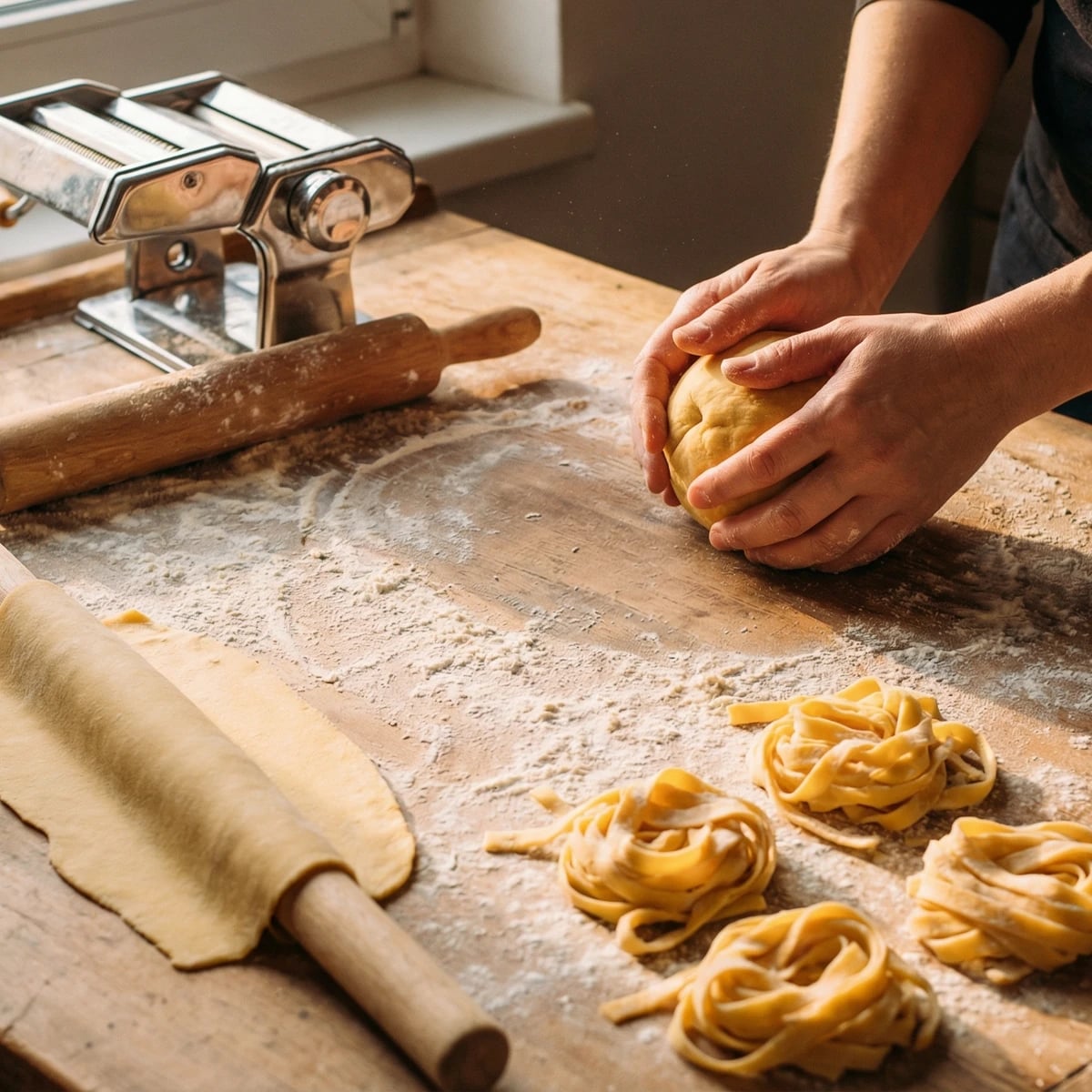
Tagliatelle
Created by Chef Graziella
The golden ribbons of Bologna, cut from sheets of fresh egg pasta so thin you can read a love letter through them. The texture grips sauce. The flavor speaks of wheat and eggs and the work of your hands.
Tagliatelle is not difficult. It is demanding. There is a difference. Difficulty implies complexity, many steps, obscure techniques. Tagliatelle has two ingredients and a rolling pin. What it demands is attention, practice, and the willingness to fail several times before you succeed.
The sfogline of Bologna, the women who have rolled pasta for generations, can produce sheets nearly as big as a bedspread. Their arms are strong, their touch is light, and they learned at their grandmothers' sides. You did not. This is no reason to despair. A hand-crank pasta machine transforms this from an expert skill into a learnable one. The result will not be identical to hand-rolled sfoglia, but it will be excellent, and it will be yours.
The dough should feel like your earlobe when you press it. This is not poetry. It is instruction. Too wet and it sticks. Too dry and it cracks. The eggs provide moisture; the flour absorbs it. Every batch is slightly different because eggs vary and flour changes with humidity. You must learn to feel the dough, not follow numbers blindly.
What you keep out matters. No oil. No water. No salt in the dough. Eggs and flour. That is all.
Ingredients
tipo 00 flour
Quantity
300 grams (about 2 1/3 cups)
plus more for dusting
large eggs
Quantity
3 (about 180 grams total)
semolina flour
Quantity
for dusting cut pasta
| Ingredient | Quantity |
|---|---|
| tipo 00 flourplus more for dusting | 300 grams (about 2 1/3 cups) |
| large eggs | 3 (about 180 grams total) |
| semolina flour | for dusting cut pasta |