Culinary Advisor
A cooking platform built around craft, culture, and the stories behind what we eat.
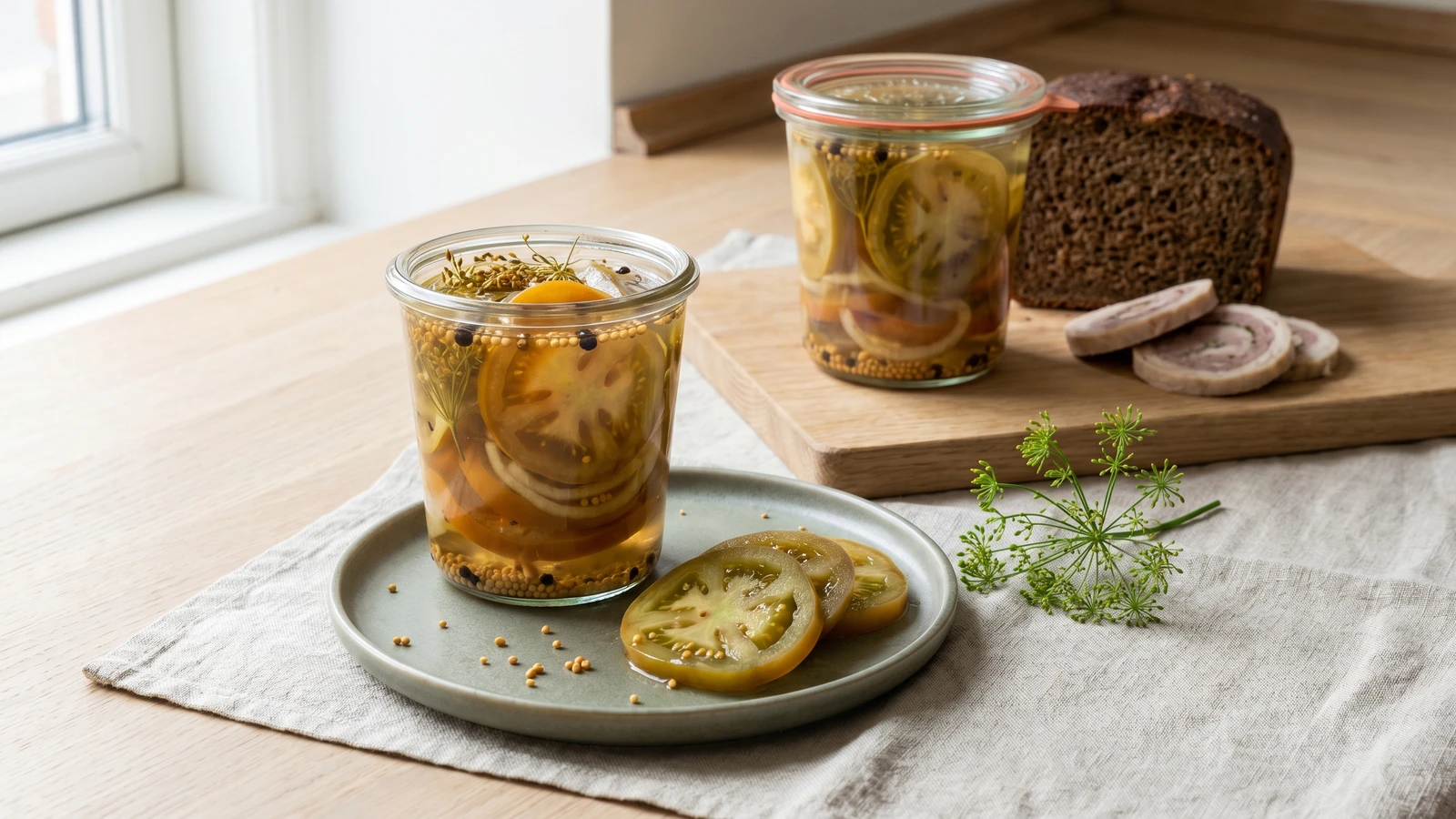
Syltede Grønne Tomater
Created by Chef Freja
Salt-drawn green tomatoes packed in spiced vinegar with mustard seed, dill, and bay. A gardener's answer to the August glut, waiting on the shelf for the winter cold-cut table.
Late August in a Danish garden is a negotiation with time. The tomatoes on the vine are still hard and green, and you know, watching the sky darken a little earlier each evening, that the warmth won't last long enough to ripen them all. This is not a loss. This is the moment syltning begins.
Syltede grønne tomater are a gardener's refusal to waste and a cook's gift to the months ahead. You slice them, draw out the moisture with salt overnight, then pack them into jars with a hot brine of vinegar, mustard seed, dill, and a few whole spices. The jars go to the shelf. By November, when the cold-cut table comes out for guests, leverpostej and rullepølse lined up on the board, you have something sharp, crisp, and bright that cuts through the richness the way a cold wind cuts through an open window. That contrast is the whole point.
The step that matters most is the salting. Don't skip it, don't shorten it. Salt draws the water from the tomatoes overnight, and that water is what would turn your pickle soft and your brine cloudy within a week. You want firm slices and a brine that stays clear. Give the salt its time and it does the work for you. The joy of waiting, as always, is that it pays you back. Two weeks on the shelf and the flavors settle. A month and they're something else entirely. You'll know when it's right.
Syltning, the art of pickling and preserving in vinegar, has been a cornerstone of the Danish kitchen since at least the 1700s, when the long winters made preservation not a hobby but a necessity. Green tomatoes arrived relatively late in the Danish preserving repertoire, as tomatoes themselves were viewed with suspicion in Scandinavia well into the 19th century, grown first as ornamental plants before anyone dared eat them. The tradition of pickling the unripened fruit likely reached Denmark through contact with German and Baltic preserving customs, and by the early 20th century syltede grønne tomater had earned a permanent place on the kolde bord, the cold table that anchors any proper Danish gathering.
The technique, the tradition, and the story behind every dish.
Discover Culinary AdvisorIngredients
firm green tomatoes
Quantity
1.5kg
sliced 5mm thick
coarse sea salt
Quantity
3 tablespoons
white onion
Quantity
1 large
sliced into thin rings
spirit vinegar or white wine vinegar
Quantity
500ml
granulated sugar
Quantity
200g
yellow mustard seeds
Quantity
2 tablespoons
dill seeds
Quantity
1 teaspoon
fresh dill crowns
Quantity
4-5 large sprigs
bay leaves
Quantity
2
whole black peppercorns
Quantity
1 teaspoon
whole allspice berries
Quantity
1 teaspoon
| Ingredient | Quantity |
|---|---|
| firm green tomatoessliced 5mm thick | 1.5kg |
| coarse sea salt | 3 tablespoons |
| white onionsliced into thin rings | 1 large |
| spirit vinegar or white wine vinegar | 500ml |
| granulated sugar | 200g |
| yellow mustard seeds | 2 tablespoons |
| dill seeds | 1 teaspoon |
| fresh dill crowns | 4-5 large sprigs |
| bay leaves | 2 |
| whole black peppercorns | 1 teaspoon |
| whole allspice berries | 1 teaspoon |
Equipment Needed
- •Large colander
- •Heavy-bottomed saucepan, 2 litre
- •4 glass preserving jars with lids, 500ml each
- •Clean kitchen towels
- •Ladle
Instructions
- 1
Salt the tomatoes
Spread the tomato slices in a single layer in a large colander set over a bowl. Sprinkle each layer evenly with the coarse salt, turning the slices so the salt touches every cut surface. Set the colander in the fridge, uncovered, and leave it overnight, or for at least ten hours. The salt pulls water from the flesh of the tomatoes, and you will be surprised by how much collects in the bowl below. That water is what would make your pickle soft and your brine diluted. By morning the slices should feel noticeably firmer, almost leathery at the edges. That's exactly what you want.
Use coarse salt, not fine table salt. Coarse salt draws moisture slowly and evenly. Fine salt dissolves too fast and can oversalt the surface before the interior has released its water. - 2
Rinse and dry
Rinse the salted tomato slices under cold running water to wash away the excess salt. Be thorough. Salt that remains on the surface will throw off the balance of the brine. Spread the rinsed slices on a clean kitchen towel and pat them dry, gently but completely. Wet tomatoes going into the jar will weaken the vinegar and compromise the preservation. The drier the slices, the crisper the finished pickle.
- 3
Sterilize the jars
Wash four 500ml glass preserving jars and their lids in hot soapy water and rinse well. Place the jars upside down on a baking tray and put them in a cold oven. Heat the oven to 120C and leave the jars for twenty minutes. Turn off the heat and leave them inside until you're ready to fill. The jars need to be hot when the brine goes in. A hot jar and hot brine together create the seal. A cold jar risks cracking and a poor seal.
Boil the lids separately in a small pan of water for five minutes. Rubber seals and metal clips don't belong in the oven. - 4
Make the brine
Pour the vinegar into a heavy saucepan and add the sugar, mustard seeds, dill seeds, bay leaves, peppercorns, and allspice berries. Bring everything to a simmer over medium heat, stirring until the sugar dissolves completely. Let the brine simmer gently for five minutes. The kitchen will smell sharply of vinegar and warm spice. That sharpness mellows in the jar over time, so don't worry that it seems aggressive now. The mustard seeds will pop and swell slightly. That means they're releasing their flavor into the liquid.
- 5
Pack the jars
Layer the dried tomato slices and onion rings into the hot jars, alternating as you go so the onion distributes evenly throughout. Tuck a dill crown into each jar, pushing it down along the glass where it will be visible. Pack firmlybut don't crush the slices. You want them snug enough that they won't float when the brine goes in, but loose enough that the liquid can reach every surface.
Stand the dill crowns upright against the inside of the glass. When the jar sits on your shelf, the dill fronds visible through the glass are half the beauty of the thing. - 6
Pour and seal
Ladle the hot brine over the packed tomatoes, filling each jar to within one centimeter of the rim. Make sure the liquid covers the tomatoes completely. Any slice sitting above the brine will discolor and may spoil. Distribute the whole spices evenly between the jars as you pour. Tap each jar gently on the counter to release any trapped air bubbles, then seal the lids tightly while everything is still hot. The heat creates a vacuum as the jars cool, and you'll hear the lids click inward over the next hour. That click is the sound of a good seal.
- 7
Store and wait
Let the sealed jars cool completely on the counter, then move them to a cool, dark shelf. The tomatoes need at least two weeks before they're ready. In that time the vinegar softens, the mustard seeds bloom, and the green slices take on a translucent amber edge that tells you the brine has done its work. A month is better. Two months is when they're truly at their best, firm and sharp and layered with spice. The season decides when you make them. Patience decides when you eat them.
Chef Tips
- •Choose the hardest, most stubbornly green tomatoes you can find. Any hint of pink or softening means the tomato has started to ripen, and ripe flesh turns to mush in vinegar. The ones at the back of the vine, the ones that never had a chance, are the ones you want.
- •Spirit vinegar, the clear Danish eddike you find in every supermarket, gives the cleanest brine. White wine vinegar is gentler and slightly rounder in flavor. Either works. Do not use apple cider vinegar or balsamic. They belong to other kitchens.
- •These are made for the kolde bord, the cold table. Serve them alongside leverpostej, cold roast pork, rullepølse, or good cheese on rugbrød. The sharpness of the pickle is designed to cut through richness. That's its purpose at the table.
- •If you have a garden that produces more green tomatoes than you know what to do with, double the recipe. The brine scales perfectly. Four jars is a start. Eight jars is a winter's supply, and you'll be grateful in January.
Advance Preparation
- •The tomatoes need overnight salting before jarring. Plan to start the salting in the evening and finish the recipe the following morning.
- •Sealed jars keep for up to a year in a cool, dark place. The flavor deepens over the first two months, then holds steady. Once opened, refrigerate the jar and use within four weeks.
- •These can be made any time from late August through the first frost, whenever your garden or market has firm green tomatoes. Earlier in the season the tomatoes are harder and give the crispest pickle.
Frequently Asked Questions
Nutrition Information
1 serving (about 125g)
Where cooking meets culture.
Culinary mentorship, cultural storytelling, and the editorial depth that makes cooking meaningful.
Explore Culinary Advisor