Culinary Advisor
A cooking platform built around craft, culture, and the stories behind what we eat.
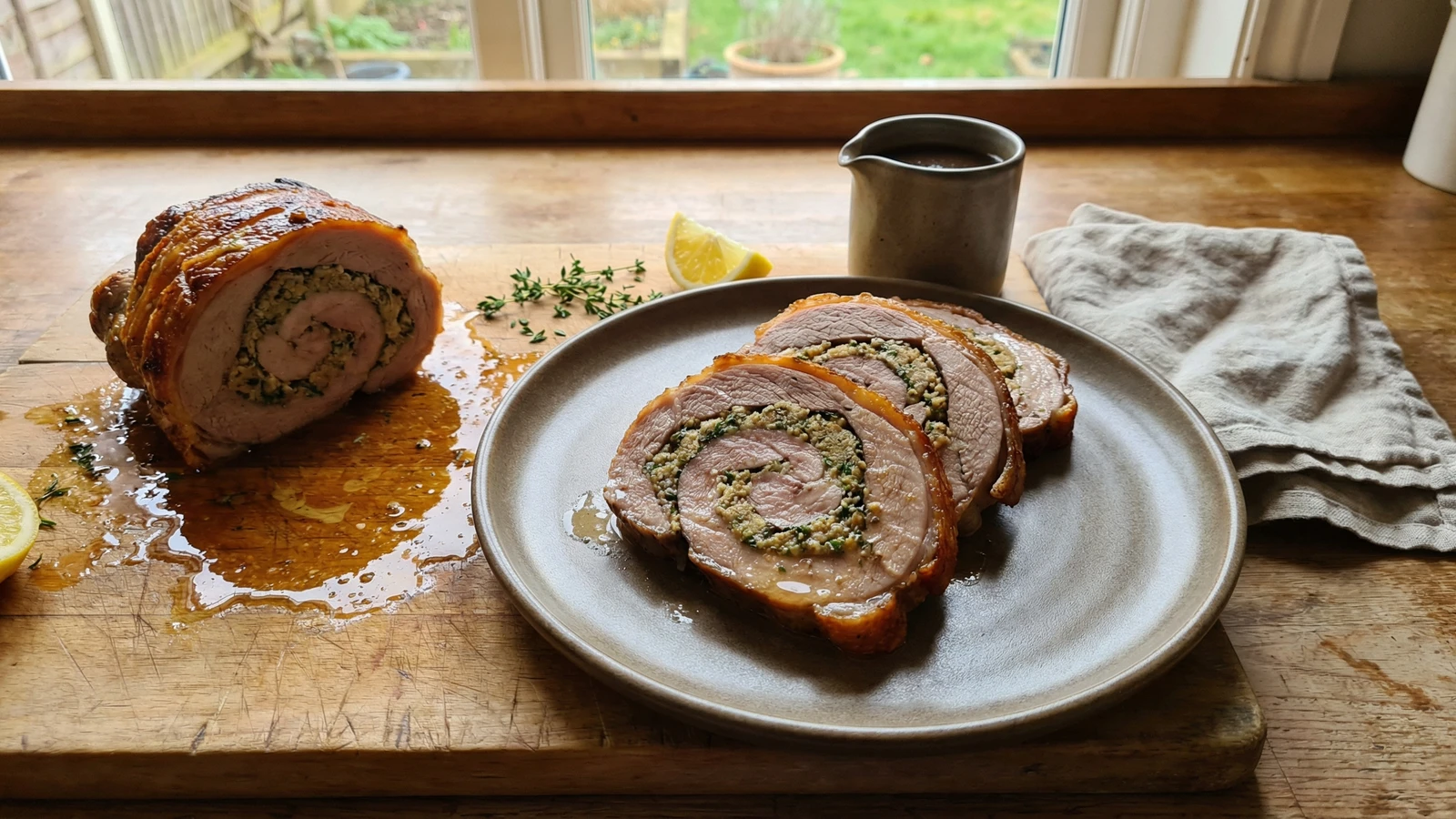
Stuffed Breast of Lamb with Herb Breadcrumbs
Created by Chef Thomas
A cheap, forgiving cut of lamb, stuffed with herbed breadcrumbs and slow-roasted until the fat renders to nothing and the outside turns golden and crisp. Thrift cooking at its most satisfying.
The breast is the cut nobody talks about. It costs almost nothing, sits there on the butcher's counter looking unpromising, a flat, fatty slab that most people walk past on their way to the leg or the shoulder. Their loss.
Boned and opened out, it takes a stuffing beautifully. Breadcrumbs made from yesterday's loaf, soft onion, garlic, and whatever herbs the garden has: parsley, rosemary, thyme. Roll it up, tie it with string, and give it time in a low oven. That's all it asks. The fat renders slowly, basting the meat from within, and by the time you turn the heat up at the end the outside has gone golden and crisp and the stuffing has absorbed all those lamb juices until it's savoury and rich and holds together in a neat spiral when you slice.
This is winter food. February, perhaps March, when the cold hasn't quite let go and you want something on the table that feels like it took more effort than it did. It's the kind of cooking that makes a small amount of money go a long way, and I'd rather eat this, honestly, than a more expensive cut cooked with less thought. I wrote it down in the notebook years ago. The note just says: "Lamb breast. Herbs. Tuesday. Worth remembering." It was.
A recipe is a conversation, not a contract. Use the herbs you have. Adjust the stuffing to your taste. The lamb will forgive you. We're only making dinner.
The technique, the tradition, and the story behind every dish.
Discover Culinary AdvisorIngredients
breast of lamb
Quantity
1, roughly 1kg
boned (ask your butcher)
fine sea salt
Quantity
to taste
black pepper
Quantity
to taste
fresh white breadcrumbs
Quantity
150g
onion
Quantity
1 small
finely chopped
garlic
Quantity
2 cloves
finely chopped
flat-leaf parsley
Quantity
large handful
roughly chopped
rosemary
Quantity
a few sprigs
needles stripped and finely chopped
thyme
Quantity
small bunch
leaves picked
lemon
Quantity
1, zest only
egg
Quantity
1
beaten
unsalted butter
Quantity
30g
olive oil
Quantity
1 tablespoon
| Ingredient | Quantity |
|---|---|
| breast of lambboned (ask your butcher) | 1, roughly 1kg |
| fine sea salt | to taste |
| black pepper | to taste |
| fresh white breadcrumbs | 150g |
| onionfinely chopped | 1 small |
| garlicfinely chopped | 2 cloves |
| flat-leaf parsleyroughly chopped | large handful |
| rosemaryneedles stripped and finely chopped | a few sprigs |
| thymeleaves picked | small bunch |
| lemon | 1, zest only |
| eggbeaten | 1 |
| unsalted butter | 30g |
| olive oil | 1 tablespoon |
Equipment Needed
- •Roasting tin with a wire rack
- •Butcher's string
- •Sharp carving knife
Instructions
- 1
Make the stuffing
Melt the butter in a small pan over a gentle heat. Add the onion with a pinch of salt and cook it slowly until it's soft and translucent, five minutes or so. Add the garlic for the last minute, stirring it through until it loses its rawness and the kitchen smells warm and savoury. Tip the lot into a bowl with the breadcrumbs, parsley, rosemary, thyme, and lemon zest. Season generously with salt and pepper. Add the beaten egg and mix with your hands until everything holds together loosely. It shouldn't be a paste. You want it crumbly but cohesive, something that stays where you put it when you press it gently.
Day-old bread makes the best breadcrumbs. Tear it into chunks and pulse in a food processor, or grate it on the coarse side of a box grater. Supermarket breadcrumbs from a packet will work, but they won't taste of much. - 2
Prepare the lamb
Lay the boned breast of lamb skin-side down on a board. If your butcher hasn't already, trim away any thick seams of hard fat, but leave a good layer. That fat is going to render in the oven and baste the meat from the inside. Season the exposed flesh well with salt and pepper. Spread the stuffing evenly over the meat, leaving a finger's width clear at the edges so it doesn't squeeze out when you roll.
- 3
Roll and tie
Starting from the shorter end, roll the breast up tightly, tucking the stuffing in as you go. Don't worry about perfection. It's a forgiving process. Tie the roll firmly with butcher's string at two-inch intervals, snipping the ends. It should look like a small, slightly rustic bolster. Rub the outside with olive oil and a good scattering of salt.
If you haven't tied a roast before, don't overthink it. Simple knots at regular intervals, pulled snug. The string just needs to hold the roll together while it cooks. It doesn't need to look professional. It needs to hold. - 4
Roast low and slow
Set the oven to 160C/140C fan. Place the lamb on a wire rack over a roasting tin, seam-side down. The rack matters because it lifts the meat out of the fat as it renders. Put it in the oven and leave it alone for two hours. No opening the door. No basting. The fat will do its work quietly. After two hours, the meat will be tender and the outside will be pale gold and slightly yielding.
- 5
Crisp the outside
Turn the oven up to 220C/200C fan. Roast for a final twenty to thirty minutes until the skin goes deep golden and properly crisp, the kind of surface that crackles when you press a knife against it. You'll hear the fat spitting. The kitchen will smell of roasted lamb and rosemary and something deeply Sunday, even if it's a Tuesday. Take it out and rest it on a board, loosely covered, for fifteen minutes. The resting is not optional. The juices need time to settle back into the meat.
Pour off the rendered fat from the roasting tin and keep it in a jar in the fridge. Lamb fat is extraordinary for roasting potatoes. It lasts for weeks and makes ordinary spuds taste like something from a better kitchen than yours. - 6
Carve and serve
Remove the string and carve the roll into thick slices, each one showing a spiral of herb-flecked stuffing inside the tender meat with its rim of golden, crisp fat. Serve on warm plates with whatever feels right: roasted roots, braised greens, a simple gravy made from the pan juices and a splash of stock. There are few better feelings than putting a warm plate of this in front of someone on a cold evening.
Chef Tips
- •Ask your butcher to bone the breast for you. Most will do it gladly and it saves you the trouble of working around the ribs yourself. Keep the bones for stock if they'll give them to you. A lamb stock made from those bones, some root vegetables, and a few hours of patience is a fine thing to have in the freezer.
- •The lemon zest in the stuffing isn't decoration. It cuts through the richness of the lamb fat and lifts everything. Don't skip it. A lemon costs pennies and earns its place here completely.
- •This is a patient dish, not a difficult one. The oven does the real work. Your job is the stuffing, the rolling, and knowing when to turn the heat up at the end. Trust your nose. When the kitchen smells deeply of roasted lamb and herbs and the fat is spitting in the tin, you're close.
- •Serve it with something sharp alongside. A mustardy green salad, braised red cabbage, or just a spoonful of good mint sauce. The lamb is rich. It wants contrast on the plate.
Advance Preparation
- •The stuffing can be made the day before and kept covered in the fridge. Bring it to room temperature before stuffing the lamb.
- •The lamb can be stuffed, rolled, and tied up to a day ahead, kept wrapped in the fridge. Take it out an hour before roasting to let it come to room temperature.
- •Leftovers are good cold the next day, sliced thinly and eaten in a sandwich with pickles and mustard. Possibly better than the first evening, though I've never been able to say that out loud at the table.
Frequently Asked Questions
Nutrition Information
1 serving (about 235g)
Where cooking meets culture.
Culinary mentorship, cultural storytelling, and the editorial depth that makes cooking meaningful.
Explore Culinary Advisor