Culinary Advisor
A cooking platform built around craft, culture, and the stories behind what we eat.
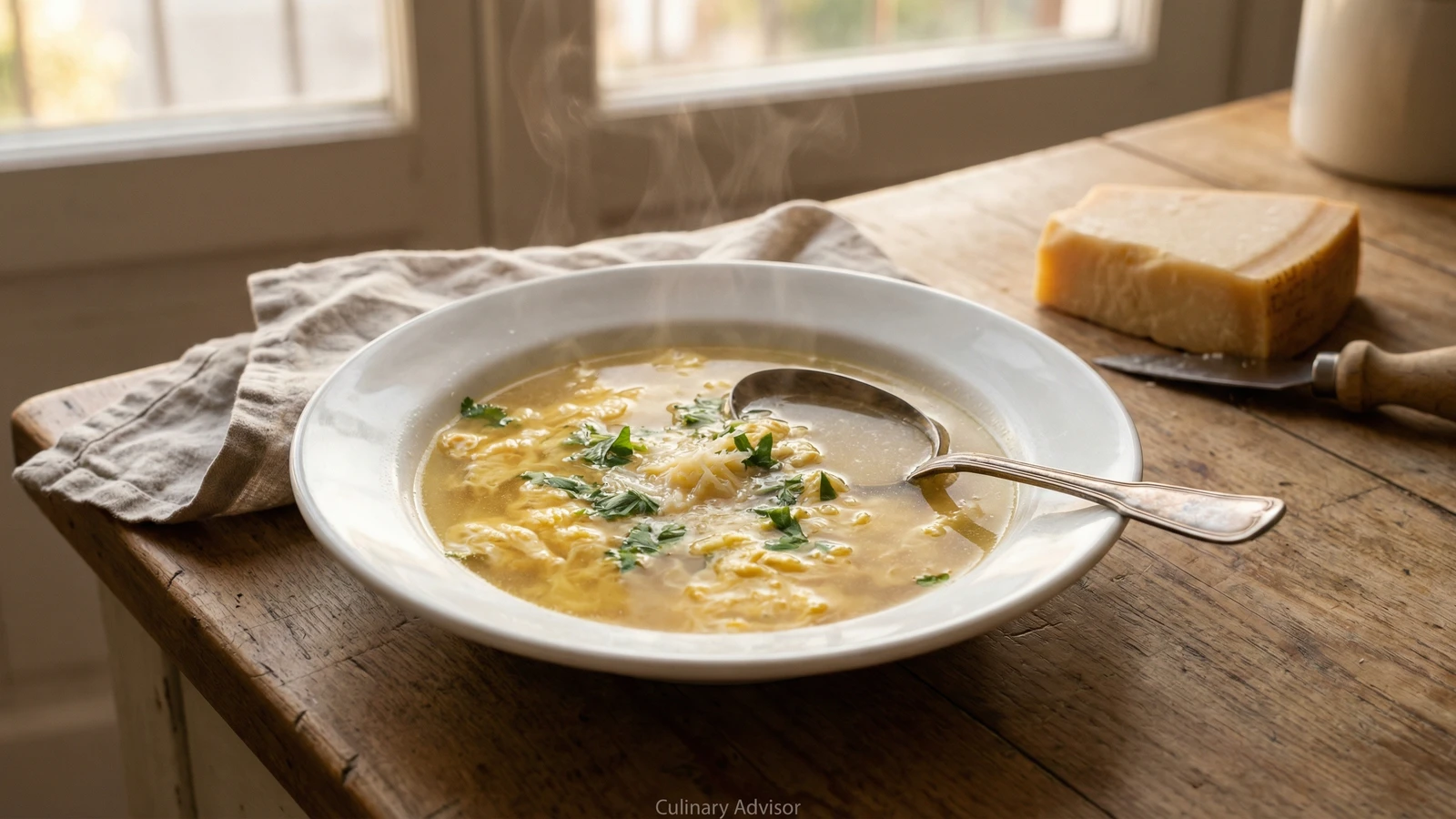
Stracciatella alla Romana
Created by Chef Graziella
The great restorative soup of Rome, where eggs and Parmigiano swirled into simmering broth prove that three ingredients and proper technique can create something profound.
In Italian cooking, there is no cream of anything soup. This is an American invention that has nothing to do with how Italians eat. What Italians do make, and have made for generations, are broths enriched with simple additions: a beaten egg, a grating of cheese, a handful of pasta. Stracciatella is perhaps the purest expression of this tradition.
The name means "little rags," and that is exactly what you will see when you make it correctly. The egg mixture, poured in a thin stream into simmering broth while you stir with a fork, sets into delicate shreds that float like wisps of silk. The Parmigiano melts into the broth, lending richness without weight. The nutmeg provides a whisper of warmth.
This is the soup Roman mothers make when someone is unwell. It is the soup you eat after a long day when you want comfort without labor. It takes fifteen minutes from start to table, and nearly all of that time is just heating the broth. Simple does not mean easy, but in this case, it comes close.
Stracciatella appears in Roman cookbooks dating to the late 19th century, though the technique of enriching broth with beaten eggs is far older. The addition of semolina distinguishes the Roman version from similar preparations across central Italy. In the trattorias of Trastevere, it remains a standard first course, unchanged from what grandmothers served a century ago.
The technique, the tradition, and the story behind every dish.
Discover Culinary AdvisorIngredients
homemade chicken broth
Quantity
6 cups
large eggs
Quantity
3
Parmigiano-Reggiano
Quantity
3 tablespoons, plus more for serving
freshly grated
fine semolina
Quantity
1 tablespoon
nutmeg
Quantity
1/8 teaspoon
freshly grated
flat-leaf parsley
Quantity
1 tablespoon
finely chopped
kosher salt
Quantity
to taste
| Ingredient | Quantity |
|---|---|
| homemade chicken broth | 6 cups |
| large eggs | 3 |
| Parmigiano-Reggianofreshly grated | 3 tablespoons, plus more for serving |
| fine semolina | 1 tablespoon |
| nutmegfreshly grated | 1/8 teaspoon |
| flat-leaf parsleyfinely chopped | 1 tablespoon |
| kosher salt | to taste |
Equipment Needed
- •Medium 3-quart saucepan
- •Fork for beating and stirring
- •Small mixing bowl
Instructions
- 1
Prepare the egg mixture
In a small bowl, beat the eggs thoroughly with a fork. Add the Parmigiano-Reggiano, semolina, nutmeg, and parsley. Beat again until completely combined. The mixture should be smooth and homogeneous. Set aside.
The semolina gives the egg ribbons body and prevents them from dissolving into the broth. Some Roman cooks use fine breadcrumbs instead. Both are correct. - 2
Heat the broth
Pour the chicken broth into a medium saucepan and bring it to a steady simmer over medium heat. Taste it. If it needs salt, add it now. The broth must be properly seasoned before you add the eggs, because afterward it is too late.
Your broth is everything here. There is nothing to hide behind. If you are using store-bought broth, choose the best you can find and taste it critically before proceeding. - 3
Create the straccetti
When the broth is simmering steadily, pour the egg mixture into it in a thin stream while stirring constantly with a fork in the same direction. Continue stirring for exactly two minutes. The eggs will set into delicate ribbons and shreds, which is what stracciatella means: little rags. The broth should remain clear, with the egg floating in wispy strands.
- 4
Serve immediately
Remove from heat the moment the eggs are set. Ladle into warm bowls and serve at once, passing additional Parmigiano-Reggiano at the table. This soup waits for no one. The eggs continue to cook in the hot broth, and the magic of those delicate ribbons lasts only minutes.
Chef Tips
- •The broth must simmer, not boil. Boiling broth produces tough, rubbery egg strands rather than delicate ribbons. Watch the pot and adjust the heat.
- •Stir in one direction only, and use a fork rather than a spoon. The tines of the fork separate the egg into fine shreds. A spoon creates clumps.
- •Grate your own Parmigiano-Reggiano from a wedge. The pre-grated cheese in containers contains cellulose to prevent clumping, and it does not melt properly into the eggs.
- •Chopped parsley here means chopped flat-leaf Italian parsley leaves. Curly parsley has no place in Italian cooking.
Advance Preparation
- •The broth can be made days ahead and refrigerated, or months ahead and frozen. In fact, it should be. Homemade broth is the foundation.
- •The egg mixture can be prepared up to one hour ahead and refrigerated. Bring it to room temperature before adding to the hot broth.
- •The finished soup cannot wait. It must be served immediately upon completion.
Frequently Asked Questions
Nutrition Information
1 serving (about 375g)
Where cooking meets culture.
Culinary mentorship, cultural storytelling, and the editorial depth that makes cooking meaningful.
Explore Culinary Advisor