Culinary Advisor
A cooking platform built around craft, culture, and the stories behind what we eat.
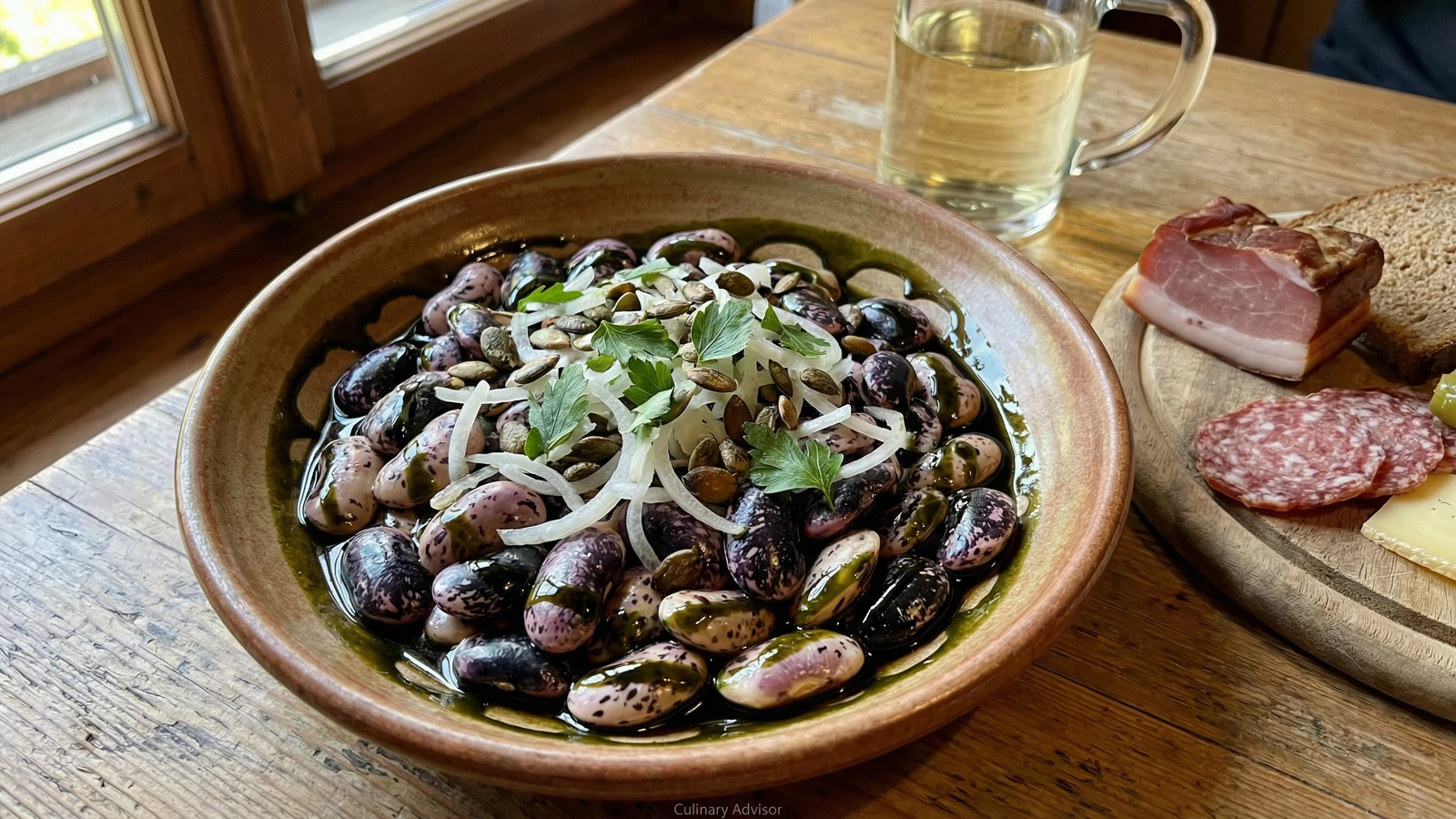
Steirischer Käferbohnensalat
Created by Chef Elsa
Speckled Käferbohnen in a sharp vinegar Marinade, finished with a generous pour of dark Steirisches Kürbiskernöl. The salad that anchors every Styrian Brettljause and proves legumes need nothing but honesty.
The first time I tasted Käferbohnensalat I was maybe ten years old, sitting at a wooden table outside a Buschenschank in southern Styria with Gretel and my grandmother Eva. Gretel ordered a Brettljause, and when it arrived, this salad sat right in the middle of the board between the Verhackert and the sliced Schweinsbraten. Creamy speckled beans in a pool of something so dark green it was nearly black. I dipped my bread in the oil before I even tried the beans. Gretel laughed and said that was exactly the right instinct.
Käferbohnen are runner beans, large and beautiful, with purple and black speckles across a pale skin that looks almost hand-painted. Styrians grow them on tall poles in kitchen gardens and along farm fences. When dried, they keep for months. When cooked, they turn creamy and dense with a flavour somewhere between chestnut and butter bean, but earthier than either. They hold a Marinade the way good bread holds soup: completely, without falling apart.
The dressing is vinegar-forward, as all Austrian salad Marinades should be. Sharp Apfelessig, thinly sliced white onion, salt, pepper, and then the Kürbiskernöl poured on at the very end. The oil is never mixed into the dressing. It sits on top, dark and glossy, swirling into the vinegar when you take your first forkful. This is the simplest salad in the Styrian kitchen and one of the best things I know how to make.
Käferbohnen have been cultivated in Styria since the 17th century, brought to Austria from the Americas via Spain. The name means 'beetle beans,' referring to their speckled markings that resemble beetle wings. Steirisches Kürbiskernöl g.g.A. received protected geographical indication status from the EU in 1996, recognizing that genuine pumpkin seed oil can only come from a specific variety of hull-less pumpkin (Cucurbita pepo var. styriaca) grown and pressed in designated Austrian regions. Together, the beans and the oil form what Styrians consider their most distinctive culinary pairing, served at nearly every Buschenschank and Heuriger in the province.
The technique, the tradition, and the story behind every dish.
Discover Culinary AdvisorIngredients
Käferbohnen (scarlet runner beans)
Quantity
250g dried
bay leaf
Quantity
1
white onion
Quantity
1 medium
halved and very thinly sliced into half-moons
Apfelessig (apple cider vinegar)
Quantity
3 tablespoons
Dijon mustard or mild Austrian Senf
Quantity
1 teaspoon
granulated sugar
Quantity
1/2 teaspoon
fine sea salt
Quantity
to taste
black pepper
Quantity
freshly ground, to taste
Steirisches Kürbiskernöl g.g.A. (Styrian pumpkin seed oil)
Quantity
3 tablespoons
neutral oil (sunflower or rapeseed)
Quantity
1 tablespoon
fresh flat-leaf parsley
Quantity
1 small handful
roughly chopped
roasted pumpkin seeds (Kürbiskerne) (optional)
Quantity
for finishing
| Ingredient | Quantity |
|---|---|
| Käferbohnen (scarlet runner beans) | 250g dried |
| bay leaf | 1 |
| white onionhalved and very thinly sliced into half-moons | 1 medium |
| Apfelessig (apple cider vinegar) | 3 tablespoons |
| Dijon mustard or mild Austrian Senf | 1 teaspoon |
| granulated sugar | 1/2 teaspoon |
| fine sea salt | to taste |
| black pepper | freshly ground, to taste |
| Steirisches Kürbiskernöl g.g.A. (Styrian pumpkin seed oil) | 3 tablespoons |
| neutral oil (sunflower or rapeseed) | 1 tablespoon |
| fresh flat-leaf parsleyroughly chopped | 1 small handful |
| roasted pumpkin seeds (Kürbiskerne) (optional) | for finishing |
Equipment Needed
- •Large pot for cooking beans
- •Wide shallow serving bowl
- •Small whisk or fork for the Marinade
Instructions
- 1
Soak the beans overnight
Place the dried Käferbohnen in a large bowl and cover with plenty of cold water, at least three times their volume. They will swell to nearly double their size. Leave them on the counter overnight, or for at least eight hours. Don't skip the soak. Käferbohnen are dense, thick-skinned beans and they need time to hydrate evenly. If you try to rush them, you'll end up with beans that are chalky in the center and splitting at the edges.
If you can find fresh Käferbohnen in season (late summer into autumn), use them. They cook in about half the time and the flavour is sweeter and more delicate. Skip the soak entirely with fresh beans. - 2
Cook the beans gently
Drain and rinse the soaked beans. Place them in a large pot, cover with fresh cold water by about five centimeters, and add the bay leaf. Bring to a gentle simmer over medium heat, then reduce the heat to low. The surface should barely move. Cook for sixty to ninety minutes, checking after an hour. The beans are done when they're completely tender and creamy inside but still holding their shape. Bite one in half. If there's any graininess at the center, keep going. Do not salt the water. Salt toughens the skins of cooking beans and you'll wait forever for them to soften.
Every batch of dried beans cooks differently depending on age. Beans from last year's harvest cook faster. If yours have been sitting in a cupboard for two years, be patient. They'll get there. - 3
Dress the beans while warm
Drain the beans and discard the bay leaf. While they are still warm, transfer them to a wide bowl. This is the most important moment in the recipe. Warm beans absorb a Marinade. Cold beans sit in it. In a small bowl, whisk together the Apfelessig, mustard, sugar, a good pinch of salt, several grinds of black pepper, and the neutral oil. Pour this Marinade over the warm beans and fold gently with a spoon, taking care not to crush them. Käferbohnen are tender once cooked and they break easily.
The neutral oil is there for body. The Kürbiskernöl comes later and is never whisked into the dressing. Heating or emulsifying Kürbiskernöl kills its flavour and turns it bitter. It goes on at the end, raw and dark. - 4
Add the onion and marinate
Scatter the thinly sliced onion over the dressed beans and fold it through. The slices should be thin enough to soften in the residual warmth and the acid of the vinegar. Let the salad sit at room temperature for at least thirty minutes, giving it a gentle stir halfway through. The beans will drink up the Marinade and the onion will lose its raw edge. Taste and adjust the salt and vinegar. Austrian salad Marinades are vinegar-forward. If it doesn't taste a little sharp on its own, it will taste flat once the beans absorb it.
- 5
Finish with Kürbiskernöl
Just before serving, scatter the chopped parsley over the salad. Pour the Steirisches Kürbiskernöl over the top in a slow, generous drizzle. Do not stir it in. The oil should pool and swirl across the surface, dark green verging on black, catching the light. Scatter a few roasted Kürbiskerne on top if you have them. Serve at room temperature. This is a salad that does not want to be cold. The flavour opens up when the beans are somewhere between warm and cool, and the Kürbiskernöl tastes richest at room temperature. Mahlzeit!
Chef Tips
- •Buy real Steirisches Kürbiskernöl g.g.A. It's not cheap, but nothing else tastes like it. The oil should be so dark it looks black in the bottle and deep emerald green when you hold it up to the light. If the label doesn't say 'g.g.A.' or 'geschützte geographische Angabe,' it's not the real thing and it will taste like disappointment.
- •Gretel always said the Marinade should be dressed on the beans, not the other way around. You pour it over while they're warm and let them take it in. If you dress cold beans, the salad will taste like vinegar sitting on top of something bland.
- •This salad improves overnight. Make it in the evening, leave it covered at room temperature for an hour, then refrigerate. The next day, bring it back to room temperature thirty minutes before serving and add the Kürbiskernöl fresh. The beans will have absorbed everything and the flavour will be deeper.
- •If you can't find Käferbohnen, large butter beans (gigantes) are the closest substitute. The texture is similar, creamy and dense, though the flavour is milder. What you lose in earthiness, the Kürbiskernöl will partly make up for.
Advance Preparation
- •Beans can be cooked up to two days ahead and refrigerated in their cooking liquid. Drain and bring to room temperature before dressing.
- •The dressed salad (without the Kürbiskernöl) can be made the night before and refrigerated. Add the oil just before serving. The oil goes on last, always fresh, always at room temperature.
Frequently Asked Questions
Nutrition Information
1 serving (about 215g)
Where cooking meets culture.
Culinary mentorship, cultural storytelling, and the editorial depth that makes cooking meaningful.
Explore Culinary Advisor