Culinary Advisor
A cooking platform built around craft, culture, and the stories behind what we eat.
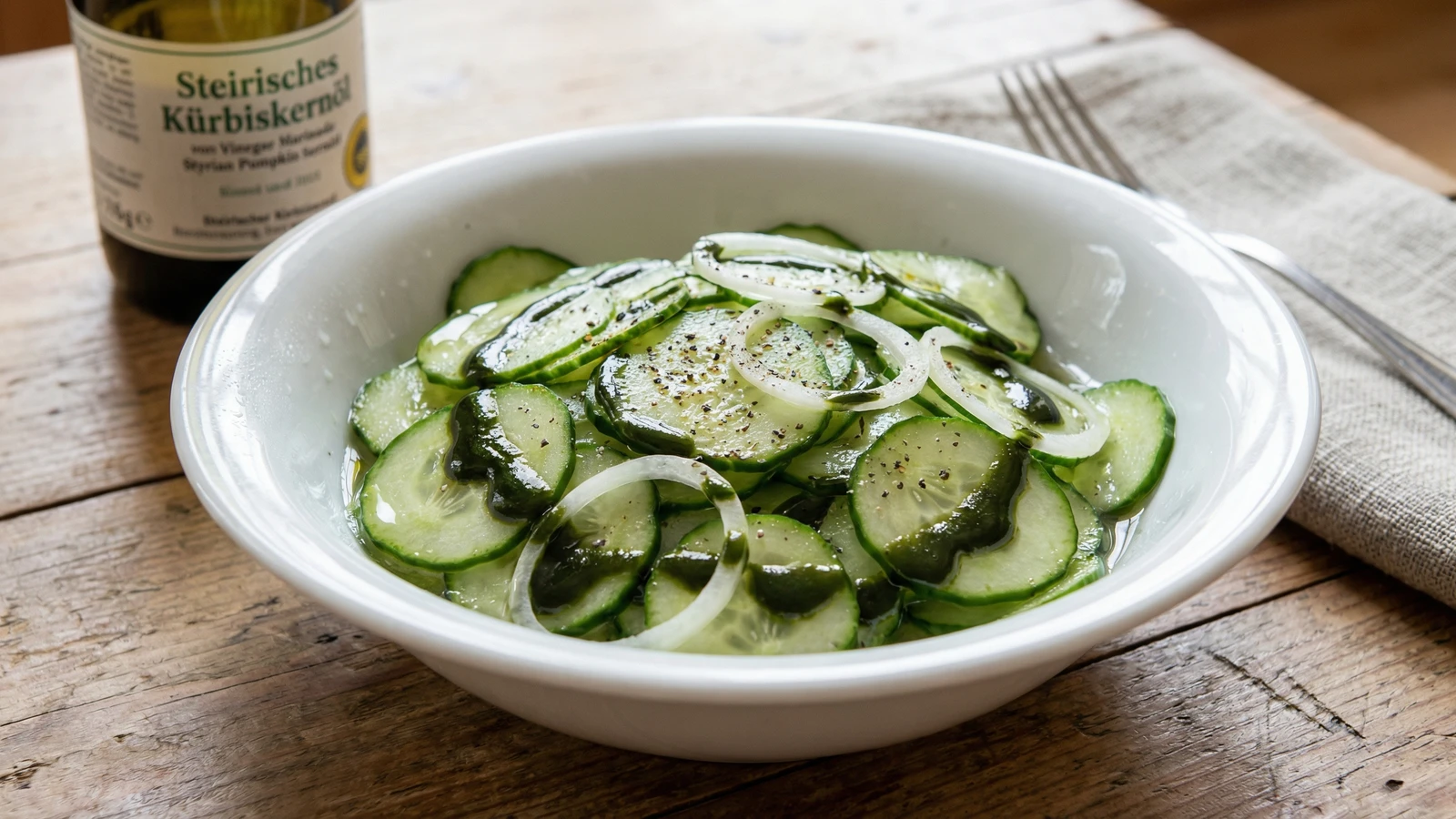
Steirischer Gurkensalat mit Kernöl
Created by Chef Elsa
Paper-thin cucumbers dressed sharp with Apfelessig and finished with a swirl of dark Steirisches Kürbiskernöl, the nutty, ink-green oil that makes everything it touches unmistakably Styrian.
The first time I saw Kernöl poured over a salad, I was maybe eight years old, sitting at a wooden table somewhere in the Salzkammergut on one of those summer trips with Gretel and my grandmother Eva. A woman at the next table drizzled something nearly black over sliced cucumbers and I thought she'd ruined them. Eva saw my face and laughed. She ordered the same salad for me. One bite and I understood. That dark, nutty oil tasted like nothing I'd ever had. I've been in love with it since.
Steirischer Gurkensalat is the salad Austrians eat all summer long. You'll find it on every Gasthaus menu in Styria from June through September, and in my restaurant in Salzburg it's on the table before you've even decided what else you want. The cucumbers must be sliced paper-thin, almost translucent. The Marinade is sharp with good cider vinegar, softened by a whisper of sugar, and thinned with a splash of water so it soaks into every slice. Then, right before serving, you pour the Kernöl over the top in a dark green swirl and let it sit there, glistening.
Gretel always said Austrian salads are honest food. No thick dressings hiding what's underneath. No complicated technique standing between you and the ingredient. Good cucumbers, good vinegar, good oil. That's the whole secret. The Kernöl does the talking, and if you've never tasted Steirisches Kürbiskernöl before, this salad is the place to start.
Styria, Austria's southeastern province, has been cultivating a specific hull-less pumpkin seed (Cucurbita pepo var. styriaca) since the 18th century, when a natural mutation produced seeds without their hard outer shell. The dark green oil pressed from these seeds received the European Union's protected geographical indication (g.g.A.) in 1996, meaning only oil produced in designated regions of Styria, Lower Austria, Burgenland, and Vienna from these specific pumpkin seeds can carry the name Steirisches Kürbiskernöl g.g.A. Styrians treat it the way Tuscans treat their olive oil: a finishing condiment, never heated, poured generously over salads, soups, and even vanilla ice cream.
The technique, the tradition, and the story behind every dish.
Discover Culinary AdvisorIngredients
European cucumbers
Quantity
2 large (about 800g total)
fine salt
Quantity
1 1/2 teaspoons
for drawing out moisture
Apfelessig (apple cider vinegar)
Quantity
4 tablespoons
cold water
Quantity
2 tablespoons
granulated sugar
Quantity
1/2 teaspoon
garlic (optional)
Quantity
1 small clove
finely grated
freshly ground black pepper
Quantity
to taste
Steirisches Kürbiskernöl g.g.A. (Styrian pumpkin seed oil)
Quantity
3 tablespoons
white or sweet onion
Quantity
1 small
sliced into very thin rings
| Ingredient | Quantity |
|---|---|
| European cucumbers | 2 large (about 800g total) |
| fine saltfor drawing out moisture | 1 1/2 teaspoons |
| Apfelessig (apple cider vinegar) | 4 tablespoons |
| cold water | 2 tablespoons |
| granulated sugar | 1/2 teaspoon |
| garlic (optional)finely grated | 1 small clove |
| freshly ground black pepper | to taste |
| Steirisches Kürbiskernöl g.g.A. (Styrian pumpkin seed oil) | 3 tablespoons |
| white or sweet onionsliced into very thin rings | 1 small |
Equipment Needed
- •Mandoline slicer or very sharp knife
- •Large mixing bowl
- •Small whisk
Instructions
- 1
Slice the cucumbers paper-thin
Peel the cucumbers if the skin is thick or waxy. If you're lucky enough to have thin-skinned ones from a garden or a farmers' market, leave them. Slice them as thin as you possibly can, ideally on a mandoline. You want translucent rounds you could nearly read a newspaper through. This is not a rough chop salad. The paper-thin slices are the whole point because they absorb the Marinade completely, and every bite delivers the full vinegar and oil flavor instead of just tasting like cucumber.
A mandoline slicer makes this effortless. If you're using a knife, keep the blade sharp and go slowly. The thinner the slices, the better the finished salad. Thick slices will not absorb the Marinade properly and you'll end up with crunchy discs sitting in a puddle of dressing. - 2
Salt and press the cucumbers
Place the cucumber slices in a large bowl and sprinkle with the salt. Toss gently with your hands so every slice gets coated. Let them sit for fifteen to twenty minutes. The salt draws out the water that would otherwise dilute your Marinade and leave you with a soggy puddle at the bottom of the bowl. After twenty minutes, take handfuls of the salted cucumbers and squeeze them firmly over the sink. Be thorough. You want to press out as much liquid as possible. The cucumbers should feel limp and pliable, not crisp.
Don't skip the squeezing. Austrian cooks press their Gurkensalat hard. You'll be surprised how much water comes out of those thin slices. If you're timid with this step, the salad will be watery no matter how good your Marinade is. - 3
Make the Marinade
Whisk together the Apfelessig, cold water, sugar, grated garlic if using, and a generous grinding of black pepper. The dressing should taste sharp and bright. The water thins it just enough that it coats the cucumbers instead of pooling at the bottom. The sugar is there to round the vinegar's edges, not to make it sweet. If you can taste sweetness, you've added too much.
Use proper Apfelessig or a mild cider vinegar with some character. White wine vinegar works in a pinch but lacks the apple-round warmth that makes this Marinade feel right. Distilled white vinegar is too harsh. Don't use it. - 4
Dress and marinate
Put the squeezed cucumbers in a clean bowl with the thin onion rings. Pour the Marinade over them and toss gently but thoroughly. Cover and let the salad sit in the fridge for at least thirty minutes before serving. An hour is better. This resting time lets the cucumbers drink up the Marinade. Taste and adjust the seasoning. It should be clearly vinegar-forward with a gentle background sweetness.
- 5
Finish with Kernöl and serve
Just before serving, drizzle the Steirisches Kürbiskernöl over the top. Don't toss it in. Let it pool and swirl in dark green ribbons over the pale cucumber slices. Serve the salad cool, straight from the fridge. The Kernöl is never mixed through aggressively. It sits on top, thick and nutty and beautiful, and every forkful picks up a different amount. That variation is part of the pleasure.
Kernöl is a finishing oil only. Never heat it, never cook with it. Heat destroys the delicate roasted-nut flavor and turns it bitter. It goes on at the table, at the very end, and nowhere else.
Chef Tips
- •Buy Steirisches Kürbiskernöl g.g.A. and accept no substitutes. The bottle will have the red and gold g.g.A. seal. Generic 'pumpkin seed oil' from the health food shop is not the same thing. The Styrian oil is pressed from roasted, hull-less seeds and it tastes like toasted hazelnuts and dark chocolate. Other pumpkin seed oils taste like grass clippings.
- •This salad is best eaten the day it's made. By the second day, the cucumbers have released more water and the texture goes soft. If you need to make it ahead, slice and salt the cucumbers, squeeze them, and keep them separate from the Marinade until an hour before serving.
- •In Styria, this salad is part of almost every Gemischter Salat (mixed salad plate) alongside shredded carrot salad, warm potato salad, and shredded white cabbage. If you want to eat like a Styrian, make three or four small salads and arrange them side by side on one plate.
- •The garlic is traditional in many Styrian households but not universal. If you use it, grate it on a Microplane so it dissolves into the Marinade. A visible chunk of garlic in a cucumber salad means you've been careless.
Advance Preparation
- •Cucumbers can be sliced, salted, and squeezed up to four hours ahead. Store them in the fridge, undressed, until you're ready to add the Marinade.
- •The Marinade can be whisked together and refrigerated a day ahead. Give it a stir before using.
- •Add the Kernöl only at the moment of serving. It loses its visual impact and its flavor fades if it sits in the vinegar too long.
Frequently Asked Questions
Nutrition Information
1 serving (about 225g)
Where cooking meets culture.
Culinary mentorship, cultural storytelling, and the editorial depth that makes cooking meaningful.
Explore Culinary Advisor