Culinary Advisor
A cooking platform built around craft, culture, and the stories behind what we eat.
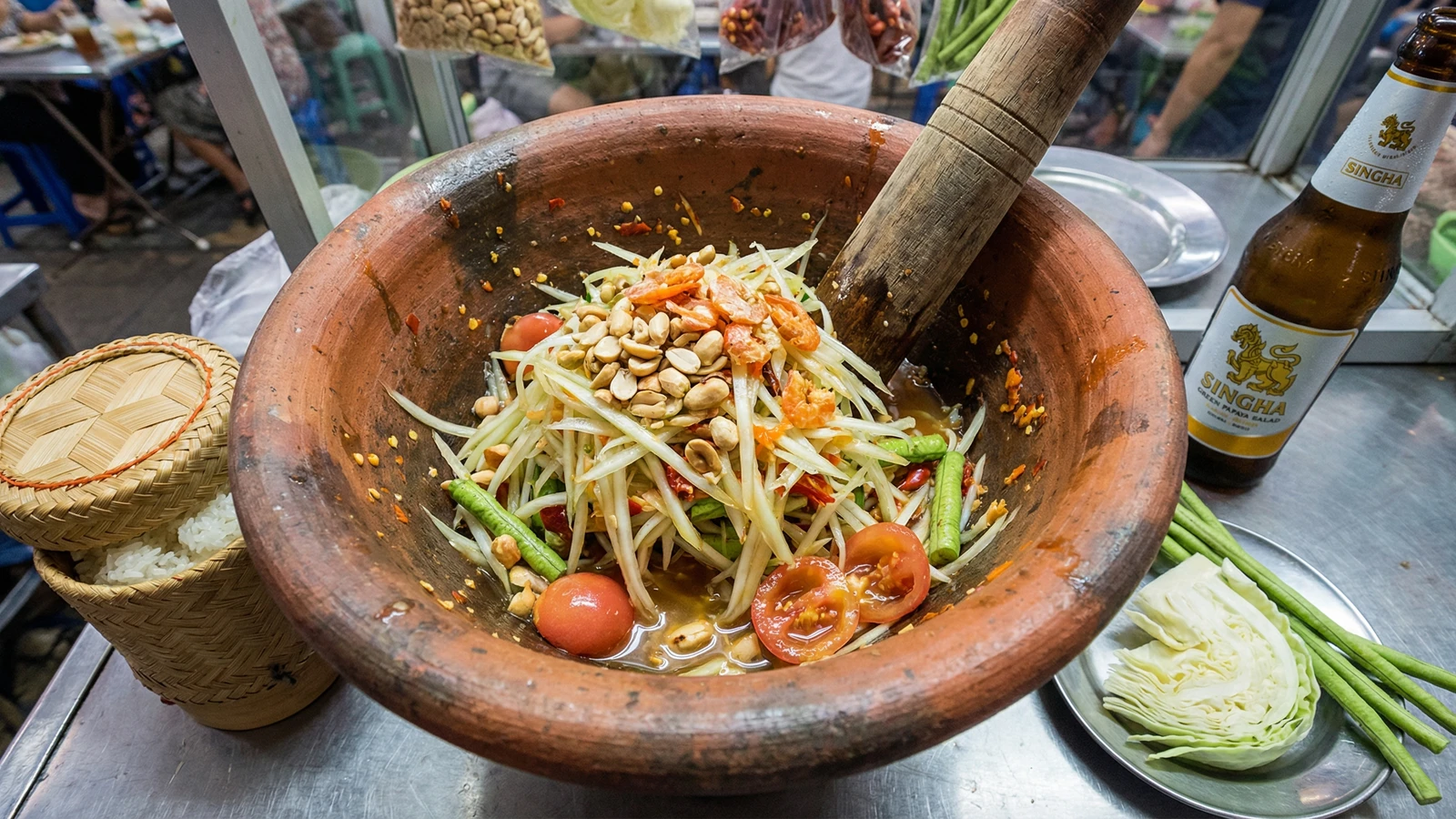
Green Papaya Salad (Som Tam Thai ส้มตำไทย)
Created by
Every strand of papaya bruised in the krok din, dressed with the four pillars in real time: nam pla for salt, nam tan pip for sweet, manao for sour, prik for heat. The Central Thai version softens the punch with peanuts and dried shrimp. Same system, different ratio.
Four ingredients govern all of Thai cuisine. Fish sauce for salt. Palm sugar for sweet. Lime for sour. Chili for heat. Ajarn McDang drilled that into me before I was allowed to touch a mortar. Som tam Thai is the clearest expression of that system you'll ever find, all four pillars working simultaneously in a single dish, adjusted by feel, balanced by taste, built in the krok din (clay mortar with wooden pestle) right in front of whoever's eating it.
Som tam Thai is not the original. Let's get that straight. The original is Isan. The original uses pla ra (fermented fish), sometimes raw field crab, less sugar, more funk. When the dish migrated to Central Thailand with Isan workers, Bangkok adapted it. Peanuts went in. Dried shrimp went in. The palm sugar went up. The fermented fish came out. The result is som tam Thai: sweeter, rounder, more approachable, but still governed by the same four-pillar framework and the same mortar technique.
And that technique is everything. Som tam is not a salad you toss in a bowl. It's a pounded dish. The word "tam" (ตำ) means to pound. The krok din bruises every strand of green papaya so it softens just enough to absorb the dressing while keeping its crunch. The garlic and chilies are crushed, not minced. The peanuts and dried shrimp crack open and release their oils. A food processor or a zip-lock bag with a rolling pin gives you something that looks like som tam. It isn't. The texture is wrong. The integration is wrong. The result is wrong. Krok ก่อน, krok ก่อน.
I grew up watching my mother do this six days a week at our stall in Khlong Toei market. She never measured. She'd ask each customer: how many chilies? How sour? She'd pound, taste, adjust. Pound, taste, adjust. That loop is the method. The recipe gives you the ratio. Your palate gives you the finish. That's how Thai food works. Principles, not recipes.
Som tam originated in Isan (northeastern Thailand) and Laos, where green papaya grows wild and abundantly. As Isan migrant workers moved to Bangkok for factory and construction jobs from the 1960s onward, they brought the dish with them, and Central Thai palates reshaped it. Som tam Thai, the version with peanuts, dried shrimp, and a sweeter dressing, emerged as the Bangkok adaptation, while the Isan original (som tam lao or som tam pla ra) retained its pla ra and raw crab. Today, the Thai version is the most widely known internationally, though som tam vendors across Bangkok still offer both styles side by side, and a customer's choice between "Thai" and "Lao" often signals regional identity as much as flavor preference.
The technique, the tradition, and the story behind every dish.
Discover Culinary AdvisorIngredients
green papaya (malakor)
Quantity
2 cups
shredded into long thin strands
garlic
Quantity
3 cloves
peeled
bird's eye chilies (prik khi nu)
Quantity
3-5
stems removed
dried shrimp (goong haeng)
Quantity
2 tablespoons
unsalted roasted peanuts
Quantity
2 tablespoons
cherry tomatoes
Quantity
6
halved
long beans (thua fak yao)
Quantity
2
cut into 1.5-inch pieces
fish sauce (nam pla)
Quantity
2 tablespoons
palm sugar (nam tan pip)
Quantity
2 tablespoons
shaved or softened
lime juice (nam manao)
Quantity
3 tablespoons (about 2-3 limes)
sticky rice (khao niew)
Quantity
for serving
raw vegetables (optional)
Quantity
for serving
cabbage wedges, long beans, morning glory
| Ingredient | Quantity |
|---|---|
| green papaya (malakor)shredded into long thin strands | 2 cups |
| garlicpeeled | 3 cloves |
| bird's eye chilies (prik khi nu)stems removed | 3-5 |
| dried shrimp (goong haeng) | 2 tablespoons |
| unsalted roasted peanuts | 2 tablespoons |
| cherry tomatoeshalved | 6 |
| long beans (thua fak yao)cut into 1.5-inch pieces | 2 |
| fish sauce (nam pla) | 2 tablespoons |
| palm sugar (nam tan pip)shaved or softened | 2 tablespoons |
| lime juice (nam manao) | 3 tablespoons (about 2-3 limes) |
| sticky rice (khao niew) | for serving |
| raw vegetables (optional)cabbage wedges, long beans, morning glory | for serving |
Equipment Needed
- •Large clay mortar with wooden pestle (krok din ครกดิน), at least 8 inches diameter
- •Long spoon for tossing (metal or wooden)
- •Thai papaya shredder or sharp knife for shredding
Instructions
- 1
Pound garlic and chilies
Drop the garlic cloves and bird's eye chilies into the clay mortar (krok din). Pound them to a rough paste with the wooden pestle. Not smooth. Not uniform. You want the garlic crushed and the chilies broken open, releasing their oils and seeds into the mortar. The aroma should hit you immediately: sharp, raw, aggressive. That's your aromatic base. Every som tam starts here. Every tam in this collection starts here. Garlic and chili, pounded first, always.
Start with 3 chilies if you're cautious. My mother's customers in Khlong Toei would ask for 10 or more. Your tolerance, your call. But the heat has to be present. It's one of the four pillars. Zero chilies is not som tam. - 2
Bruise the long beans
Add the long bean pieces to the mortar. Give them 4-5 firm strikes with the pestle. You're bruising, not mashing. The beans should crack slightly and soften, with some pieces splitting open and others staying mostly intact. This irregular texture is the point. If everything is the same size and consistency, you're pounding too hard.
- 3
Crack the dried shrimp and peanuts
Add the dried shrimp and roasted peanuts. Pound lightly, 3-4 strikes, just enough to crack them open. The peanuts should break into halves and rough pieces, not crumbs. The dried shrimp should split and start releasing their briny, toasty aroma into the mortar. These two ingredients are what make it som tam Thai instead of som tam Isan. They add sweetness, crunch, and a layer of protein richness that the Isan version gets from pla ra and crab instead.
Use good dried shrimp. They should be orange-pink and smell like the ocean, not fishy or stale. If they smell off, they are off. Toss them. Bad dried shrimp will ruin the whole dish. - 4
Build the dressing in the mortar
Add the palm sugar, fish sauce, and lime juice directly into the mortar. Use the pestle to stir and dissolve the palm sugar into the liquid. This is your dressing forming in real time: nam pla for salt, nam tan pip for sweet, manao for sour. Taste it now, before the papaya goes in. This is your calibration moment. The som tam Thai dressing is sweeter than the Isan version. The palm sugar should be clearly present, balancing the lime and fish sauce into something round and almost caramelized. Too sour? More sugar. Too flat? More fish sauce. Too sweet? Hit it with lime. Adjust until it tastes right to you.
Ajarn always said: "Add sour last, add sour slowly." Lime juice changes the moment it hits. You can always add more. You can't take it back. Start conservative, taste, then commit. - 5
Add tomatoes and papaya
Add the halved cherry tomatoes and the shredded green papaya to the mortar. Now the real work begins. Hold a long spoon in one hand and the pestle in the other. The technique is a two-handed rhythm: strike down with the pestle to bruise, then use the spoon to toss and fold everything from the bottom up. Pound, toss, fold. Pound, toss, fold. You're bruising the papaya so it softens just enough to absorb the dressing while keeping its crunch. The tomatoes should split and release their juice, mixing into the dressing. 10-15 rounds of this motion. The papaya should look glossy, slightly limp, dressed through, but still crunchy when you bite a strand.
- 6
Taste and adjust
Pull a strand of papaya out and taste it. Is it salty enough? Sour enough? Sweet enough? Hot enough? This is where the recipe ends and your palate takes over. Pound, taste, adjust. That's the method my mother used for twenty-five years. She didn't measure. She listened to the mortar and trusted her tongue. The balance for som tam Thai should read: sweet and sour as co-leads, salty supporting, heat present but tamed. When it's right, you'll know. Serve it straight from the mortar or transfer to a plate. Eat immediately with sticky rice (khao niew), raw cabbage, and long beans. Som tam does not hold. The lime juice starts breaking down the papaya within minutes. This is a dish that lives in the present tense.
Every som tam vendor in Thailand adjusts for each customer. Spicier? More chilies. More sour? Extra lime. The dish is designed to be personalized at the mortar. You're the vendor now. Pound, taste, adjust.
Chef Tips
- •Green papaya must be rock-hard, unripe, with white or very pale green flesh inside. If you see any orange or the flesh feels soft, it's too ripe. The whole point is crunch. A ripe papaya turns to mush in the mortar. At the market, knock on it like a door. It should sound solid.
- •Shred the papaya with a Thai papaya shredder (a claw-like serrated knife scored into the surface, then sliced thin) or cut by hand into long, thin matchsticks. The strands should be roughly 3-4 inches long. Do not use a food processor. It chops instead of shredding, and the texture is completely wrong. The strands need length to absorb the dressing properly.
- •Som tam Thai uses a clay mortar (krok din) with a wooden pestle. Not granite. The granite mortar (krok hin) is for curry pastes where you need to pulverize hard spices and fibrous roots. The clay mortar is lighter, the unglazed interior grips the ingredients, and the wooden pestle bruises gently instead of crushing. Every som tam vendor in Thailand uses clay and wood. If you use granite and stone, you'll turn the papaya to paste. The tool matters.
- •The distinction between som tam Thai and som tam Isan is not just about heat level. It's about governing ingredients. Som tam Thai uses peanuts, dried shrimp, and a generous dose of palm sugar. Som tam Isan (som tam lao, som tam pla ra) uses pla ra (fermented fish) and sometimes poo na (salted field crab), with less sugar and more funk. They share the mortar technique and the four-pillar framework, but they're different dishes with different regional identities. When someone says "som tam," ask which one.
- •Serve with sticky rice (khao niew), always. Not jasmine rice. Sticky rice. You tear off a piece, pinch some som tam on top, and eat it in one bite. The stickiness of the rice is the textural counterpoint to the crunch of the papaya. Serve alongside raw cabbage wedges, long beans, and morning glory. Those raw vegetables aren't garnishes. They're part of the meal, eaten between bites to reset the palate.
Advance Preparation
- •Green papaya can be shredded up to 2 hours ahead. Store submerged in cold water in the refrigerator to keep the strands crisp. Drain thoroughly and pat dry before pounding.
- •Roasted peanuts can be toasted in a dry pan ahead of time and stored in an airtight container for days.
- •Som tam cannot be made ahead. The moment the lime hits the papaya, the clock starts. Within 15-20 minutes, the acid softens the strands and the dressing pools at the bottom. Pound it, serve it, eat it. That's the rule.
Frequently Asked Questions
Nutrition Information
1 serving (about 290g)
Where cooking meets culture.
Culinary mentorship, cultural storytelling, and the editorial depth that makes cooking meaningful.
Explore Culinary Advisor