Culinary Advisor
A cooking platform built around craft, culture, and the stories behind what we eat.
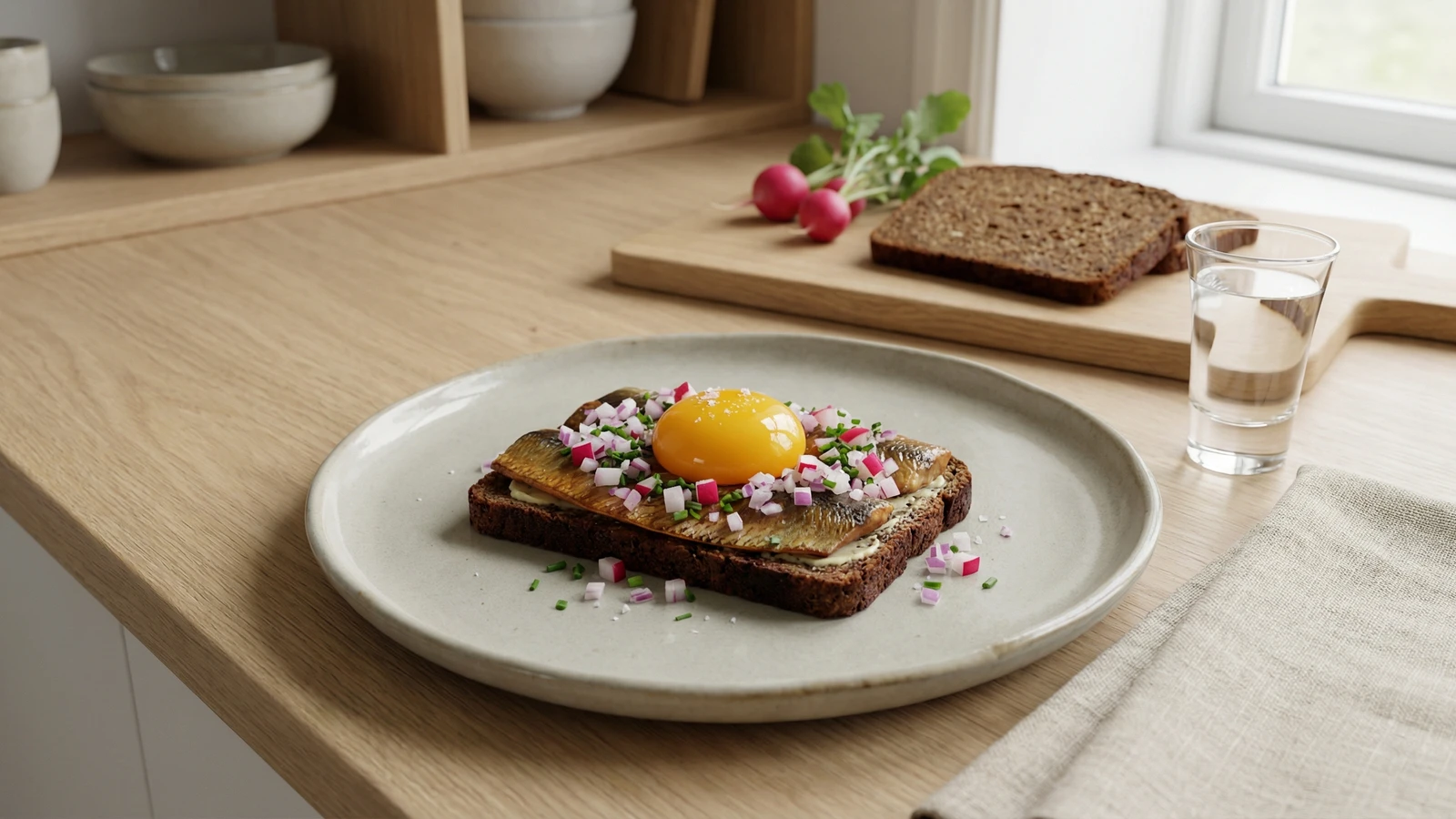
Sol over Gudhjem
Created by Chef Freja
Bornholm's most famous smorrebrod. Hot-smoked herring on dark rugbrod with a raw egg yolk sitting on top like the sun rising over the smokehouse chimneys, ringed with radish, chives, and red onion.
Bornholm in summer has a light you don't get anywhere else in Denmark. The island sits far out in the Baltic, closer to Sweden than to Copenhagen, and the sun comes off the water in a way that makes the whole place feel lit from below. In the fishing town of Gudhjem, the white chimneys of the old smokehouses rise above the red roofs, and for more than a century they've been turning fresh herring bronze over alder smoke. This is the dish those chimneys made famous.
Sol over Gudhjem means sun over Gudhjem, and the sun is a raw egg yolk, placed in the centre of a smoked herring on dark rugbrod and ringed with finely diced radish, red onion, and chives. It's one of the simplest pieces of smorrebrod in the Danish canon and one of the most photographed, because the image is already complete the moment you put it together. You don't have to arrange it. You just have to understand what each element is doing.
There's no cooking here. This is an assembly, and the season decides the quality. You want the freshest eggs you can find, because the yolk is raw and its job is to stand up round and golden on the fish. You want smoked herring that still tastes of the wood it was smoked over, not something vacuum-sealed and tired. And you want good rugbrod, dark and dense, sliced thick. Get those three things right and everything else is five minutes of dicing.
Pay attention to one thing in particular: the yolk stays whole on the plate. It breaks at the table, under the tip of your own knife, and that's when the dish becomes itself. You'll know when it's right.
The smokehouses of Bornholm, recognisable across the island by their whitewashed conical chimneys, have been curing herring over alder wood since the 19th century, when the island's fishing fleet supplied smoked fish to the whole of Denmark. Sol over Gudhjem entered the formal smorrebrod repertoire in the mid-20th century, codified at Copenhagen lunch restaurants like Oscar Davidsen's where the piece took its place among the classic open sandwiches. The name, sun over Gudhjem, is traditionally attributed to the painter and writer Oluf Høst, who spent his working life on Bornholm and whose canvases are filled with the particular Baltic light that the raw egg yolk at the centre of the dish is meant to summon.
The technique, the tradition, and the story behind every dish.
Discover Culinary AdvisorIngredients
hot-smoked herring fillets
Quantity
4 whole
preferably from Bornholm, skin on, pin-boned
dark rugbrod
Quantity
4 thick slices
unsalted butter
Quantity
30g
softened
very fresh egg yolks
Quantity
4
separated from the whites at the last moment
red onion
Quantity
1 small
finely diced
radishes
Quantity
6
finely diced
fresh chives
Quantity
small bunch
finely snipped
flaky sea salt
Quantity
to taste
black pepper
Quantity
freshly ground, to taste
lemon wedges (optional)
Quantity
to serve
| Ingredient | Quantity |
|---|---|
| hot-smoked herring filletspreferably from Bornholm, skin on, pin-boned | 4 whole |
| dark rugbrod | 4 thick slices |
| unsalted buttersoftened | 30g |
| very fresh egg yolksseparated from the whites at the last moment | 4 |
| red onionfinely diced | 1 small |
| radishesfinely diced | 6 |
| fresh chivesfinely snipped | small bunch |
| flaky sea salt | to taste |
| black pepper | freshly ground, to taste |
| lemon wedges (optional) | to serve |
Equipment Needed
- •Small sharp knife for dicing
- •Kitchen scissors for the chives
- •Small bowls for the garnishes
- •Fish tweezers for pin bones
Instructions
- 1
Prepare the garnishes
Dice the red onion as finely as you can, the radishes the same. You want tiny pieces, no bigger than a grain of rice. Snip the chives finely with scissors rather than chopping with a knife, which bruises them and turns them dark. Keep each garnish in its own small bowl. This isn't fussiness. The architecture of this smorrebrod depends on the three colors staying separate until the moment they meet on the bread.
A small sharp knife and patience will do more than any fancy tool. The garnish should look like confetti, not salsa. - 2
Prepare the herring
Lift the skin from the smoked herring fillets and discard it. Check carefully for any pin bones and pull them out with your fingers or tweezers. Good Bornholm herring is smoked over alder wood until the flesh turns bronze and the oils come to the surface, and you'll taste the smoke clearly before you taste the fish. If the fillets are very large, cut them to match the shape of the bread.
- 3
Butter the bread
Spread each slice of rugbrod with a generous layer of softened butter, going right to the edges. The butter is not optional and it is not thin. It's a seal between the dense rye and the oily fish, and without it the bread draws moisture from the herring and turns damp. Cold butter tears the rugbrod. Soft butter glides across it. Take the butter out of the fridge before you start anything else.
- 4
Lay the herring
Place a smoked herring fillet on each buttered slice, arranging it to cover most of the bread but leaving a thin rim of dark rye visible at the edges. The visible rye matters. It tells your eye what you're eating, and it's part of why this piece looks the way it does.
- 5
Set the sun
Make a small hollow in the centre of each herring with the back of a spoon. Separate one egg yolk at a time, catching it first in the half shell, then sliding it gently into the hollow. The yolk should sit round and trembling on the fish, bright as a midsummer sun over the Baltic. Use the freshest eggs you can find. A fresh yolk holds its shape. A tired one collapses and runs.
If you're nervous about raw egg, use pasteurised eggs. The texture is almost identical and the dish still works. But the best version is a farm egg from that morning, and you'll know it the moment you see the yolk stand up. - 6
Scatter the garnish
Scatter the diced radish, red onion, and chives around the yolk, not on top of it. You want the sun to stay visible, a clear golden circle at the centre of the piece. Finish with a small pinch of flaky sea salt and a twist of black pepper. The garnish shouldn't bury anything. It should frame it.
There's a reason for the three garnishes and no others. Radish gives crisp and pepper. Red onion gives sharpness. Chives give green and a mild allium note. Together they balance the rich smoke of the herring. Anything more is noise. - 7
Serve and break the yolk
Serve immediately with lemon wedges on the side. This smorrebrod is eaten with a knife and fork, and it's eaten in a specific way: you break the yolk with the tip of your knife and let it run across the herring and into the garnish. That's the whole point. The raw yolk is sauce and richness and binder, and until it breaks, the dish hasn't really started. Tak for mad.
Chef Tips
- •Source matters more than technique on this one. If you can find Bornholmer røget sild from an actual Bornholm smokehouse, buy it. The alder smoke is real and you'll taste the difference in a single bite. Failing that, any good hot-smoked herring from a trusted fishmonger will do.
- •Use the freshest eggs you can buy, and use them raw with confidence. The rawness is the dish. If you are serving this to someone who can't eat raw egg, pasteurised yolks work, though the flavor is slightly muted.
- •A cold beer or a small glass of aquavit belongs alongside this piece. The aquavit cuts through the smoke and the yolk in a way that no wine quite manages, and it is how Danes have always drunk it. Snaps and sild is one of the oldest pairings in the Danish kitchen.
- •If you want to make this a summer lunch for guests, build a small board with three pieces of smorrebrod per person and serve herring first, as the grammar demands. Sol over Gudhjem is a fine opening piece because it teaches the table what the rest of the meal is going to be.
Advance Preparation
- •The garnishes can be diced up to two hours ahead and kept in the fridge, each in its own covered bowl. Any longer and the radish loses its bite and the onion turns bitter.
- •Assemble the smorrebrod at the last moment, just before sitting down. A raw egg yolk held on a piece of fish for too long goes slack, and the whole piece loses its composure. This is not a dish you prepare and plate an hour ahead.
Frequently Asked Questions
Nutrition Information
1 serving (about 160g)
Where cooking meets culture.
Culinary mentorship, cultural storytelling, and the editorial depth that makes cooking meaningful.
Explore Culinary Advisor