Culinary Advisor
A cooking platform built around craft, culture, and the stories behind what we eat.
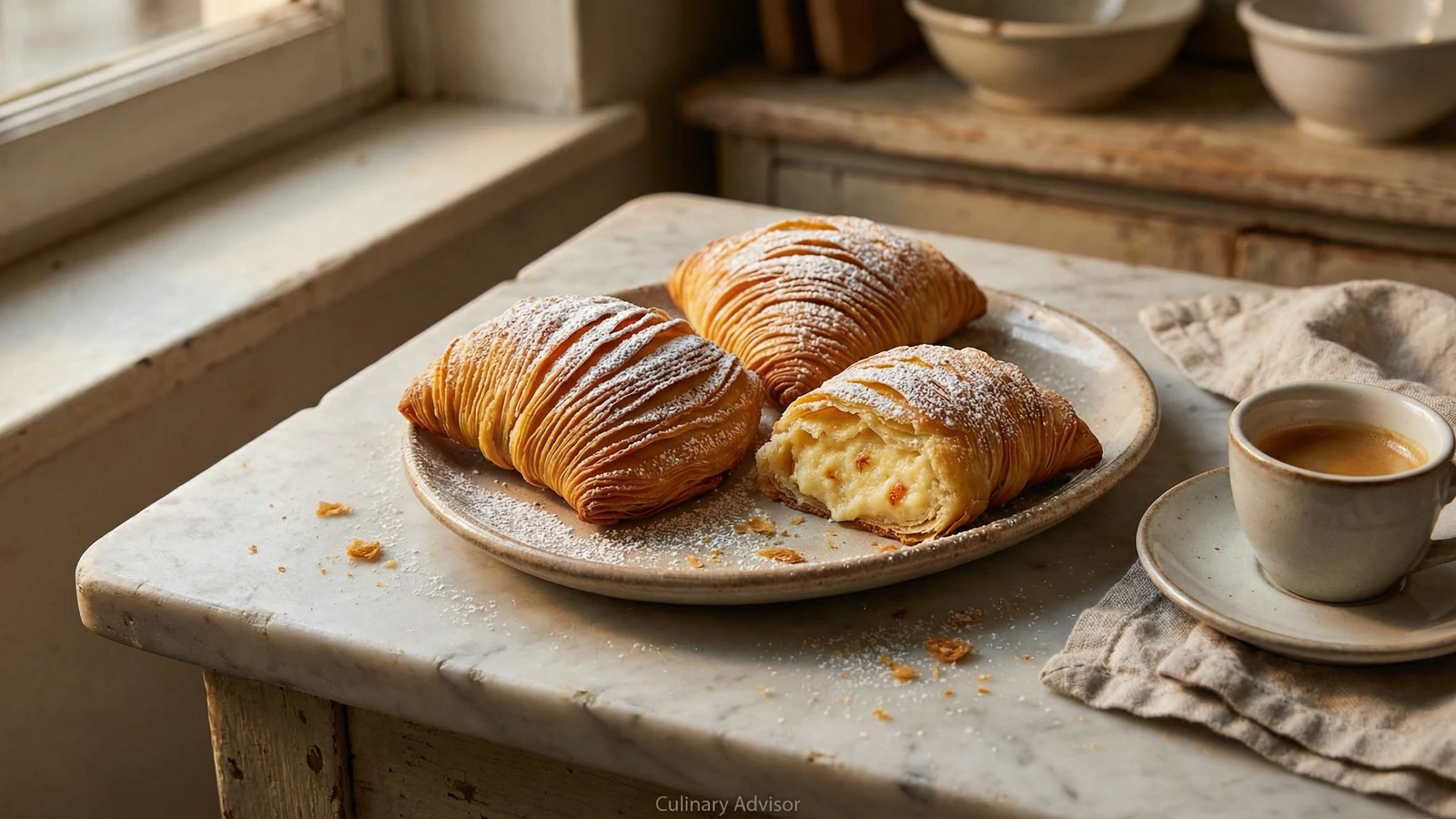
Sfogliatelle Ricce
Created by Chef Graziella
The legendary ridged pastry of Naples, where paper-thin dough is stretched, laminated with lard, and shaped into shells that shatter at first bite. This is not a recipe for the impatient.
Sfogliatelle ricce is the most demanding pastry in the Italian repertoire, and I tell you this not to discourage but to prepare. The dough must be stretched until you can read a newspaper through it. The lamination requires lard, patience, and arms that do not tire easily. The shaping asks you to coax hundreds of layers into a shell that will hold its form through baking. If you are not willing to fail the first time, perhaps the second, do not begin.
I have watched Americans attempt shortcuts with puff pastry and phyllo dough. The results prove my point: there are no shortcuts worth taking. The authentic sfogliatella gets its character from the specific way the dough is stretched and rolled, the way the lard separates each gossamer layer, the way the shell opens like a clamshell when you push your thumbs into the sliced rounds. Nothing else produces that shattering crispness, that accordion of layers visible when you bite through.
Nuns invented this pastry in a convent kitchen on the Amalfi Coast, using leftover semolina and whatever citrus grew in the monastery gardens. They had time. They had patience. They had no expectations of instant gratification. You must approach sfogliatelle with the same temperament.
The filling is simple: semolina cooked in milk until thick, enriched with ricotta, sweetened with sugar, perfumed with candied orange and a whisper of cinnamon. It must be cold when you fill the shells, or it will melt the lard and destroy the layers. Every step matters. Every detail counts. This is why sfogliatelle separates serious bakers from casual ones.
Sfogliatelle were born in the 17th century at the Santa Rosa convent in Conca dei Marini, where a nun transformed leftover semolina porridge into filled pastries. The recipe remained cloistered for over a century until Pasquale Pintauro, a Neapolitan pastry chef, acquired it around 1818 and opened a shop on Via Toledo that still operates today. Naples claimed the pastry as its own, and the rest of Italy has never successfully argued otherwise.
The technique, the tradition, and the story behind every dish.
Discover Culinary AdvisorIngredients
bread flour
Quantity
500g
water
Quantity
200g
at room temperature
fine sea salt
Quantity
15g
honey
Quantity
15g
high-quality lard
Quantity
300g
softened to spreadable consistency
whole milk ricotta
Quantity
250g
drained overnight
whole milk
Quantity
200g
fine semolina
Quantity
100g
granulated sugar
Quantity
150g
large egg yolks
Quantity
2
candied orange peel
Quantity
100g
finely diced
ground cinnamon
Quantity
1/4 teaspoon
pure vanilla extract
Quantity
1 teaspoon
fine sea salt
Quantity
pinch
confectioners' sugar
Quantity
for dusting
| Ingredient | Quantity |
|---|---|
| bread flour | 500g |
| waterat room temperature | 200g |
| fine sea salt | 15g |
| honey | 15g |
| high-quality lardsoftened to spreadable consistency | 300g |
| whole milk ricottadrained overnight | 250g |
| whole milk | 200g |
| fine semolina | 100g |
| granulated sugar | 150g |
| large egg yolks | 2 |
| candied orange peelfinely diced | 100g |
| ground cinnamon | 1/4 teaspoon |
| pure vanilla extract | 1 teaspoon |
| fine sea salt | pinch |
| confectioners' sugar | for dusting |
Equipment Needed
- •Stand mixer with dough hook
- •Large clean work surface for stretching dough
- •Rolling pin
- •Sharp chef's knife
- •Medium saucepan
- •Wire cooling rack
- •Parchment-lined baking sheets
Instructions
- 1
Make the dough
In a stand mixer fitted with the dough hook, combine the flour, water, salt, and honey. Mix on low speed until a shaggy dough forms, then increase to medium and knead for 10 minutes. The dough should be very smooth, elastic, and quite stiff. It will resist you. This is correct. Wrap tightly in plastic and rest at room temperature for at least 2 hours, or refrigerate overnight.
The dough must be stiff enough to stretch without tearing. If it feels slack or sticky, you have added too much water. There is no remedy but to begin again. - 2
Prepare the filling
While the dough rests, make the filling. In a medium saucepan, bring the milk to a simmer over medium heat. Slowly whisk in the semolina in a thin stream, stirring constantly to prevent lumps. Cook, stirring, until the mixture is very thick and pulls away from the sides of the pan, about 5 minutes. Remove from heat and stir in the sugar until dissolved. Let cool for 10 minutes.
- 3
Complete the filling
Beat the egg yolks into the cooled semolina one at a time. Fold in the drained ricotta until smooth, then add the candied orange peel, cinnamon, vanilla, and salt. The filling should be thick enough to hold its shape. Transfer to a bowl, press plastic wrap directly onto the surface, and refrigerate until completely cold, at least 2 hours.
The ricotta must be drained overnight in a fine-mesh strainer set over a bowl. Wet ricotta makes wet filling, and wet filling destroys crisp pastry. - 4
Stretch the dough
Clear a large work surface and have the softened lard ready. Divide the dough into four pieces. Working with one piece at a time, roll it into a rough rectangle, then begin stretching it with your hands. Work from the center outward, using the backs of your hands, letting the weight of the dough help stretch itself. The dough must become so thin you can see through it. This takes practice and patience. Do not rush.
Traditional Neapolitan pastry makers stretch the dough over their forearms, spinning it like pizza dough. You may use a large pasta machine on its thinnest setting if your arms fail you, though the texture will differ slightly. - 5
Laminate with lard
Spread a very thin layer of softened lard over the entire surface of the stretched dough, using your hands or a pastry brush. The layer should be nearly translucent. Starting from one short end, roll the dough tightly into a log, keeping constant tension. The roll should be about 2 inches in diameter. Repeat with remaining dough pieces, placing each roll seam-side down. Wrap tightly in plastic and refrigerate for at least 4 hours, preferably overnight.
- 6
Shape the shells
Using a sharp knife, slice the chilled log into rounds about 1/2 inch thick. You will see the spiral of layers clearly. Working quickly while the dough is cold, hold a round in both hands with your thumbs in the center. Push your thumbs outward and forward while cupping the edges with your fingers, creating a cone shape. The layers should fan out like a shell. The cone should be about 3 inches deep with thin walls. Place on a parchment-lined baking sheet.
- 7
Fill the pastries
Spoon about 2 tablespoons of cold filling into each shell, filling it to just below the rim. Do not overfill, or the filling will leak during baking. Press the edges gently to seal, pinching the top closed. The pastry should resemble a ridged clamshell. Refrigerate the filled pastries for 20 minutes before baking.
Keep the filling and shaped shells cold at all times. If the lard melts, the layers will fuse and you will have lost the characteristic texture. - 8
Bake until deeply golden
Heat the oven to 200°C (400°F). Bake the sfogliatelle for 20 to 25 minutes, rotating the pan halfway through, until deeply golden brown and the layers are visibly crisp. Underbaked sfogliatelle are a tragedy: pale, soft, and heavy. You want shattering crispness. Remove to a wire rack and dust generously with confectioners' sugar while still warm. Serve within hours.
Chef Tips
- •Lard is not optional. Butter melts at too low a temperature and does not create the same separation between layers. Leaf lard, rendered from the fat around pig kidneys, is the finest quality. Ask your butcher or render it yourself.
- •The dough-stretching takes practice. Your first attempts will likely tear. This is normal. The dough can be patched by overlapping torn edges, but a hole-free sheet produces superior pastry.
- •Sfogliatelle must be eaten the day they are baked, preferably within hours. They cannot be stored. They cannot be reheated successfully. This is why Neapolitan bakeries make them fresh throughout the day.
- •If you lack the confidence to stretch dough by hand, a pasta machine on its thinnest setting produces acceptable results. Purists will disapprove. I will not tell them if you do not.
- •The filling can be made with a combination of candied orange and candied citron for a more complex citrus flavor. Use what the nuns would have had: whatever grew in the garden.
Advance Preparation
- •The dough can be made one day ahead and refrigerated. It stretches more easily when slightly chilled.
- •The filling must be made at least 2 hours ahead to chill completely. It can be refrigerated for up to 2 days.
- •The laminated dough logs can be refrigerated for up to 2 days or frozen for 1 month. Slice while still very cold.
- •Shaped and filled sfogliatelle can be refrigerated for up to 2 hours before baking, but no longer. The filling will begin to soften the layers.
Frequently Asked Questions
Nutrition Information
1 serving (about 105g)
Where cooking meets culture.
Culinary mentorship, cultural storytelling, and the editorial depth that makes cooking meaningful.
Explore Culinary Advisor