Culinary Advisor
A cooking platform built around craft, culture, and the stories behind what we eat.
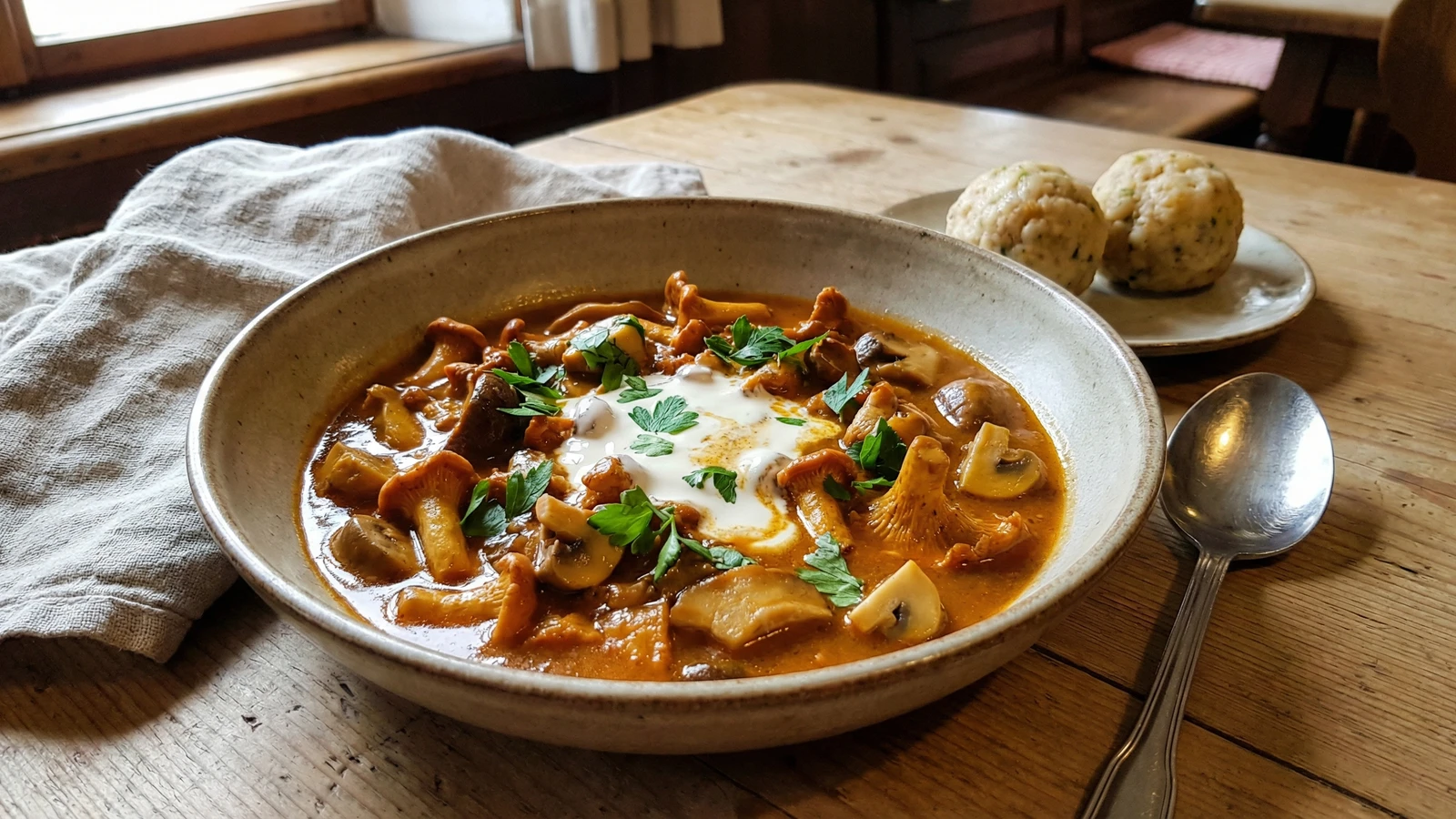
Schwammerlgulasch (Wild Mushroom Goulash)
Created by Chef Elsa
Forest mushrooms slow-cooked in a paprika and onion sauce with marjoram and caraway, finished with sour cream and served the way Austrian grandmothers have been making it since before anyone wrote it down.
Every autumn in Salzburg, the Grünmarkt fills up with Schwammerl. Chanterelles the color of egg yolks, porcini with caps as wide as your hand, wild mushrooms I still can't name in English tumbling out of wooden crates. The women selling them have dirt under their fingernails and opinions about how you should cook what they've picked. I love those conversations.
Schwammerlgulasch is what happens when you take those mushrooms and cook them the way Austrians cook everything that matters: slowly, with good paprika, too many onions, and enough patience to let it all become something greater than the sum of its parts. It's a Gulasch without meat, but don't mistake it for a compromise. In the Austrian kitchen, mushrooms have always stood on their own. The forest provides, and the cook listens.
Gretel always said a proper Gulasch is built on three things: onions cooked until they dissolve, paprika that hasn't been burnt, and time. The technique is the same whether you're making Rindsgulasch or Schwammerlgulasch. The onion base carries everything. You cook it low and slow until it becomes the sauce itself, then you let the paprika bloom off the heat so it stays sweet instead of turning bitter. After that, the mushrooms do the rest. They bring the earth, the forest floor, that deep savory quality the Viennese call Geschmack. The whole thing comes together in under an hour, which means this is a weeknight dish, not a weekend project. That's part of what makes it so good. Austrian home cooking at its most honest: simple food done well, on the table before you've had time to get impatient.
Gulasch came to Austria from Hungary, carried along the trade routes of the Habsburg empire and adopted so thoroughly by Viennese cooks that most Austrians consider it their own. The original Hungarian gulyás was a cattlemen's stew, but Austrian kitchens transformed it into dozens of variations: Rindsgulasch, Saftgulasch, Fiakergulasch, and Schwammerlgulasch among them. The mushroom version has roots in the Alpine and Bohemian forest traditions where foraging was a way of life, not a hobby. Marjoram and caraway mark it as distinctly Austrian rather than Hungarian, and the addition of sour cream at the end is a Viennese refinement that softens the paprika's heat into something gentler.
The technique, the tradition, and the story behind every dish.
Discover Culinary AdvisorIngredients
mixed wild mushrooms (Eierschwammerl, Steinpilze, Champignons)
Quantity
800g
cleaned and torn or thickly sliced
onions
Quantity
3 large
finely diced
unsalted butter
Quantity
3 tablespoons
sunflower oil
Quantity
2 tablespoons
sweet Hungarian paprika (edelsüß)
Quantity
2 tablespoons
hot paprika (optional)
Quantity
1 teaspoon
garlic
Quantity
2 cloves
finely minced
plain flour
Quantity
1 tablespoon
vegetable or mushroom stock
Quantity
250ml
tomato paste
Quantity
1 tablespoon
dried marjoram
Quantity
1 teaspoon
caraway seeds
Quantity
1 teaspoon
lightly crushed
white wine vinegar
Quantity
1 tablespoon
salt and freshly ground black pepper
Quantity
to taste
sour cream (Sauerrahm)
Quantity
150ml
plus extra for serving
fresh flat-leaf parsley
Quantity
for garnish
roughly chopped
| Ingredient | Quantity |
|---|---|
| mixed wild mushrooms (Eierschwammerl, Steinpilze, Champignons)cleaned and torn or thickly sliced | 800g |
| onionsfinely diced | 3 large |
| unsalted butter | 3 tablespoons |
| sunflower oil | 2 tablespoons |
| sweet Hungarian paprika (edelsüß) | 2 tablespoons |
| hot paprika (optional) | 1 teaspoon |
| garlicfinely minced | 2 cloves |
| plain flour | 1 tablespoon |
| vegetable or mushroom stock | 250ml |
| tomato paste | 1 tablespoon |
| dried marjoram | 1 teaspoon |
| caraway seedslightly crushed | 1 teaspoon |
| white wine vinegar | 1 tablespoon |
| salt and freshly ground black pepper | to taste |
| sour cream (Sauerrahm)plus extra for serving | 150ml |
| fresh flat-leaf parsleyroughly chopped | for garnish |
Equipment Needed
- •Heavy-bottomed pot or Dutch oven (24-26cm)
- •Wooden spoon
- •Mortar and pestle or heavy knife (for crushing caraway)
Instructions
- 1
Prepare the mushrooms
Clean your mushrooms with a dry brush or a slightly damp cloth. Don't wash them under running water. Mushrooms are sponges and they'll soak up the water instead of browning later. If you've found fresh Eierschwammerl (chanterelles), leave the small ones whole and tear the larger ones by hand. Steinpilze (porcini) should be sliced about a centimeter thick. Regular Champignons you can quarter. You want a mix of shapes and sizes so every spoonful is a little different.
If fresh wild mushrooms aren't available, use a mix of cremini and oyster mushrooms with a handful of dried porcini soaked in warm water for twenty minutes. Strain the soaking liquid through a paper towel and use it in place of some of the stock. That concentrated flavor is liquid gold. - 2
Cook the onion base
This is a Gulasch, and every Gulasch begins the same way: with more onions than you think is reasonable. Melt the butter with the oil in a heavy pot over medium heat. Add all three onions and stir them through the fat. Now turn the heat to medium-low and cook them slowly, stirring now and then, for fifteen to twenty minutes. You're not caramelizing them. You're softening them until they turn golden and almost translucent, until they've given up their liquid and collapsed into a sweet, silky mass. This onion base is the backbone of the dish. Rushing it is the single fastest way to ruin a Gulasch.
The ratio of onion to main ingredient in any Austrian Gulasch should make you raise an eyebrow. Three large onions for 800g of mushrooms sounds excessive. It isn't. The onions melt into the sauce and become the sauce. Trust it. - 3
Build the paprika base
Pull the pot off the heat. This part matters. Add the sweet paprika and the hot paprika if you're using it, and stir everything together for about thirty seconds. Paprika burns in an instant over direct flame, and burnt paprika tastes bitter and acrid. It will ruin everything you've built. Off the heat, the residual warmth of the onions is enough to bloom the spice and release that deep, earthy sweetness. You'll smell it change. That's when you know it's working. Stir in the tomato paste and the garlic, then return the pot to low heat for another minute.
- 4
Sear the mushrooms
Turn the heat up to medium-high and add the mushrooms to the pot. They'll seem like far too many. They'll shrink. Stir them through the paprika-onion base and let them cook for five to six minutes, stirring occasionally. The mushrooms will release their liquid first, then as it evaporates they'll start to concentrate in flavor and pick up a little color. You want them to have given up most of their water before you add any stock. Wet mushrooms in a thin sauce is not a Gulasch. It's a disappointment.
- 5
Simmer the Gulasch
Sprinkle the flour over the mushrooms and stir it in. The flour thickens the sauce gently as it cooks. No slurry, no cornstarch, just a spoonful of flour worked into the pot the old-fashioned way. Add the stock, the marjoram, the crushed caraway seeds, and the vinegar. Stir everything together and bring it to a gentle simmer. The vinegar is not optional. Gretel always said a Gulasch without a little sharpness is flat, and she was right. Let it simmer uncovered for fifteen to twenty minutes, stirring occasionally, until the sauce thickens and coats the mushrooms in a rich, glossy paprika gravy.
Crush the caraway seeds lightly with the flat side of a knife or in a mortar. You want them cracked open, not powdered. Whole seeds slip past your teeth without giving you anything. Crushed seeds release their warm, anise-like flavor into the sauce. - 6
Finish with sour cream
Take the potoff the heat and stir in the sour cream. Off the heat. If you add sour cream to a bubbling pot it will split, and you'll have grainy white flecks in your beautiful sauce instead of a smooth, creamy finish. Stir it through until the sauce turns from deep rust to a warm, earthy terracotta. Taste it. Adjust salt, pepper, and vinegar. A good Schwammerlgulasch should taste earthy, warm with paprika, a little sharp from the vinegar, and rounded by the cream. Season it until all four of those things are in balance.
- 7
Serve the Gulasch
Ladle the Schwammerlgulasch into warm bowls. Drop a generous spoonful of sour cream into the center and let it sit there, white against the terracotta sauce. Scatter rough-chopped parsley over the top. Serve with Semmelknödel (bread dumplings) or a thick slice of dark bread to drag through the sauce. This is a dish that needs something starchy alongside it, something to soak up every last bit of that paprika gravy. Don't serve it alone. Mahlzeit!
Chef Tips
- •Buy Hungarian paprika, not Spanish. Austrian cooking depends on Hungarian edelsüß paprika for its Gulasch, and there's no substitute that comes close. It should smell sweet and earthy when you open the tin. If it smells like dust, it's too old. Buy a new one.
- •If you can find fresh Eierschwammerl (chanterelles), use them as at least half of your mushroom mix. Their peppery, apricot-like flavor is what makes this dish sing in autumn. The rest can be whatever looks good at the market.
- •This Gulasch tastes better the next day. The flavors deepen overnight in the fridge. Reheat gently and stir in a fresh spoonful of sour cream before serving. It makes excellent leftovers and is even better on day two with fresh Knödel.
- •Serve with Semmelknödel if you have the time, or with good dark bread if you don't. A Gulasch without something starchy to soak up the sauce is only half a meal.
Advance Preparation
- •The complete Gulasch can be made a day ahead and refrigerated. The flavor improves overnight. Reheat gently over low heat and stir in fresh sour cream just before serving.
- •Mushrooms should be cleaned and prepped no more than a few hours before cooking. They darken and dry out if left too long.
Frequently Asked Questions
Nutrition Information
1 serving (about 300g)
Where cooking meets culture.
Culinary mentorship, cultural storytelling, and the editorial depth that makes cooking meaningful.
Explore Culinary Advisor