Culinary Advisor
A cooking platform built around craft, culture, and the stories behind what we eat.
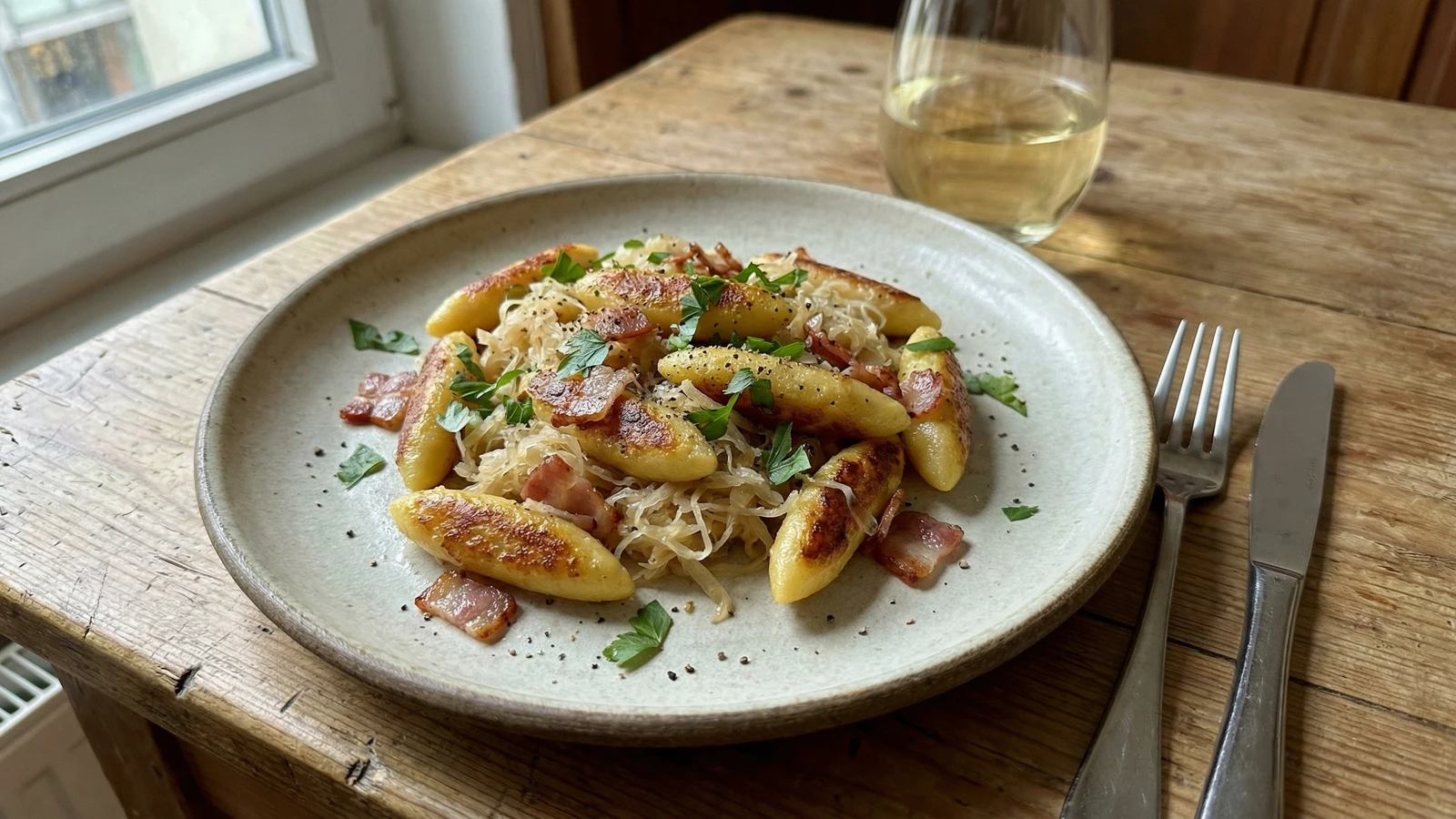
Schupfnudeln mit Sauerkraut und Speck
Created by Chef Elsa
Golden, crispy potato finger noodles tossed with tangy sauerkraut and salty Speck, the kind of honest Alpine cooking that turns a cold evening into something worth coming home to.
On our trips to Austria when I was small, Gretel and my grandmother Eva would sometimes take us off the main roads into the Salzkammergut, where the Gasthäuser were plain wooden rooms with checkered curtains and menus written on chalkboards. That's where I first ate Schupfnudeln. They arrived in a heavy pan, golden and slightly blistered from the butter, tangled up with sauerkraut and bits of crispy Speck. I remember thinking they looked like fat little fingers. Gretel told me that's exactly what they were supposed to look like, and that the name came from the rolling motion you use to shape them on the board.
Schupfnudeln are potato noodles, but calling them noodles doesn't quite capture it. You make a dough from cooked potatoes, flour, and egg, then roll small pieces between your palms and the work surface until they taper at both ends. They go into boiling water first, just until they float, then into a hot pan with butter until the outside turns golden and slightly crisp while the inside stays dense and soft. That contrast is everything. A Schupfnudel that's only been boiled is a sad, slippery thing. The pan is where it comes alive.
The sauerkraut and Speck are not afterthoughts. The kraut needs to cook down slowly with onion and caraway until it mellows from sharp to sweet and tangy. The Speck renders in its own fat until the edges go glassy and crisp. When you toss all three together in the pan, the sauerkraut juices glaze the noodles, the Speck fat coats everything, and you end up with a dish that is simple, substantial, and impossible to stop eating. This is good Austrian home cooking at its most direct.
Schupfnudeln belong to the family of hand-rolled potato doughs that spread across Central Europe after the potato became a staple crop in the 18th century. The name derives from the Swabian-Bavarian word 'schupfen,' meaning to roll or nudge, describing the palm-rolling technique that gives each noodle its tapered shape. In Austria, they're rooted in Alpine peasant cooking, particularly in Tyrol, Carinthia, and the Salzburg region, where potatoes and preserved cabbage were winter staples. The pairing with Sauerkraut and Speck reflects a time when mountain farming families ate what the cellar and the smokehouse provided.
The technique, the tradition, and the story behind every dish.
Discover Culinary AdvisorIngredients
floury potatoes (King Edward or Agria)
Quantity
800g
unpeeled
griffiges Mehl or plain flour
Quantity
200g
plus extra for dusting
egg
Quantity
1 large
fine salt
Quantity
1/2 teaspoon
nutmeg
Quantity
pinch
freshly grated
Tiroler Speck or smoked bacon
Quantity
200g
cut into small lardons
Sauerkraut
Quantity
500g
drained but not rinsed
onion
Quantity
1 medium
finely diced
caraway seeds
Quantity
1 teaspoon
dry white wine or light beer
Quantity
150ml
unsalted butter
Quantity
40g
black pepper
Quantity
to taste
freshly ground
fresh flat-leaf parsley
Quantity
for finishing
roughly chopped
| Ingredient | Quantity |
|---|---|
| floury potatoes (King Edward or Agria)unpeeled | 800g |
| griffiges Mehl or plain flourplus extra for dusting | 200g |
| egg | 1 large |
| fine salt | 1/2 teaspoon |
| nutmegfreshly grated | pinch |
| Tiroler Speck or smoked baconcut into small lardons | 200g |
| Sauerkrautdrained but not rinsed | 500g |
| onionfinely diced | 1 medium |
| caraway seeds | 1 teaspoon |
| dry white wine or light beer | 150ml |
| unsalted butter | 40g |
| black pepperfreshly ground | to taste |
| fresh flat-leaf parsleyroughly chopped | for finishing |
Equipment Needed
- •Potato ricer or food mill
- •Large pot for boiling
- •Heavy-bottomed pan or skillet (30cm)
- •Slotted spoon
Instructions
- 1
Cook the potatoes
Place the potatoes, unpeeled, in a large pot of salted water. Bring to a boil and cook until a knife slides through without resistance, about 25 to 30 minutes depending on size. The skins keep water out while they cook. Waterlogged potatoes make gluey dough, and gluey dough makes Schupfnudeln you won't want to eat. Drain them well and peel while still hot. Use a tea towel to hold them. It's worth the burnt fingertips.
Choose the floury, starchy varieties. Waxy potatoes won't break down properly and you'll end up fighting the dough. If you press a cooked potato with a fork and it crumbles, you've chosen right. - 2
Rice and cool the potatoes
Pass the hot peeled potatoes through a ricer or a fine-holed food mill directly onto a clean work surface. Spread them out and let them cool until you can handle them comfortably but they're still warm. Warm potatoes absorb flour more evenly than cold ones, and they release their remaining moisture as they sit. Give them ten minutes. Don't skip this. If you seal wet potatoes into dough, the Schupfnudeln will fall apart in the water.
A ricer gives you the lightest, fluffiest result. If you don't have one, use the fine disc of a food mill. Never use a food processor or a blender. They turn potatoes into wallpaper paste. - 3
Make the dough
Gather the cooled potato into a mound. Scatter the flour over the top, crack in the egg, and add the salt and nutmeg. Work everything together with your hands, folding and pressing gently until you have a smooth, soft dough. This should take two or three minutes, no more. The dough should hold together and feel slightly tacky but not stick to your hands. If it's too wet, dust in a little more flour, a tablespoon at a time. If it's dry and cracking, you've added too much already.
Handle the dough as little as possible. The more you knead it, the more gluten develops, and Schupfnudeln with too much gluten go rubbery and chewy. You want tender and yielding, not bouncy. Think of it like pastry, not bread. - 4
Shape the Schupfnudeln
Dust your work surface with flour. Divide the dough into four portions. Roll each portion into a rope about two centimeters thick. Cut the rope into pieces roughly four centimeters long. Now here's where the name earns itself: take each piece and roll it under your palms on the floured board, applying light pressure at the ends so it tapers into a spindle shape, fat in the middle, pointed at both tips. They should be about the length and thickness of your finger. Work quickly and don't agonize over perfection. Some will be fatter, some thinner. They'll all taste the same.
If the dough sticks while you're rolling, dust your palms with flour, not the dough. Too much flour on the surface makes them slide instead of roll and you can't get the taper. - 5
Boil the Schupfnudeln
Bring a large pot of salted water to a gentle boil. Drop the Schupfnudeln in, working in batches so you don't crowd them. They'll sink to the bottom. When they float to the surface, give them another thirty seconds, then lift them out with a slotted spoon onto a lightly oiled tray. They're cooked through at this point but pale and soft. The pan will fix that. Let them cool slightly so the surface dries. A dry surface is what gives you a golden crust in the next step.
- 6
Prepare the Sauerkraut
While the Schupfnudeln are boiling, loosen the drained Sauerkraut with your fingers, separating anyclumps. In a saucepan, melt a knob of butter over medium heat. Add the diced onion and cook until soft and translucent, about five minutes. Add the caraway seeds and let them toast for thirty seconds until fragrant. Tip in the Sauerkraut, stir to coat, then pour in the wine or beer. Let it simmer gently, partially covered, for fifteen to twenty minutes. The liquid will cook down and the kraut will soften from sharp and aggressive to mellow, sweet, and tangy. Season with black pepper. It shouldn't need salt. The Speck and the kraut itself will handle that.
- 7
Render the Speck
In a large, heavy pan, cook the Speck lardons over medium heat without any added fat. Speck has enough fat of its own. Stir occasionally and let the pieces render slowly until the edges turn golden and crisp and the fat has pooled in the pan, about six to eight minutes. The kitchen will smell like a Tyrolean smokehouse. Lift the crispy Speck out with a slotted spoon and set aside. Leave every drop of that rendered fat in the pan. You need it.
- 8
Pan-fry the Schupfnudeln
Turn the heat under the Speck pan to medium-high. Add the butter to the rendered fat. When the butter foams, add the boiled Schupfnudeln in a single layer. Don't stir them right away. Let them sit and develop a golden crust on the underside, about three minutes. Then turn them gently, giving different sides a chance to color. You're looking for golden brown patches and a dry, crisp surface with a soft, yielding center. This takes another four to five minutes. Resist the urge to move them constantly. Patience is what makes the crust happen.
Don't crowd the pan. If your pan isn't big enough, do this in two batches. Schupfnudeln piled on top of each other will steam instead of fry, and you'll end up with something limp instead of golden. - 9
Bring it all together
Add the braised Sauerkraut to the pan with the Schupfnudeln. Toss gently to combine, letting the juices from the kraut coat the noodles and glaze them slightly. Scatter the crispy Speck back in and toss once more. The dish should look generous and tangled, the golden noodles mixed through with strands of sauerkraut and bits of Speck catching the light. Pile it onto warm plates, grind black pepper over the top, and finish with a handful of roughly chopped parsley. Mahlzeit!
Chef Tips
- •The potato-to-flour ratio is everything. Start with less flour than you think you need and add gradually. Every batch of potatoes holds a different amount of moisture, so there's no single magic number. The dough should hold together when you squeeze a handful, and it should roll without crumbling. That's your test.
- •Use proper Austrian Speck if you can find it. Tiroler Speck is dry-cured and cold-smoked, and it has a concentrated, juniper-tinged flavor that regular bacon can't match. If you can't find it, use a good smoked pancetta or slab bacon. Avoid pre-sliced streaky bacon. It's too thin and turns brittle instead of chewy-crisp.
- •Don't rinse your Sauerkraut. I know some recipes tell you to. Rinsing washes away the complex, fermented tang that makes this dish work. You want that acidity cutting through the richness of the Speck and butter. Drain it, squeeze out the excess liquid, but leave the flavor alone.
- •Leftover shaped Schupfnudeln freeze beautifully. Lay them on a floured tray in a single layer, freeze until solid, then transfer to a bag. Boil them straight from frozen, adding an extra minute to the cooking time. This makes the dish a weeknight possibility instead of a weekend project.
Advance Preparation
- •The Schupfnudeln can be shaped, boiled, and refrigerated on a lightly oiled tray up to one day ahead. Pan-fry them straight from the fridge. The cold surface actually helps them crisp better.
- •The Sauerkraut can be braised up to two days ahead and reheated gently. It improves with time as the flavors settle.
- •Speck can be rendered ahead and stored with its fat. Reheat the fat in the pan and crisp the lardons again briefly before assembling.
Frequently Asked Questions
Nutrition Information
1 serving (about 425g)
Where cooking meets culture.
Culinary mentorship, cultural storytelling, and the editorial depth that makes cooking meaningful.
Explore Culinary Advisor