Culinary Advisor
A cooking platform built around craft, culture, and the stories behind what we eat.
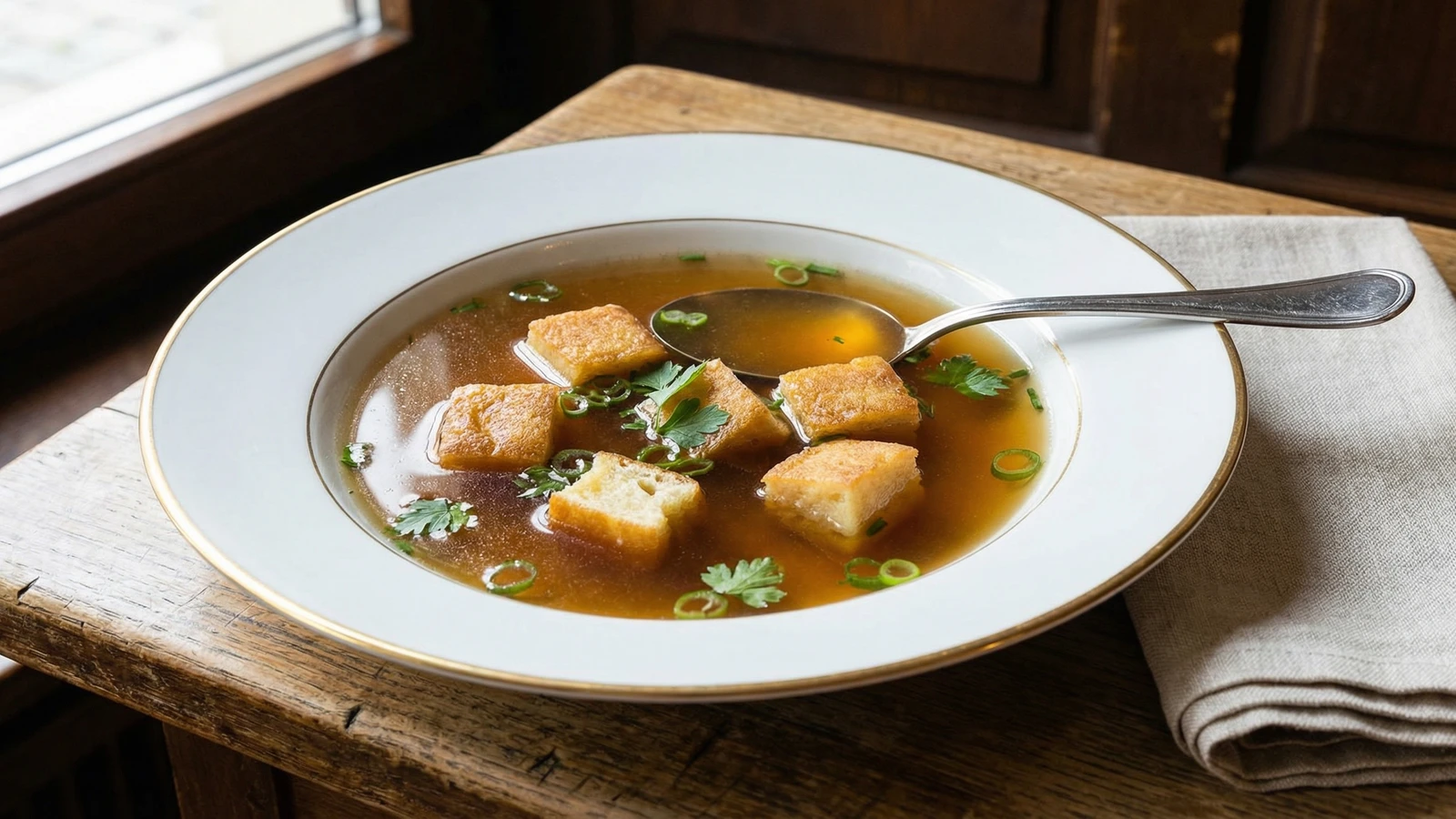
Schöberlsuppe
Created by Chef Elsa
Golden egg sponge cut into neat little cubes and floated in clear, honest Rindssuppe. A Viennese Suppeneinlage that proves the simplest things in Austrian cooking are often the most satisfying.
There's a whole universe of soup garnishes in Viennese cooking that most people outside Austria never hear about. Everyone knows Frittaten and Leberknödel, but the list runs deep: Grießnockerl, Backerbsen, Lungenstrudel, and these, Schöberl. Little savory sponge cubes, golden and light, baked in a sheet and cut with a knife, then dropped into a bowl of clear Rindssuppe. They're one of the secrets of Viennese cuisine that Gretel always insisted belonged in the conversation alongside the showier Einlagen.
In my grandmother Eva's kitchen in Kent, Gretel would make the broth one day and the Schöberl the next morning. She'd cream the butter and yolks together until the mixture went pale, then fold in whipped egg whites so gently you'd think she was handling something alive. Into a buttered tin, into the oven, and twenty minutes later the kitchen smelled like nutmeg and toasted butter. She'd cut the sheet into cubes with a short, sharp knife while it was still warm, and they'd sit on a board looking like little golden building blocks until the broth was hot.
What I love about Schöberl is the texture. They're not dumplings, not noodles, not anything you'd expect to find in a soup. They have a lovely chew on the outside where the bake gives them structure, and a soft, almost custard-like center that absorbs the broth without dissolving. One spoonful and you understand why the Viennese developed dozens of Suppeneinlagen: because a good clear broth deserves a companion worthy of it, and the companion you choose says something about the kind of cook you are.
The Viennese tradition of Suppeneinlagen, soup garnishes served in clear broth, developed through the 19th century as part of the Bürgerlich kitchen, the respectable middle-class cooking that defined how Austrians ate at home and in Gasthäuser. A proper meal always began with Rindssuppe, and the choice of Einlage varied by day, occasion, and region. Schöberl belong to the older, more refined end of this tradition. The name comes from the Austrian German word for a small, neat piece, and the technique of baking an egg sponge and cutting it into cubes appears in Viennese cookbooks dating to the mid-1800s. They fell out of fashion in many home kitchens as quicker garnishes like Frittaten took over, but they never disappeared from the kitchens that take soup seriously.
The technique, the tradition, and the story behind every dish.
Discover Culinary AdvisorIngredients
beef bones with marrow
Quantity
1.5 kg
beef shin or chuck
Quantity
500g
cold water
Quantity
3 liters
carrots
Quantity
2 medium
peeled
parsnip
Quantity
1
peeled
celeriac
Quantity
1/4
peeled
onion
Quantity
1 medium
halved and charred
leek
Quantity
1
cleaned and halved
whole black peppercorns
Quantity
6
bay leaves
Quantity
2
fresh parsley
Quantity
3 sprigs
salt (for broth)
Quantity
1 tablespoon
unsalted butter (for Schöberl)
Quantity
60g
softened
eggs (for Schöberl)
Quantity
3 large
separated
plain flour
Quantity
60g
fine salt (for Schöberl)
Quantity
1/4 teaspoon
freshly grated nutmeg
Quantity
pinch
butter
Quantity
for greasing
fresh chives
Quantity
for serving
finely cut
fresh flat-leaf parsley
Quantity
for serving
leaves only
| Ingredient | Quantity |
|---|---|
| beef bones with marrow | 1.5 kg |
| beef shin or chuck | 500g |
| cold water | 3 liters |
| carrotspeeled | 2 medium |
| parsnippeeled | 1 |
| celeriacpeeled | 1/4 |
| onionhalved and charred | 1 medium |
| leekcleaned and halved | 1 |
| whole black peppercorns | 6 |
| bay leaves | 2 |
| fresh parsley | 3 sprigs |
| salt (for broth) | 1 tablespoon |
| unsalted butter (for Schöberl)softened | 60g |
| eggs (for Schöberl)separated | 3 large |
| plain flour | 60g |
| fine salt (for Schöberl) | 1/4 teaspoon |
| freshly grated nutmeg | pinch |
| butter | for greasing |
| fresh chivesfinely cut | for serving |
| fresh flat-leaf parsleyleaves only | for serving |
Equipment Needed
- •Large stockpot (8-liter minimum)
- •Fine-mesh sieve and muslin cloth
- •Hand mixer or stand mixer
- •Shallow baking tin or rimmed sheet pan (roughly 20cm x 30cm)
- •Sharp knife for cutting cubes
Instructions
- 1
Build the broth
Place the beef bones and shin in your largest pot and cover with three liters of cold water. Cold water is essential. It coaxes the proteins out gently so the broth stays clear. Bring to a gentle simmer over medium heat. Gray scum will rise to the surface. Skim it off patiently, again and again, until the foam turns white and fine. This takes about twenty minutes and it cannot be skipped.
Gretel always said the difference between phony soup and real soup is patience. Real soup is clear, golden, and honest. You earn that by skimming and by keeping the heat low. - 2
Add the soup vegetables
Once you've skimmed the foam, add the carrots, parsnip, celeriac, charred onion, leek, peppercorns, bay leaves, parsley, and salt. The charred onion is what gives the broth that deep amber color. Reduce the heat until you see one lazy bubble breaking the surface every few seconds. Let it simmer, uncovered, for two hours. Don't stir it. Don't rush it. Just let it be.
- 3
Cream the butter and yolks
While the broth simmers, make the Schöberl. Preheat your oven to 180°C (350°F). Beat the softened butter with a hand mixer until pale and fluffy, about two minutes. Add the egg yolks one at a time, beating well after each. The mixture should be light and creamy, almost mousse-like. Sift in the flour, add the salt and nutmeg, and fold gently until just combined. Don't overwork it or the Schöberl will be tough instead of tender.
- 4
Whip and fold the whites
In a separate clean bowl, whip the egg whites with a pinch of salt until they hold stiff, glossy peaks. If you turn the bowl upside down and they stay put, you're there. Fold one third of the whites into the butter mixture first to lighten it. This loosens the batter so the next two additions don't lose all their air. Then fold in the remaining whites in two gentle sweeps. You want to see a few small streaks of white still visible. That's better than a deflated, overworked batter.
The air in those egg whites is the only leavening in this recipe. Every bubble you knock out is height and lightness you won't get back. Use a large metal spoon or silicone spatula and fold from the bottom, turning the bowl as you go. - 5
Bake the Schöberl sheet
Butter a shallow baking tin or line a rimmed sheet pan with parchment. Spread the batter evenly into the tin, about one and a half centimeters thick. Smooth the top gently. Bake for twenty to twenty-five minutes, until the surface is golden and the sponge feels springy when pressed in the center. A skewer should come out clean. The kitchen will smell of butter and nutmeg, which is exactly right.
- 6
Cut the cubes
Let the Schöberl sheet cool in the tin for ten minutes, then turn it out onto a board. Using a sharp knife, cut it into neat cubes, roughly two centimeters on each side. They should hold their shape cleanly. If they crumble, the batter was either too dry or overbaked. If they're dense and heavy, the whites weren't folded gently enough. Good Schöberl are light, golden on the outside, with a soft, yielding center that drinks up the broth without falling apart.
- 7
Strain the broth
Strain the finished broth through a fine-mesh sieve lined with muslin or a clean kitchen towel. Discard the spent vegetables and bones. What you have now should be clear and deeply golden, the kind of liquid you can see straight through. If it's cloudy, your simmer was too aggressive. Taste it. Adjust the salt. The broth is the whole foundation here, so it needs to be right before anything else goes into the bowl.
- 8
Serve the soup
Divide the Schöberl cubes among warm soup bowls, five or six cubes per person. Ladle the hot broth over them carefully so the cubes don't tumble. They'll float or settle depending on how light you got them, either way is fine. Scatter fresh chives and a few parsley leaves across the surface. Serve immediately. This is the kind of first course that makes people sit up and pay attention. Mahlzeit!
Chef Tips
- •The butter must be properly soft before you start. Not melted, not cool and firm. Soft enough that a finger pressed into it leaves a clean impression. If it's too cold, it won't cream properly and the batter will be heavy. Take it out of the fridge a good hour before you begin.
- •Nutmeg makes this dish. Use whole nutmeg and grate it fresh. The pre-ground stuff in a jar lost its soul six months ago. You only need a pinch, but that pinch should be fragrant enough to smell from across the kitchen.
- •If you don't have time to make Rindssuppe from scratch, buy the best beef broth you can find and reduce it by a third to concentrate the flavor. It won't be the same, but a strong bought broth with good Schöberl is still better than no Schöberlsuppe at all.
- •The cubes can be stored in the fridge for a day and reheated gently in the broth. They actually firm up a bit overnight, which means they hold their shape even better in the hot soup.
Advance Preparation
- •The broth can be made up to three days ahead and refrigerated. The fat will solidify on top, forming a natural seal. Remove it before reheating.
- •The Schöberl sheet can be baked a day ahead, cooled, wrapped, and refrigerated. Cut into cubes just before serving and warm them briefly in the hot broth.
- •For a dinner party, having both components ready the day before means the soup course comes together in five minutes. Reheat the broth, add the cubes, garnish, and serve.
Frequently Asked Questions
Nutrition Information
1 serving (about 400g)
Where cooking meets culture.
Culinary mentorship, cultural storytelling, and the editorial depth that makes cooking meaningful.
Explore Culinary Advisor