Culinary Advisor
A cooking platform built around craft, culture, and the stories behind what we eat.
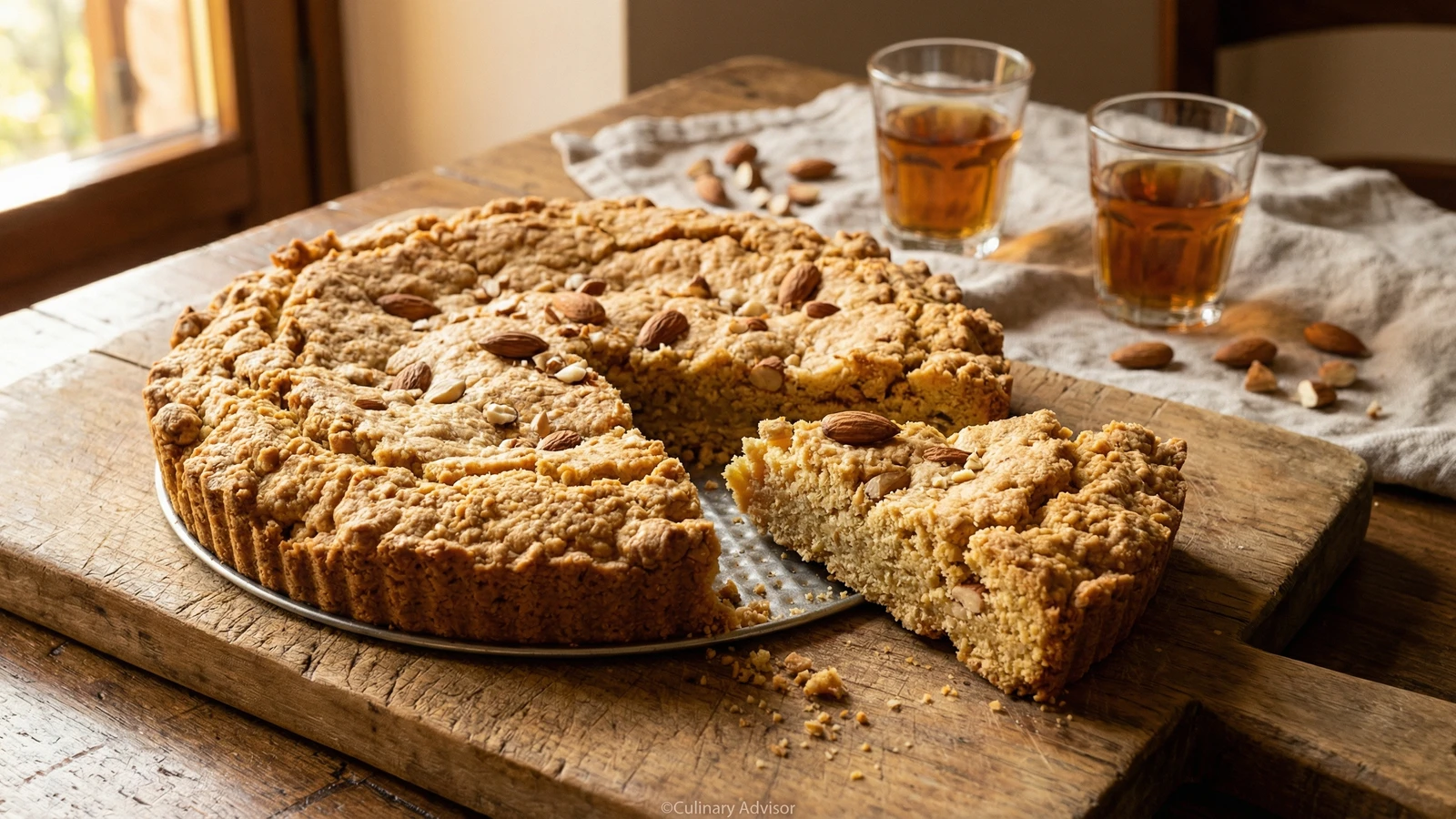
Sbrisolona di Mantova
Created by Chef Graziella
The crumbly almond cake of Mantua, where coarse cornmeal and irregular almonds create a texture that shatters at the touch. Tradition demands you break it by hand, never slice it.
Sbrisolona teaches a lesson that too many modern bakers have forgotten: not everything should be smooth, even, or refined. This cake from Mantua is deliberately rough. It crumbles. It shatters. It makes a mess of the tablecloth. This is not failure. This is the entire point.
The name comes from brisa, the Mantuan dialect word for crumb. Coarse cornmeal gives it that distinctive sandy texture, while irregular almond pieces create pockets of crunch throughout. The dough is barely dough at all. You work it just enough to hold together, then scatter it carelessly into the pan. If your sbrisolona looks neat and professional, you have made something else.
In Mantua, this cake appears at the end of every Sunday pranzo, set in the center of the table for everyone to break apart with their hands. Children reach across adults. Crumbs scatter everywhere. This is the warmth of the Italian table made physical. What you keep out matters as much as what you put in: keep out the knife, keep out the precision, keep out any impulse to make it pretty.
Sbrisolona traces to the 17th century Gonzaga court in Mantua, though its origins lie in humbler peasant baking where coarse cornmeal stretched expensive wheat flour. The cake appears in records as early as 1600, served to nobility and farmers alike. It remains fiercely protected in Mantua, where bakers argue over whether eggs belong in the dough and whether lard or butter makes the superior cake.
The technique, the tradition, and the story behind every dish.
Discover Culinary AdvisorIngredients
coarse-ground yellow cornmeal
Quantity
150g
all-purpose flour
Quantity
150g
whole almonds
Quantity
150g
skin on
granulated sugar
Quantity
150g
cold unsalted butter
Quantity
150g
cut into small cubes
large egg yolks
Quantity
2
lemon
Quantity
1
finely grated zest
fine sea salt
Quantity
1/4 teaspoon
pure vanilla extract
Quantity
1/2 teaspoon
| Ingredient | Quantity |
|---|---|
| coarse-ground yellow cornmeal | 150g |
| all-purpose flour | 150g |
| whole almondsskin on | 150g |
| granulated sugar | 150g |
| cold unsalted buttercut into small cubes | 150g |
| large egg yolks | 2 |
| lemonfinely grated zest | 1 |
| fine sea salt | 1/4 teaspoon |
| pure vanilla extract | 1/2 teaspoon |
Equipment Needed
- •10-inch tart pan with removable bottom
- •Large mixing bowl
- •Rimmed baking sheet for toasting almonds
Instructions
- 1
Prepare the almonds
Spread the almonds on a baking sheet and toast in a 350°F oven for 8 to 10 minutes, until fragrant and lightly golden inside when one is broken open. Let them cool completely. Chop them coarsely with a knife. You want irregular pieces, some as large as a chickpea, others nearly powder. This unevenness is essential. Do not use a food processor, which would reduce them to uniform meal and ruin the texture.
The skins stay on. They add color, flavor, and the rustic character that defines this cake. Blanched almonds make an inferior sbrisolona. - 2
Combine dry ingredients
In a large bowl, whisk together the cornmeal, flour, sugar, chopped almonds, lemon zest, and salt. The cornmeal must be coarse, the type labeled polenta bramata or polenta per sbrisolona. Fine cornmeal will not give you the proper sandy, shattering texture. This is not negotiable.
- 3
Work in the butter
Add the cold butter cubes to the dry mixture. Using your fingertips, work the butter into the flour mixture as you would for pastry, pinching and rubbing until you have a coarse, uneven, sandy mass. Some butter pieces should remain visible, others should disappear entirely. The mixture should hold together loosely when squeezed, then crumble apart when released.
- 4
Add the yolks
Beat the egg yolks with the vanilla extract. Drizzle over the crumb mixture and toss with your hands, working the yolks through without overhandling. You are not making a dough. You are making a shaggy, crumbly mass that barely holds together. If it becomes smooth or cohesive, you have gone too far.
Some Mantuan bakers use no egg at all, relying on butter alone for binding. The yolks add richness and a slightly more forgiving texture, but the cake must remain crumbly. This is its nature. - 5
Form the cake
Butter a 10-inch tart pan with a removable bottom. Turn the crumb mixture into the pan and spread it in an uneven layer, pressing very lightly to create irregular mounds and valleys. The surface should look rough, almost careless. Do not compact it. Do not smooth it. The Mantuan word sbrisolona comes from brisa, meaning crumb. The cake must look like what it is.
- 6
Bake until golden
Bake in a preheated 350°F oven for 40 to 45 minutes, until the cake is deep golden brown across the surface and the edges have darkened slightly. The center may still look pale. It will continue cooking from residual heat. The cake should crack as it cools. This is correct.
- 7
Cool completely
Let the sbrisolona cool completely in the pan, at least one hour. It is fragile when warm and will shatter if moved too soon. When cooled, remove the outer ring of the tart pan. The cake travels on its metal bottom. Do not attempt to remove it.
- 8
Serve properly
Never cut sbrisolona with a knife. Set it on the table and let your guests break off pieces with their hands. This is tradition, and it is also practical. A knife would shatter it unpredictably. Hands break it into manageable, irregular pieces that crumble beautifully. Serve with Vin Santo for dipping, or with a small glass of grappa alongside.
Chef Tips
- •Seek out polenta bramata, the coarsest grade of Italian cornmeal. Regular fine cornmeal produces a cake that is too dense and lacks the shattering quality that defines sbrisolona. Specialty Italian grocers carry it, or order it online.
- •The butter must be cold. Soft butter creates a cohesive dough rather than a crumbly one. If your kitchen is warm, refrigerate the butter cubes for 15 minutes before using.
- •Traditional recipes from Mantua often use half butter and half strutto (lard). The lard creates an even more shattering texture and a subtle savory note. If you have good-quality leaf lard, try using 75g butter and 75g lard.
- •Sbrisolona keeps remarkably well. Store it uncovered at room temperature for up to one week. The texture actually improves after a day, becoming more crumbly and less moist.
Advance Preparation
- •The cake improves after resting overnight at room temperature. The texture becomes more characteristically crumbly.
- •Sbrisolona keeps for one week stored at room temperature, loosely covered with a kitchen towel. Do not refrigerate it or seal it in plastic, which traps moisture and softens the texture.
- •The almonds can be toasted and chopped up to one week ahead. Store them in an airtight container at room temperature.
Frequently Asked Questions
Nutrition Information
1 serving (about 90g)
Where cooking meets culture.
Culinary mentorship, cultural storytelling, and the editorial depth that makes cooking meaningful.
Explore Culinary Advisor