Culinary Advisor
A cooking platform built around craft, culture, and the stories behind what we eat.
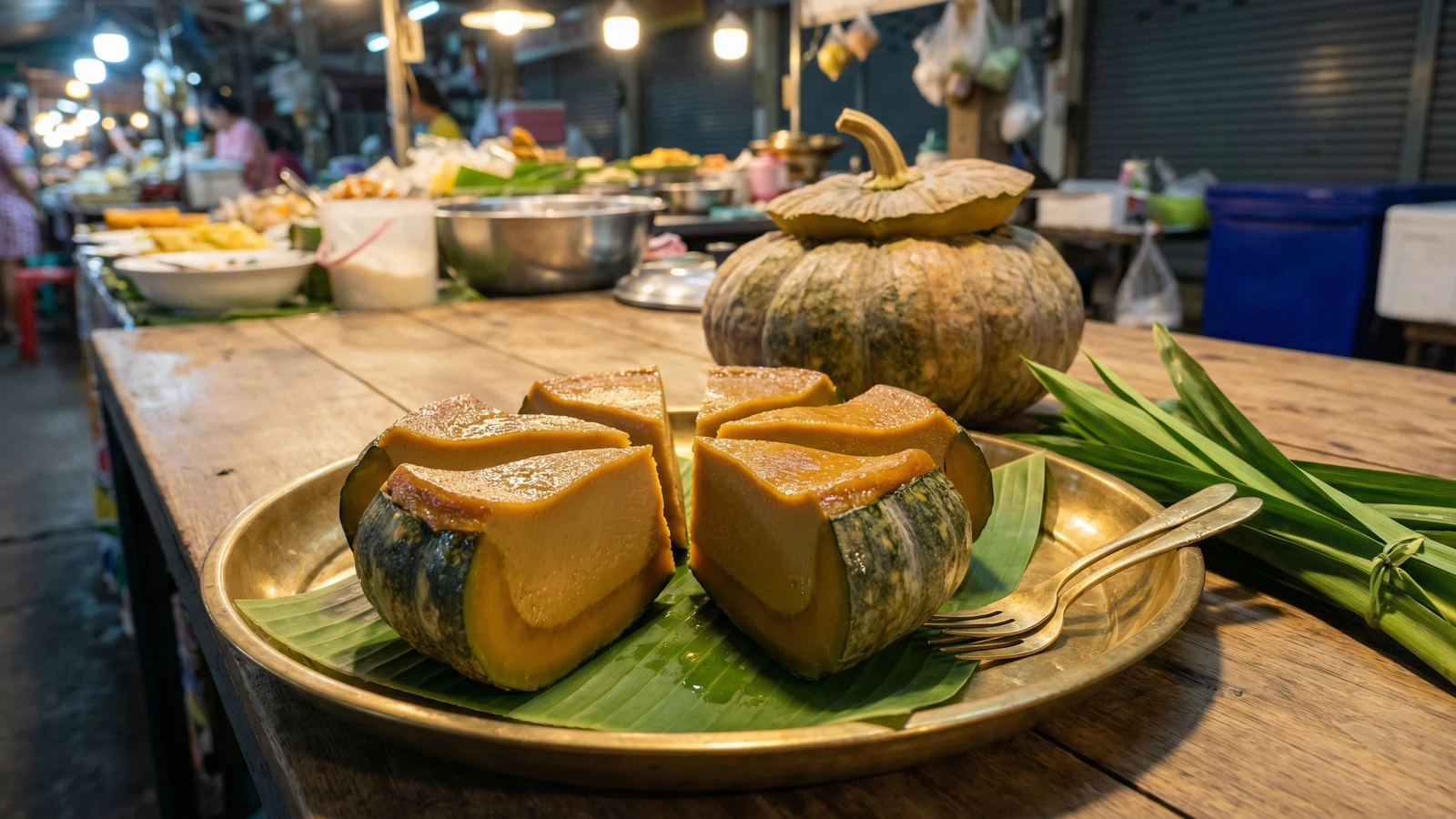
Steamed Pumpkin Custard (Sangkhaya Fak Thong)
Created by
The sweet pillar of Thai cuisine lives inside this pumpkin: palm sugar for sweetness, coconut cream for body, duck eggs for richness, pandan for perfume. The system governs even dessert.
Palm sugar. That's where this starts. Not granulated white sugar. Not cane sugar. Palm sugar (nam tan pip), the caramel-dark, mineral-rich sweetener tapped from coconut or palmyra palms. Ajarn always said the four pillars govern everything: salt, sweet, sour, spice. In dessert, the sweet pillar steps forward, and if you use anything other than palm sugar, you've already broken the system.
Sangkhaya fak thong is proof that Thai desserts aren't an afterthought. They follow the same governing rules as every curry and stir-fry. Coconut cream (hua kathi) is the only fat, the only liquid richness. Not milk. Not cream. Coconut. Duck eggs (khai pet) set the custard because they're higher in fat than chicken eggs, with bigger, richer yolks that give the custard its dense, silky texture and deep golden color. Pandan leaves (bai toey) provide the perfume: grassy, sweet, floral in a way vanilla can never replicate. These are Thai ingredients following Thai rules. Nothing is borrowed from a Western pastry playbook.
The pumpkin itself is not a bowl. It's an ingredient. As the custard steams, the kabocha flesh softens, absorbs the coconut and palm sugar, and becomes part of the dessert. When you slice a wedge, you get a stripe of jade-green pumpkin, a stripe of golden custard, and a bite that holds both textures together. That integration is the whole point. Vessel and filling become one dish.
I teach this at Fai Thai workshops because it shows young cooks that Thai desserts have engineering. The custard has to be strained twice for smoothness. The steaming heat has to be gentle or the custard cracks. The pumpkin has to be the right size for the steamer and the right ripeness for the sweetness. None of this is accidental. It's a system. Principles, not recipes.
Sangkhaya (สังขยา) likely derives from the Malay-Indonesian custard tradition of srikaya (kaya), a coconut egg jam that spread through Southeast Asia via maritime trade routes. The technique of steaming custard inside a whole pumpkin is distinctly Central Thai, appearing in royal and temple fair sweets for centuries. While Thailand's more famous egg-based sweets (foi thong, thong yip, thong yod) trace directly to Maria Guyomar de Pinha, the 17th-century Japanese-Portuguese-Bengali woman who introduced Portuguese egg confectionery to the Ayutthaya court, sangkhaya represents the other lineage: coconut-based custards indigenous to the region, where Thai cooks replaced foreign sugar with palm sugar and foreign dairy with coconut cream, making the technique follow Thai rules.
The technique, the tradition, and the story behind every dish.
Discover Culinary AdvisorIngredients
kabocha pumpkin (fak thong)
Quantity
1 whole, about 1-1.5 kg
top cut off, seeds and strings scooped out
duck eggs (khai pet)
Quantity
5
palm sugar (nam tan pip)
Quantity
200g
shaved or grated
coconut cream (hua kathi)
Quantity
250ml
fresh-pressed preferred
pandan leaves (bai toey)
Quantity
4
knotted
fine sea salt
Quantity
1/4 teaspoon
| Ingredient | Quantity |
|---|---|
| kabocha pumpkin (fak thong)top cut off, seeds and strings scooped out | 1 whole, about 1-1.5 kg |
| duck eggs (khai pet) | 5 |
| palm sugar (nam tan pip)shaved or grated | 200g |
| coconut cream (hua kathi)fresh-pressed preferred | 250ml |
| pandan leaves (bai toey)knotted | 4 |
| fine sea salt | 1/4 teaspoon |
Equipment Needed
- •Large steamer or wok with steaming rack (wide enough for the whole pumpkin)
- •Heatproof plate for the pumpkin
- •Fine-mesh sieve for straining custard
- •Small saucepan for coconut cream infusion
- •Clean kitchen towel for wrapping steamer lid
Instructions
- 1
Prepare the pumpkin
Wash the kabocha pumpkin and dry it. Cut a lid around the stem, about 3 inches in diameter, angling the knife inward so the lid sits back in place without falling through. Scoop out all the seeds and fibrous strings with a spoon. Scrape the cavity clean but don't dig into the flesh. You want a smooth, hollow chamber for the custard. The walls should be at least 1 inch thick. If your pumpkin is too thin, the whole thing collapses during steaming. Pick a heavy, dense kabocha. It should feel like it weighs more than it looks.
Japanese kabocha is the standard here: dark green skin, dense orange flesh, naturally sweet. Butternut squash won't work. It's too watery, too thin-walled, and the flavor is wrong. Kabocha has a chestnut-like density that holds up to 45 minutes of steaming. - 2
Infuse the coconut cream
Pour the coconut cream into a small saucepan. Add the knotted pandan leaves and the palm sugar. Warm gently over low heat, stirring until the palm sugar dissolves completely. Do not boil. You're dissolving, not cooking. The mixture should be warm, fragrant, and a deep amber color from the palm sugar. Once the sugar is dissolved, remove from heat and let the pandan steep for 10 minutes. Then remove the pandan leaves and let the mixture cool to room temperature.
If you pour hot coconut cream into the eggs, you'll scramble them. Patience. Let it cool. The pandan infusion happens during the cooling anyway, so you're not wasting time, you're building flavor. - 3
Make the custard
Crack the duck eggs into a mixing bowl. Whisk gently with a fork. Gently. You are not making a meringue. You want the eggs combined, yolks and whites fully integrated, but with almost no air incorporated. Air bubbles become craters in the finished custard. Whisk slowly, deliberately, keeping the fork below the surface. Add the salt. Then pour in the cooled pandan coconut cream in a steady stream, stirring as you go. Strain the mixture through a fine-mesh sieve into a clean bowl. Then strain it again through the sieve into a pouring jug. Two passes. The first catches the chalazae and any undissolved sugar. The second catches whatever the first missed. Smooth custard requires this discipline.
Duck eggs are not optional. Their yolks are larger and higher in fat than chicken eggs, which gives the custard its dense, silky set and deep golden color. Five chicken eggs will give you a pale, looser custard. If you must use chicken eggs, use 6 whole eggs plus 2 extra yolks. But find the duck eggs. - 4
Fill the pumpkin
Pour the strained custard into the prepared pumpkin cavity. Fill it to about 1 centimeter below the rim. Not to the top. The custard will expand slightly as it steams, and overfilling means it spills and stains the outside of the pumpkin. Place the pumpkin lid back on top.
- 5
Steam the custard
Set up your steamer with water at a rolling boil before you place the pumpkin inside. Use a large steamer or a wok with a steaming rack. The pumpkin needs to sit on a heatproof plate to catch any drips. Place the filled pumpkin (with lid on) in the steamer. Wrap the steamer lid with a clean kitchen towel to prevent condensation from dripping onto the custard. This is important. Water drops on the surface create pockmarks. Steam over medium heat for 40 to 45 minutes. Medium heat. Not high. A gentle, steady steam sets the custard evenly. High heat cracks it, creates bubbles, ruins the texture.
Ajarn always said: custard tells you it's done by how it moves. Open the lid at 35 minutes and give the pumpkin a gentle nudge. The custard should jiggle like set jelly, not ripple like liquid. If the center still waves, give it another 5 minutes. If it's firm at the edges but still liquid in the very center, it will finish setting as it cools. Oversteaming turns custard grainy. - 6
Cool and slice
Remove the pumpkin from the steamer carefully. It's fragile when hot. Let it cool completely at room temperature for at least 2 hours, then refrigerate for another hour until the custard is fully set and cold. This is a cold dessert. Slice the whole pumpkin into wedges like a melon, cutting through both pumpkin and custard. Each wedge should show a clean layer of green skin, orange pumpkin flesh, and golden custard. That cross-section is the presentation. No plate decoration needed. The pumpkin is the plate, the vessel, and the ingredient.
Chef Tips
- •Palm sugar (nam tan pip) is the only sweetener. This is the sweet pillar of Thai cuisine at work. Granulated white sugar gives you sweetness with zero character: no caramel depth, no mineral complexity, no smokiness. Palm sugar gives you all of that. It's not a substitution. It's the law. If your palm sugar comes in a hard disk, shave it with a knife or microplane. If it's the soft paste type, measure by weight, not volume.
- •Fresh-pressed coconut cream (hua kathi) yields a richer, thicker custard than canned. If you can find freshly grated coconut, squeeze it through cheesecloth with a splash of warm water. The first press is the cream: thick, almost solid. That's what you want. Canned coconut cream works, but shake the can and use the thickest portion. Coconut milk (the thin stuff) will make the custard too loose to set properly.
- •The pandan leaf (bai toey) is the vanilla of Southeast Asia, but calling it that undersells it. Pandan has a grassy, floral, almost nutty aroma that vanilla can't replicate. Knot the leaves before steeping so they release more essential oils from the bruised fibers. If you can find pandan extract as a backup, use the natural kind (green from chlorophyll, not neon green from food coloring). But fresh leaves are always better. Always.
- •This is a temple fair and market dessert, sliced into wedges and sold from a tray. At Thai festivals, vendors cut the whole pumpkin at the stall and you buy wedges wrapped in plastic. It's meant to be eaten cold or at room temperature, never warm. The custard firms as it cools, and the pumpkin sweetens overnight. Day-two sangkhaya fak thong is often better than day one.
- •Banana leaf can be placed under the pumpkin during steaming as a functional layer: it prevents the pumpkin skin from sticking to the plate and imparts a faint grassy note. It's a cooking tool, not decoration.
Advance Preparation
- •Sangkhaya fak thong must be made ahead. The custard needs at least 3 hours of cooling (2 hours at room temperature plus 1 hour refrigerated) to set fully. Make it the morning of your dinner, or better yet, the day before. The flavors deepen overnight as the pumpkin flesh absorbs the palm sugar and coconut.
- •The pumpkin can be cleaned and hollowed out up to a day ahead. Wrap tightly in plastic and refrigerate.
- •Sliced wedges keep refrigerated for up to 3 days. The custard firms further but stays smooth. Let wedges sit at room temperature for 15 minutes before serving for the best texture.
Frequently Asked Questions
Nutrition Information
1 serving (about 275g)
Where cooking meets culture.
Culinary mentorship, cultural storytelling, and the editorial depth that makes cooking meaningful.
Explore Culinary Advisor