Culinary Advisor
A cooking platform built around craft, culture, and the stories behind what we eat.
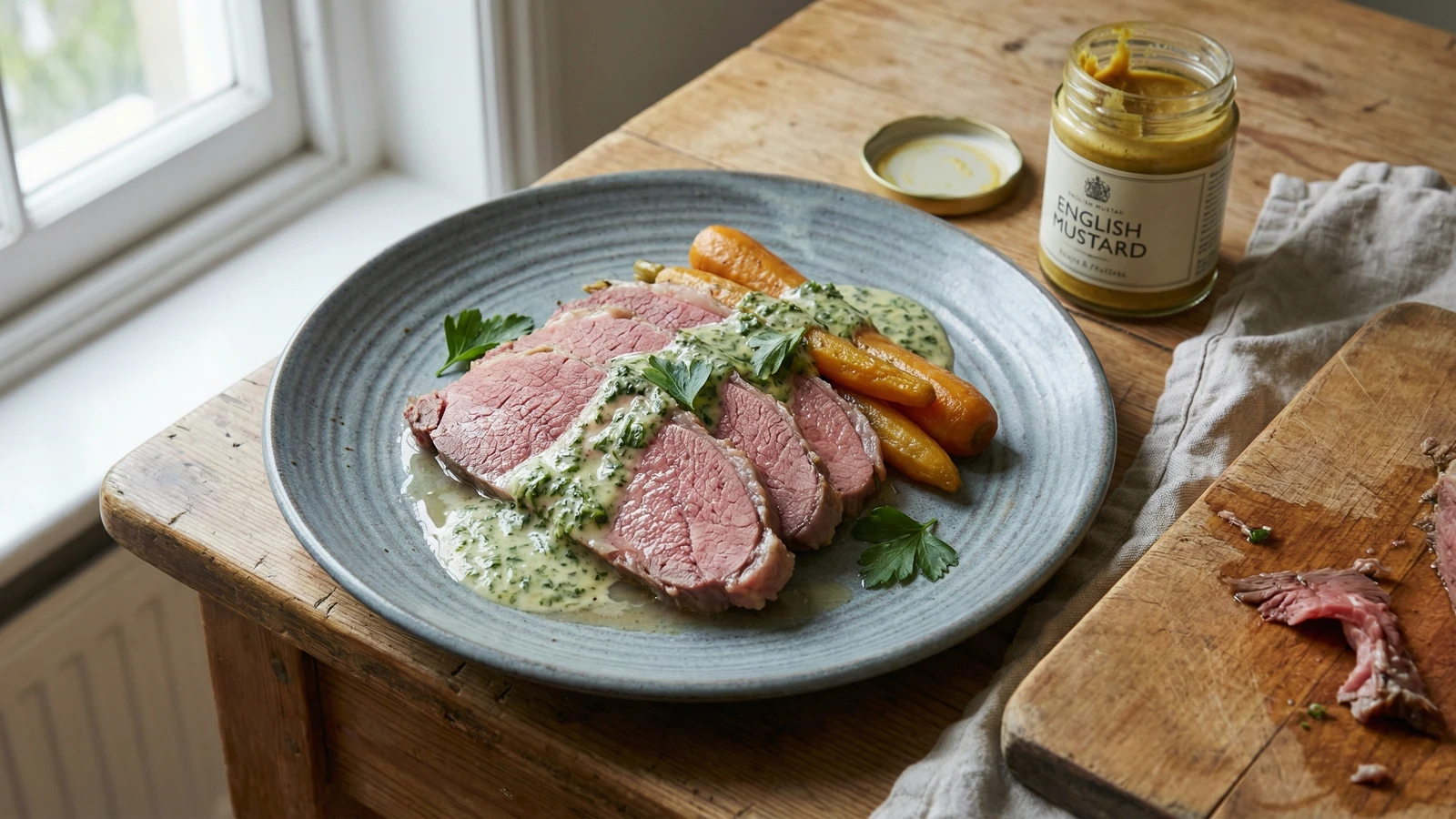
Salt Beef with Carrots and Parsley Sauce
Created by Chef Thomas
Brisket, brined for days in salt and spice, then poached so gently the kitchen barely notices until the smell fills every room. Carved thick, with whole carrots and a parsley sauce that earns its place.
There's a quiet satisfaction in deciding, five days before you eat, what dinner will be. Salt beef asks for that. Not skill, not fuss, just the willingness to plan ahead and then leave things alone. You make a brine on Sunday, lower a piece of brisket into it, and put it in the fridge. The kitchen carries on around it. By Friday, the salt has done its slow, invisible work, and you have something worth cooking.
On the day, you lift the beef from its bath, rinse it, and set it to poach in clean water with an onion, some celery, a couple of bay leaves. The kitchen fills slowly. Not a roasting smell, something gentler: savoury and deep, with a mineral warmth from the cure. The carrots go in towards the end, to cook in that same liquor and carry its flavour to the plate. This is a London meal, in the truest sense. The kind of thing you'd queue for on Brick Lane, but better when you've made it yourself and the house smells like it.
Parsley sauce is not optional. It's the thing that lifts the plate from good to right. A proper white sauce, thick with chopped parsley, loosened with a ladle of the poaching liquor, sharpened with a touch of English mustard. The beef goes on a warm plate, sliced against the grain, pink if you used saltpetre, grey-brown and honest if you didn't. Carrots alongside. Sauce over everything. There are few better feelings than putting this in front of someone on a cold evening.
The leftovers are half the point. Cold salt beef in a beigel with mustard and a gherkin is another meal entirely, and just as good. I wrote it down in the notebook once: beef, brine, five days, worth it. I still think that covers it.
The technique, the tradition, and the story behind every dish.
Discover Culinary AdvisorIngredients
beef brisket
Quantity
2kg, flat cut
rolled and tied by the butcher
coarse sea salt
Quantity
250g
demerara sugar
Quantity
100g
water
Quantity
2 litres
black peppercorns
Quantity
2 teaspoons
juniper berries
Quantity
1 teaspoon
lightly crushed
bay leaves
Quantity
4
cloves
Quantity
4
saltpetre (optional)
Quantity
1 teaspoon
onion
Quantity
1
halved
celery sticks
Quantity
2
snapped in half
carrots
Quantity
6 medium
peeled and left whole
unsalted butter
Quantity
40g
plain flour
Quantity
40g
whole milk
Quantity
300ml
poaching liquor
Quantity
200ml
flat-leaf parsley
Quantity
large bunch
finely chopped
English mustard
Quantity
1 teaspoon
fine sea salt and white pepper
Quantity
to taste
| Ingredient | Quantity |
|---|---|
| beef brisketrolled and tied by the butcher | 2kg, flat cut |
| coarse sea salt | 250g |
| demerara sugar | 100g |
| water | 2 litres |
| black peppercorns | 2 teaspoons |
| juniper berrieslightly crushed | 1 teaspoon |
| bay leaves | 4 |
| cloves | 4 |
| saltpetre (optional) | 1 teaspoon |
| onionhalved | 1 |
| celery stickssnapped in half | 2 |
| carrotspeeled and left whole | 6 medium |
| unsalted butter | 40g |
| plain flour | 40g |
| whole milk | 300ml |
| poaching liquor | 200ml |
| flat-leaf parsleyfinely chopped | large bunch |
| English mustard | 1 teaspoon |
| fine sea salt and white pepper | to taste |
Equipment Needed
- •Large non-reactive container for brining (ceramic, plastic, or stainless steel)
- •Large stockpot, big enough to hold the brisket submerged
- •Heavy-bottomed saucepan for the parsley sauce
- •Sharp carving knife
Instructions
- 1
Make the brine
Put the water, salt, sugar, peppercorns, juniper berries, bay leaves, cloves and saltpetre (if using) into a large saucepan. Bring to the boil, stirring until the salt and sugar dissolve. Take it off the heat and leave it to cool completely. This matters. You cannot put raw meat into a warm brine. Let it go stone cold, patient as you like.
Saltpetre gives salt beef its familiar rosy pink colour. Without it, the beef will be grey-brown when cooked. It tastes the same either way. If you want the pink, most chemists or online suppliers carry it. If you don't mind the colour, leave it out and lose no sleep. - 2
Brine the beef
Place the brisket in a container large enough to hold it submerged: a deep ceramic dish, a large plastic tub, a stockpot. Pour the cooled brine over the beef. It must be fully covered. If it bobs up, weigh it down with a plate. Cover and refrigerate for five to seven days. Turn it once a day if you remember. If you forget, it won't matter much. The brine is doing the work.
Five days is the minimum for a proper cure on a 2kg piece. Seven days gives a deeper, more savoury result. Anything less and the salt won't have reached the centre. Ask your butcher to roll and tie the brisket for you. A compact shape brines and cooks more evenly. - 3
Rinse and set to poach
When the brining days are up, lift the beef from the brine and rinse it well under cold running water. Discard the brine. Place the beef in a large, clean pot and cover with fresh cold water. Add the halved onion, the celery sticks, and a couple of the bay leaves from the spice rack if you have them. Bring to the boil. A scum will rise to the surface in the first few minutes. Skim it off with a spoon. Then turn the heat right down to the gentlest simmer you can manage: a few lazy bubbles breaking the surface, nothing more.
A rolling boil will tighten the meat and make it stringy. You want it barely trembling. If the surface of the water is calm with just the occasional bubble rising, you're there. - 4
Poach low and slow
Let the beef poach gently for three to three and a half hours, depending on the size and thickness of your piece. Top up with a kettle of boiling water if the level drops below the meat. You'll know it's done when a skewer or sharp knife slides into the thickest part with almost no resistance, like pushing into warm butter. The meat should feel yielding, not firm.
- 5
Cook the carrots
About forty minutes before the beef is ready, add the whole peeled carrots to the pot. They'll cook in the poaching liquor and take on a gentle, savoury sweetness that plain boiled carrots never have. They're done when a knife tip meets no resistance at the thickest part. Lift them out carefully and keep warm.
- 6
Make the parsley sauce
While the carrots cook, make the sauce. Melt the butter in a saucepan over a medium heat. When it foams, add the flour and stir it into a smooth paste. Cook it for a minute or two, stirring constantly, until it smells biscuity and has lost its raw flour taste. Your nose will tell you. Pour in the milk, a good splash at a time, stirring well between each addition to keep the sauce smooth. When all the milk is in, ladle in the poaching liquor from the beef pot. This is what gives the sauce its backbone: a savoury depth that milk alone can't provide. Let it simmer gently for five minutes, stirring now and then, until it coats the back of a spoon.
Taste the poaching liquor before adding it to the sauce. It will be salty from the brine. If it's very salty, use less and make up the difference with milk. You can always add more. You can't take it back. - 7
Finish the sauce
Take the sauce off the heat. Stir in the chopped parsley, generous amounts of it, more than looks reasonable. The sauce should be green-flecked and fragrant, not white with a few token leaves. Add the English mustard and a grind of white pepper. Taste it. Season with salt only if it needs it; the poaching liquor may have done that job already. The sauce should taste bright and savoury, with the parsley right at the front.
- 8
Slice and serve
Lift the beef from the pot onto a board. Let it rest for ten minutes. Slice it against the grain, as thick or thin as you like, though I prefer it in generous slabs that hold their shape. Lay the slices on warm plates with the whole carrots alongside. Spoon the parsley sauce over everything, or put it in a jug and let people help themselves. There's something about carrying this plate to the table that feels like a proper occasion, even on a Wednesday.
Chef Tips
- •Talk to your butcher. Ask for a flat-cut brisket, not the point end, and have them roll and tie it for you. A neat, compact piece brines evenly and slices beautifully. This isn't the place for a random cut from the supermarket shelf. The beef is the whole meal. Start with a good piece.
- •The poaching liquor is golden. Don't throw it away. Strain it and use it as the base for a soup the next day, with barley and root vegetables. One meal becomes two. This is how a kitchen should work.
- •English mustard in the parsley sauce is a quiet insistence I won't apologise for. Not enough to make it a mustard sauce, just enough to sharpen things and stop the parsley sauce from being polite. Half a teaspoon if you're cautious, a full teaspoon if you trust me.
- •If you want to serve this as a cold supper instead, let the beef cool completely in its poaching liquor. It stays moist and the flavour deepens overnight. Slice it cold, thinner than you would hot, and serve with pickles, mustard, and good bread.
Advance Preparation
- •The beef must brine for five to seven days in the fridge. This is not optional. Plan accordingly.
- •Once cooked, the beef can be cooled in its poaching liquor and refrigerated for up to three days. Reheat gently in the liquor, or serve cold.
- •The parsley sauce is best made fresh, as the parsley loses its brightness if it sits too long. The base sauce (before adding parsley) can be made a day ahead and refrigerated. Reheat gently, stir in the parsley just before serving.
Frequently Asked Questions
Nutrition Information
1 serving (about 350g)
Where cooking meets culture.
Culinary mentorship, cultural storytelling, and the editorial depth that makes cooking meaningful.
Explore Culinary Advisor