Culinary Advisor
A cooking platform built around craft, culture, and the stories behind what we eat.
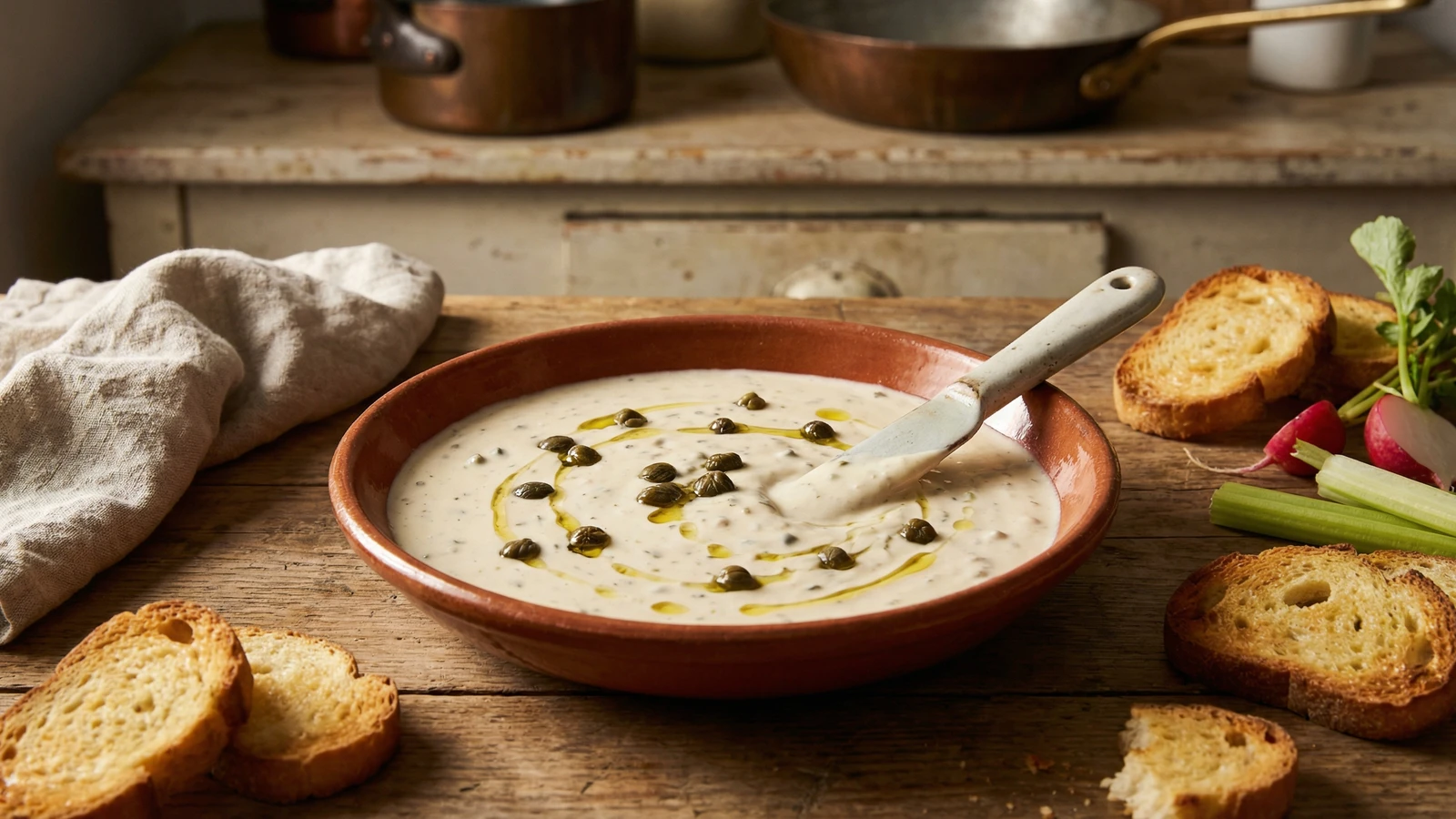
Salsa Tonnata alla Piemontese
Created by Chef Graziella
The silken tuna sauce of Piedmont, where canned fish, capers, and anchovies become something far greater than their humble origins suggest. Served cold, made ahead, and improved by waiting.
Salsa tonnata is proof that canned fish can achieve elegance. In Piedmont, during the sweltering summers when no one wants to stand over a hot stove, cooks have long relied on this cool, silken sauce. It drapes over thin slices of poached veal in the famous vitello tonnato, but it has other lives too: as a dip for raw vegetables, spread on crostini, or spooned over hard-boiled eggs.
The sauce depends on quality tuna packed in olive oil. Not water. Never water. That pale, flaky tuna packed in brine has no place here. You want the dense, meaty tuna from Italy or Spain, packed in good olive oil that becomes part of the sauce itself. The anchovies add depth without fishiness. The capers provide salt and bright punctuation. The egg yolks bind everything into something rich and spoonable.
This is not mayonnaise, though lazy cooks sometimes reach for that shortcut. Traditional tonnata achieves its creaminess through emulsification: egg yolks and olive oil, bound slowly, with the tuna providing body. The result is lighter than mayonnaise, more complex, and unmistakably Italian.
Vitello tonnato, and by extension its sauce, appears in Piedmontese cookbooks from the late 19th century, though the pairing of preserved tuna with cold meat likely predates written records. The dish gained international fame in the 20th century as a symbol of sophisticated Italian summer cooking, though its roots are in thrifty home kitchens where canned tuna stretched a modest amount of veal to feed a crowd.
The technique, the tradition, and the story behind every dish.
Discover Culinary AdvisorIngredients
Italian tuna packed in olive oil
Quantity
2 cans (5 ounces each)
drained, oil reserved
anchovy fillets
Quantity
4
drained
capers
Quantity
3 tablespoons
rinsed and drained
egg yolks from hard-boiled eggs
Quantity
3 large
extra virgin olive oil
Quantity
1/2 cup
fresh lemon juice
Quantity
2 tablespoons
white wine vinegar
Quantity
1 tablespoon
black pepper
Quantity
to taste
freshly ground
cold water
Quantity
as needed
| Ingredient | Quantity |
|---|---|
| Italian tuna packed in olive oildrained, oil reserved | 2 cans (5 ounces each) |
| anchovy filletsdrained | 4 |
| capersrinsed and drained | 3 tablespoons |
| egg yolks from hard-boiled eggs | 3 large |
| extra virgin olive oil | 1/2 cup |
| fresh lemon juice | 2 tablespoons |
| white wine vinegar | 1 tablespoon |
| black pepperfreshly ground | to taste |
| cold water | as needed |
Equipment Needed
- •Food processor or blender
- •Medium saucepan for eggs
- •Bowl of ice water
Instructions
- 1
Hard-boil the eggs
Place three eggs in a single layer in a saucepan and cover with cold water by one inch. Bring to a boil over high heat. The moment the water boils, remove the pan from heat, cover, and let stand exactly 12 minutes. Transfer eggs immediately to ice water. When cool, peel and separate the yolks from the whites. Reserve the whites for another use.
Older eggs peel more easily than fresh ones. If you struggle with peeling, crack the shell all over before peeling under cold running water. - 2
Prepare the capers
If using salt-packed capers, rinse them thoroughly under cold running water and soak in fresh cold water for 10 minutes, then drain and pat dry. Salt-packed capers have superior flavor but must be rinsed or the sauce will be unbearably salty. Capers in brine need only a quick rinse.
- 3
Blend the base
In a food processor, combine the drained tuna, anchovy fillets, two tablespoons of the capers, and the hard-boiled egg yolks. Process until the mixture forms a rough paste, scraping down the sides as needed. The texture should be uniform but not yet smooth.
- 4
Emulsify with oil
With the processor running, add the olive oil in a thin, steady stream. Then add two tablespoons of the reserved tuna oil. The sauce will become pale and creamy, similar to mayonnaise in texture but with more character. Add the lemon juice and vinegar. Process until completely smooth.
The reserved tuna oil carries flavor. Do not discard it. If your tuna was packed in inferior oil, use all olive oil instead. - 5
Adjust consistency
The sauce should flow slowly when spooned, coating the back of a spoon and holding a line when you draw your finger through it. If too thick, thin with cold water, one tablespoon at a time, processing after each addition. Season with pepper. Taste for balance. The anchovies and capers provide salt, so additional salt is rarely needed.
- 6
Rest and serve
Transfer to a bowl, cover, and refrigerate for at least one hour. The flavors need time to marry. Before serving, stir well and adjust seasoning if needed. Garnish with the remaining capers. Serve cold or at cool room temperature with crudités, crostini, or as tradition demands, spooned over thin slices of cold poached veal.
Chef Tips
- •Seek out Italian or Spanish tuna packed in olive oil. Callipo, Ortiz, and Flott are reliable brands. The difference between good canned tuna and mediocre is the difference between this dish succeeding or failing.
- •Salt-packed capers from Pantelleria have the finest flavor, firm and briny without the vinegar tang of those packed in brine. They require soaking, but the effort rewards you.
- •The sauce thickens as it chills. Always bring it to cool room temperature before serving, or thin it with a splash of water. It should pour, not plop.
- •For vitello tonnato, poach a boneless veal roast, chill it completely, slice paper-thin, and blanket with this sauce. Let it rest overnight for the flavors to penetrate the meat.
Advance Preparation
- •The sauce must be made at least one hour ahead and improves overnight. It keeps refrigerated for up to five days.
- •For a dinner party, make the sauce two days ahead. The flavors deepen and meld. Stir well before serving.
Frequently Asked Questions
Nutrition Information
1 serving (about 60g)
Where cooking meets culture.
Culinary mentorship, cultural storytelling, and the editorial depth that makes cooking meaningful.
Explore Culinary Advisor