Culinary Advisor
A cooking platform built around craft, culture, and the stories behind what we eat.
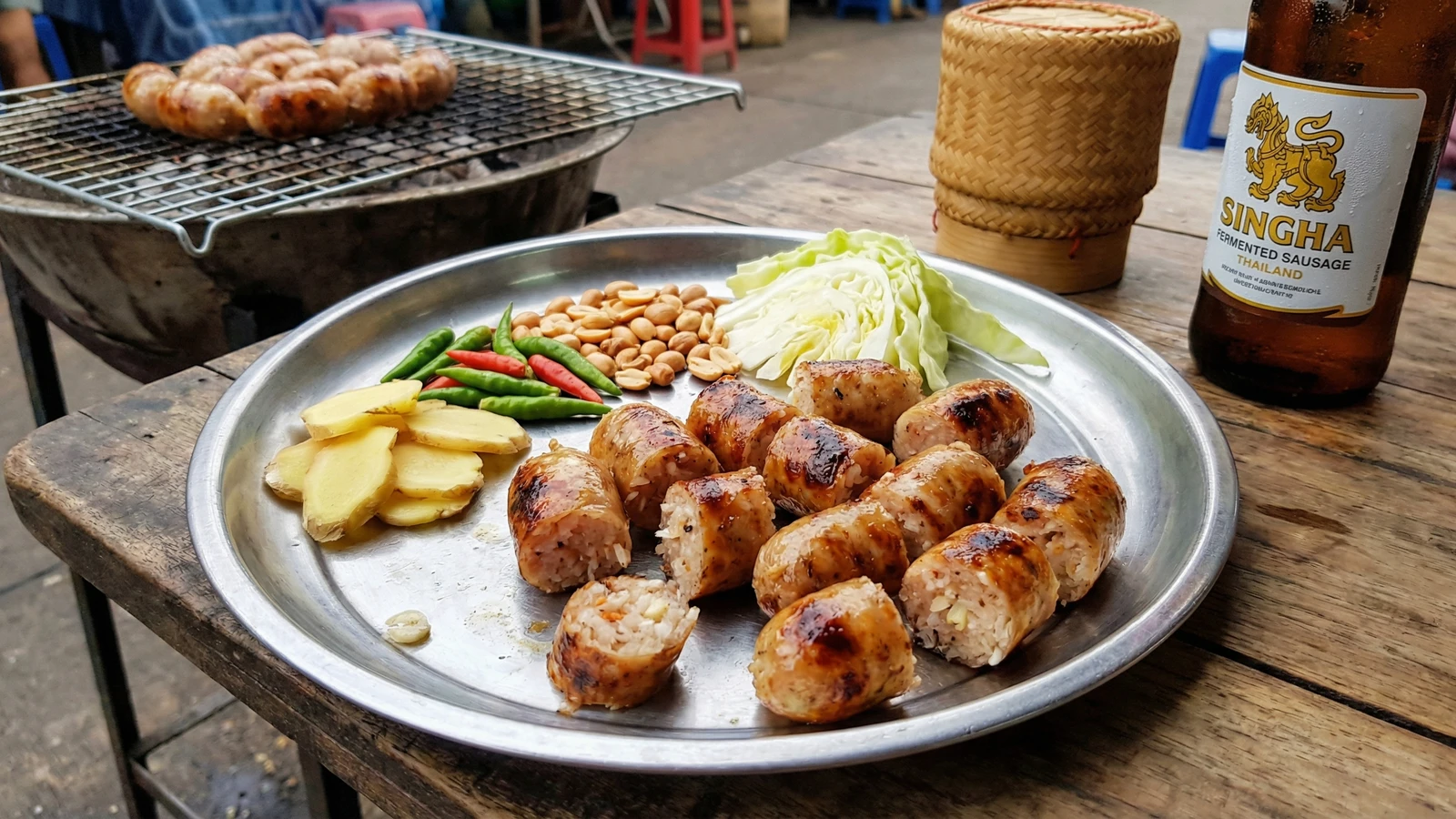
Isan Fermented Sausage (Sai Krok Isan)
Created by
Sourness without lime. Sticky rice feeds the bacteria, garlic guards the gate, time does the cooking. Lactic acid fermentation is Isan's oldest flavor principle, and the charcoal grill finishes what biology started.
Sourness in Thai food usually comes from lime. Squeeze, taste, adjust. But Isan has another way. Fermentation. In sai krok Isan, the sourness doesn't come from a fruit. It comes from time.
Here's the science Ajarn drilled into me: cooked sticky rice (khao niew) is packed with starch. When you mix it with raw pork and garlic, stuff it into casings, and leave it at room temperature, lactobacillus bacteria start eating those rice sugars and converting them into lactic acid. That acid is your sour. Same process as yogurt, same process as kimchi, same genus of bacteria. The four pillars still hold: salt for salt (plain salt here, not fish sauce, because nam pla can muddy a clean ferment), the lactic acid for sour, and chili comes on the side. The system adapts.
The garlic isn't just flavor. It's antimicrobial. A massive amount of raw garlic creates conditions that favor beneficial lactobacillus over the bacteria you don't want. That's not folk wisdom. That's food science embedded in a recipe that's been passed down for generations. This is what our grandmothers knew without needing a textbook.
I first understood sai krok Isan on a road trip to Khon Kaen with Ajarn. We pulled over at a highway rest stop, the kind where the charcoal smoke hits you before you even see the stall. A woman was grilling small, pale sausages over low coals, turning them slowly, the casings blistering and splitting in spots. She handed us a plate: sausages cut into coins, a side of sliced raw ginger (khing), bird's eye chilies (prik khi nu), roasted peanuts, and raw cabbage. No sauce. No dressing. The sausage was tangy, garlicky, and porky, with a chew from the rice. The ginger cut through the fat. The chili added heat. The peanut added crunch. That plate was a complete system. Nothing missing, nothing extra.
The filling is almost stupid simple: coarsely ground pork, cooked sticky rice, garlic, salt, white pepper. That's it. Five ingredients. The fermentation does the rest. You don't need complexity when you have biology working for you. Principles, not recipes.
Sai krok Isan (ไส้กรอกอีสาน) belongs to a broader Southeast Asian tradition of lactic-acid-fermented sausages shared between Thailand's Isan region, Laos, and parts of Vietnam and Myanmar. Unlike European cured sausages that rely on nitrates and cold aging, Isan fermentation uses sticky rice as the bacterial fuel and tropical ambient heat (30-35°C) to drive rapid lacto-fermentation in just one to three days. The sausage was originally a preservation method for pork in a region without refrigeration, and it spread to Bangkok with the Isan migrant worker diaspora in the latter half of the 20th century, becoming one of Thailand's most popular street snacks.
The technique, the tradition, and the story behind every dish.
Discover Culinary AdvisorIngredients
pork shoulder or belly
Quantity
1 kg
coarsely ground or chopped, about 70% lean and 30% fat
cooked sticky rice (khao niew)
Quantity
1 cup
cooled to room temperature
garlic
Quantity
15 cloves (about 1 full head)
finely minced
salt
Quantity
1 tablespoon
white pepper
Quantity
1 teaspoon
ground
natural pork casings (28-32mm)
Quantity
2 meters
soaked in water for 30 minutes, rinsed inside and out
kitchen twine
Quantity
as needed
fresh ginger (khing)
Quantity
1 knob
sliced into thin coins
bird's eye chilies (prik khi nu)
Quantity
10-15
whole, raw
roasted unsalted peanuts
Quantity
1/4 cup
raw cabbage leaves
Quantity
4-6 leaves
sticky rice (khao niew)
Quantity
for serving
| Ingredient | Quantity |
|---|---|
| pork shoulder or bellycoarsely ground or chopped, about 70% lean and 30% fat | 1 kg |
| cooked sticky rice (khao niew)cooled to room temperature | 1 cup |
| garlicfinely minced | 15 cloves (about 1 full head) |
| salt | 1 tablespoon |
| white pepperground | 1 teaspoon |
| natural pork casings (28-32mm)soaked in water for 30 minutes, rinsed inside and out | 2 meters |
| kitchen twine | as needed |
| fresh ginger (khing)sliced into thin coins | 1 knob |
| bird's eye chilies (prik khi nu)whole, raw | 10-15 |
| roasted unsalted peanuts | 1/4 cup |
| raw cabbage leaves | 4-6 leaves |
| sticky rice (khao niew) | for serving |
Equipment Needed
- •Sausage stuffer or wide funnel for stuffing casings
- •Charcoal grill (no gas)
- •Kitchen twine
- •Toothpicks for pricking air pockets
- •Wire rack for fermentation
Instructions
- 1
Prepare the casings
Soak the natural pork casings in lukewarm water for at least 30 minutes. Run water through the inside of each casing to flush out the salt and check for holes. If you find a tear, cut the casing at that point and work with shorter lengths. The casings should be supple and translucent. Set them in a bowl of water until you're ready to stuff.
Natural pork casings come packed in salt. You need to rinse them thoroughly or the sausage will be too salty and the salt will interfere with fermentation. Rinse inside and out. Be patient with this step. - 2
Mix the filling
In a large bowl, combine the coarsely ground pork, cooked sticky rice, minced garlic, salt, and white pepper. Mix with your hands. Work it thoroughly for 3 to 4 minutes until everything is evenly distributed and the mixture is slightly sticky. You should see rice grains throughout, and every bit of pork should have garlic on it. The garlic quantity looks aggressive. It is. That's correct. The garlic is doing double duty: flavor and microbial control.
The pork grind matters. You want coarse, not fine. If you're chopping by hand, aim for pieces about the size of a small pea. Too fine and the texture turns into a paste when fermented. The chew of distinct pork pieces and sticky rice grains is what makes sai krok Isan feel like sai krok Isan. - 3
Stuff the casings
Slide a casing onto the nozzle of a sausage stuffer or a wide funnel. Push the filling through, packing it firmly but not so tight the casing splits. You want it snug. Leave about 2 inches of empty casing between each sausage, then twist and tie with twine to form small links, each about 2 to 3 inches long. Sai krok Isan are small, round links, not long tubes. Think golf balls connected by string. Prick each link once or twice with a toothpick to release air pockets. Air is the enemy of clean fermentation.
- 4
Ferment the sausages
Hang the sausage links in a warm spot (ideally 28 to 35°C) or lay them on a rack in an area with some air circulation. In Thailand, this means hanging them outside under a roof. In cooler climates, use your oven with just the light on, or a proofing box. The target is warm and consistent. After 24 hours, check. Squeeze a link gently. It should feel firmer. After 48 hours, the sausages should have a noticeable sour tang when you pinch off a tiny piece and taste it. The casing may look slightly dull and the links will feel firmer throughout. That's the lactic acid at work. In hot weather (above 32°C), 24 to 36 hours may be enough. In cooler conditions, go the full 48 to 72 hours. Your nose and tongue tell you when it's ready, not a timer.
Fermentation endpoint is personal. Some Isan vendors ferment for just one day for a mild tang. Others go three days for an aggressive sourness that hits you in the back of the jaw. Start at two days and adjust next time. You're building a relationship with the process. The science is: more time equals more lactic acid equals more sour. Simple.If you see any green or black mold, or if the sausage smells rotten rather than pleasantly sour and garlicky, discard it. Good fermentation smells tangy and alive. Bad fermentation smells like something died. Trust your nose. It's a better food safety tool than any thermometer. - 5
Grill over charcoal
Light a charcoal grill and let the coals burn down to a medium heat with a layer of white ash. You want steady, moderate heat, not a blazing inferno. Lay the fermented sausage links directly on the grill grate. Cook slowly, turning every 2 to 3 minutes, for about 15 to 20 minutes total. The casings should blister and char in spots, turning golden brown with dark grill marks. The fat inside renders and the links become slightly translucent-looking through the casing. When you press a link, it should feel firm and the juices should be clear. The inside will still be slightly pink from the fermentation. That's normal. That's the lactic acid, not rawness.
Charcoal only. Gas changes the flavor. The smoky char from real coals is structural to sai krok Isan. Every highway stall in Isan uses charcoal. There's a reason for that. The smoke becomes part of the dish. - 6
Slice and serve
Cut the grilled sausages into thick coins, about half an inch each. Arrange them on a plate with sliced raw ginger (khing), whole bird's eye chilies (prik khi nu), roasted peanuts, and raw cabbage leaves. Sticky rice (khao niew) on the side. Always. That's the only accompaniment that belongs here. You eat it with your hands: tear off a piece of sticky rice, press a sausage coin on top, add a thin slice of ginger, maybe a peanut. That one bite is the whole point. The sour, garlicky, charred sausage. The sharp heat of raw ginger cutting through the pork fat. The crunch of the peanut. The fresh snap of cabbage. Chili if you want heat. Everything on that plate has a job.
Chef Tips
- •The fat ratio is critical. Too lean and the sausage dries out during fermentation and grilling. Too fatty and it's greasy and the ferment doesn't develop properly because fat doesn't ferment, the lean protein and rice do. Aim for 70% lean, 30% fat. Pork shoulder hits this ratio naturally. Pork belly works if you trim off some of the thicker fat layers. Ask your butcher to coarsely grind it, or chop it yourself.
- •Cooked sticky rice is the bacterial engine. The starch in the rice feeds lactobacillus during fermentation, converting to lactic acid. Jasmine rice won't work the same way. Sticky rice (khao niew) has a different starch composition (almost entirely amylopectin) that the bacteria break down more efficiently. Use sticky rice. It's not a suggestion.
- •The raw ginger served alongside is not garnish. It's functional. Ginger's sharp heat and volatile oils cut through the rich, fatty, sour sausage and reset your palate between bites. Every sai krok vendor in Isan serves ginger. If you skip it, you're eating an incomplete dish. The accompaniment plate (ginger, chilies, peanuts, cabbage) is as important as the sausage itself.
- •In cooler climates where ambient temperature is below 25°C, fermentation will stall or take too long, risking spoilage. Use an oven with just the light on (most oven lights maintain about 30-35°C), a proofing box, or a cooler with a jar of hot water inside. You need consistent warmth. The bacteria are tropical. Give them tropical conditions.
Advance Preparation
- •Sticky rice should be soaked overnight and steamed before using. Cool it completely to room temperature before mixing with pork. Warm rice will start cooking the meat and kill the bacteria you need.
- •Sausages must ferment for 1 to 3 days before grilling. Plan accordingly. Once fermented, they can be refrigerated for up to 3 days before grilling (the cold slows fermentation nearly to a stop). They can also be frozen for up to a month.
- •The accompaniment plate (ginger, chilies, peanuts, cabbage) can be prepped a few hours ahead and kept covered in the fridge. Slice the ginger thin, right before serving if possible, so it stays sharp and pungent.
Frequently Asked Questions
Nutrition Information
1 serving (about 55g)
Where cooking meets culture.
Culinary mentorship, cultural storytelling, and the editorial depth that makes cooking meaningful.
Explore Culinary Advisor