Culinary Advisor
A cooking platform built around craft, culture, and the stories behind what we eat.
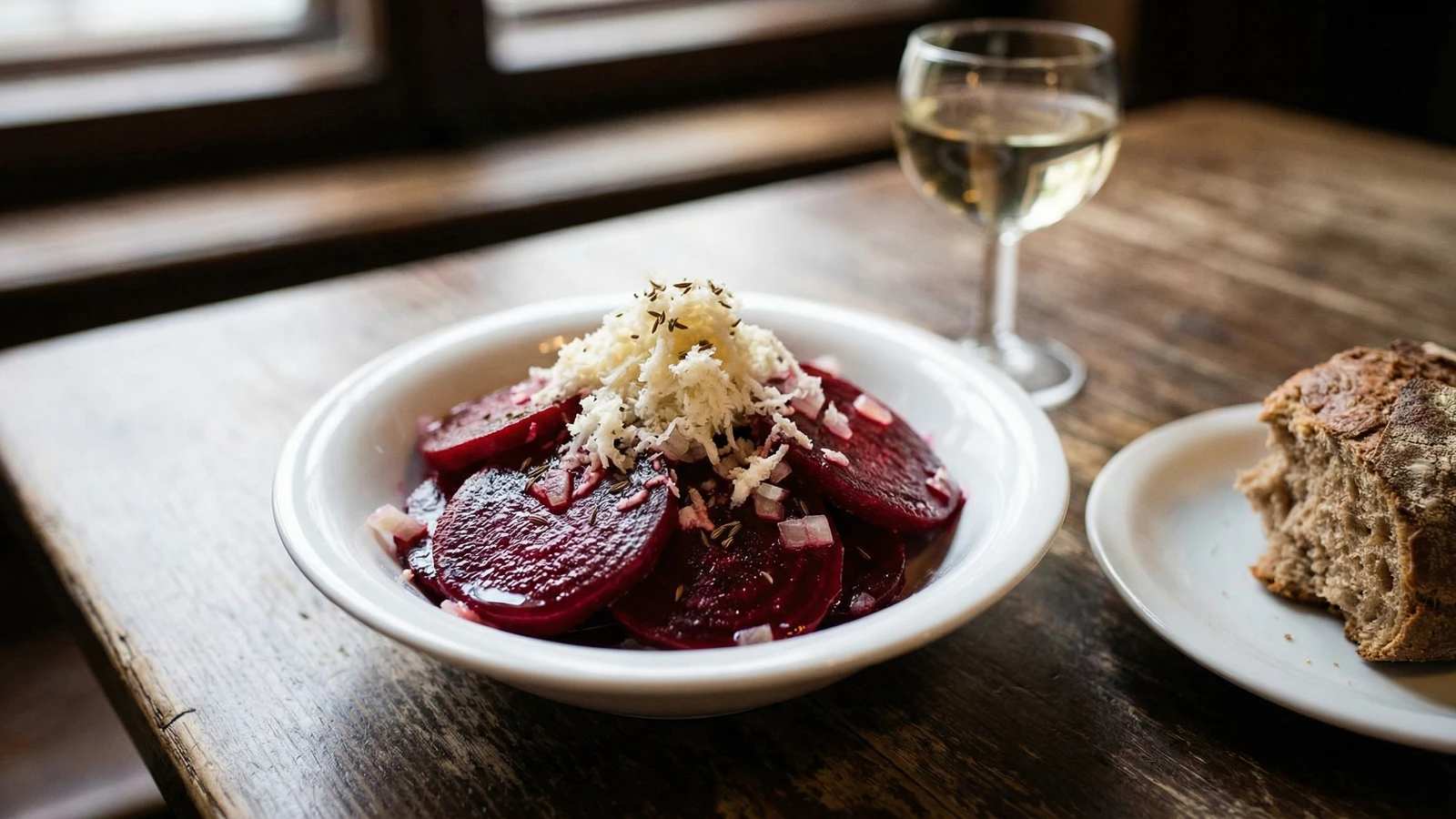
Rote Rüben Salat mit Kren
Created by Chef Elsa
Cooked beetroot sliced and soaked in warm caraway vinegar until the color deepens to garnet, then hit with freshly grated Kren at the table. Earthy, sharp, and better tomorrow than today.
Every Heuriger buffet in Vienna has a bowl of this salad sitting quietly between the Erdäpfelsalat and the Krautsalat, glowing that unmistakable deep magenta. Most people walk past it. That's their loss.
Rote Rüben Salat is one of those dishes that looks like nothing and delivers everything. Beetroot, cooked whole until tender, sliced, and dressed in a warm marinade of vinegar, a little oil, onion, and caraway. That's the whole recipe. The genius is in the marinating. You dress the beets while they're still warm, with a marinade that's also warm, and the slices drink it in like dry soil after rain. Four hours later the flavor has settled into every layer. Overnight, it's transformed.
Gretel always said that Austrian salads are the honest part of the meal. No hiding behind complicated dressings or piles of garnish. Good ingredients, good vinegar, and time. Rote Rüben Salat proves her right. The caraway gives it that unmistakable Austrian character, and the Kren, the fresh horseradish grated at the table, turns something gentle and earthy into something that wakes you up. I've watched guests at my restaurant in Salzburg take their first bite and go completely still for a second. Sweet beet, sharp Kren, the warmth of caraway underneath it all. It's a small plate of food that does more than dishes ten times more complicated.
Rote Rüben have been a staple of Austrian kitchens since the 18th century, when beetroot cultivation spread through Central Europe as a reliable cold-climate crop. The pairing with Kren (horseradish) reflects an older Austrian instinct for balancing sweet root vegetables with sharp, pungent condiments. Horseradish has been grown in the Steirisches (Styrian) region since at least the 16th century, and fresh Kren remains so central to Austrian food culture that it appears alongside Tafelspitz, in Semmelkren sauce, and grated raw over beet salad as a matter of course. The caraway-vinegar marinade ties this salad to the broader Austrian tradition of warm-dressed vegetable salads, where the dressing does the work of seasoning the ingredient from the inside out.
The technique, the tradition, and the story behind every dish.
Discover Culinary AdvisorIngredients
beetroot (Rote Rüben)
Quantity
600g, about 4-5 medium
caraway seeds (Kümmel)
Quantity
1 tablespoon
whole, for cooking water
bay leaf
Quantity
1
salt
Quantity
1 teaspoon
for cooking water
Hesperidenessig or Apfelessig (apple cider vinegar)
Quantity
80ml
sunflower oil or mild rapeseed oil
Quantity
60ml
granulated sugar
Quantity
1 teaspoon
salt
Quantity
1 teaspoon
for marinade
black pepper
Quantity
freshly ground, to taste
onion
Quantity
1 small
very finely diced
caraway seeds (Kümmel)
Quantity
1 teaspoon
lightly crushed, for marinade
fresh Kren (horseradish root)
Quantity
30-40g
peeled, grated fresh at the table
| Ingredient | Quantity |
|---|---|
| beetroot (Rote Rüben) | 600g, about 4-5 medium |
| caraway seeds (Kümmel)whole, for cooking water | 1 tablespoon |
| bay leaf | 1 |
| saltfor cooking water | 1 teaspoon |
| Hesperidenessig or Apfelessig (apple cider vinegar) | 80ml |
| sunflower oil or mild rapeseed oil | 60ml |
| granulated sugar | 1 teaspoon |
| saltfor marinade | 1 teaspoon |
| black pepper | freshly ground, to taste |
| onionvery finely diced | 1 small |
| caraway seeds (Kümmel)lightly crushed, for marinade | 1 teaspoon |
| fresh Kren (horseradish root)peeled, grated fresh at the table | 30-40g |
Equipment Needed
- •Large pot for boiling beets
- •Small saucepan for warming marinade
- •Fine Microplane grater or box grater for Kren
- •Wide shallow bowl for marinating
Instructions
- 1
Cook the beetroot whole
Wash the beetroots gently but don't peel them and don't cut off the root tails. If you nick the skin before cooking, the color bleeds into the water and your beets come out pale and washed-out. Place them in a large pot, cover with cold water by a few centimeters, and add the whole caraway seeds, bay leaf, and a teaspoon of salt. Bring to a steady simmer and cook until a knife slides through the center without resistance. Depending on size, this takes forty-five minutes to an hour. Small beets cook faster, so check early.
Choose beets that are roughly the same size so they cook evenly. If you're stuck with a mix, pull the smaller ones out first and let the larger ones keep simmering. - 2
Peel while warm
Drain the beets and let them cool just enough to handle. The skins slip off under running water while they're still warm. If you let them go cold, the skins cling and you'll be there all afternoon with a knife, staining everything in sight. Rub gently with your thumb and the skin should slide right off. Trim the root end and the stem.
- 3
Slice the beets
Cut the peeled beets into slices about three to four millimeters thick. Some cooks prefer half-moons, some prefer full rounds. I like full rounds for a Beisl-style presentation, half-moons if it's part of a Gemischter Salat. The slices should be thin enough to absorb the marinade but thick enough to hold their shape. Put them in a wide, shallow bowl where they can lie in a single layer or just slightly overlapping.
- 4
Make the warm marinade
In a small saucepan, warm the vinegar with the oil, sugar, salt, pepper, finely diced onion, and the crushed caraway seeds over low heat. You're not cooking it, just warming it through until the sugar and salt dissolve and the caraway starts to release its fragrance, about two minutes. The marinade must be warm when it hits the beets. Warm vinegar opens the surface of the slices and lets the flavor soak in. Cold marinade sits on top and never really penetrates.
Crush the caraway seeds lightly with the flat of a knife or in a mortar. You want them cracked open, not ground to powder. Whole seeds bounce off the tongue; powdered caraway turns bitter. Cracked is the middle ground where the flavor lives. - 5
Dress and marinate
Pour the warm marinade over the sliced beets while they're still warm. Tilt the bowl gently to distribute it. Don't stir with a spoon or you'll break the slices and end up with pink rubble. Let the salad cool to room temperature, then cover and refrigerate for at least four hours. Overnight is better. The beets deepen in color as they marinate and the caraway and vinegar work their way through every slice. Tomorrow's salad will be twice the salad today's is.
Hesperidenessig is a mild, slightly citrusy Viennese vinegar that Gretel always preferred for beet salad. If you can't find it, a good Apfelessig (apple cider vinegar) is the right substitute. Avoid white wine vinegar here. It's too sharp and it fights the earthiness of the beets instead of lifting it. - 6
Finish with fresh Kren
Take the salad out of the fridge thirty minutes before serving. It should be cool, not ice cold. Arrange the slices on a plate or in a shallow bowl. Spoon some of the marinade and the soft onion pieces over the top. Grate fresh Kren directly over the beets at the table using a fine Microplane or the small holes of a box grater. The horseradish must be freshly grated. The moment it hits the air, the sharp heat starts to fade, so you grate it at the last second. That first bite, where the sweet, earthy beet meets the sinus-clearing punch of raw Kren, is everything this salad is about. Mahlzeit!
Chef Tips
- •Buy your beetroot with the leaves still attached if you can. The leaves tell you how fresh the beets are. Wilted leaves mean the beet has been sitting around too long. And save those leaves: wilt them in butter with a little garlic and you've got a second dish for free.
- •Wear gloves when you peel the beets, or accept that your hands will be pink for two days. I've accepted it. My kitchen towels in Salzburg are permanently stained and I've stopped caring.
- •The vinegar-to-oil ratio matters. This is a vinegar-forward salad, not a vinaigrette. The oil is there to round the edges, not to dominate. If your instinct is to add more oil, resist it. Austrian salad dressings are sharper than French ones. That's the point.
- •Fresh Kren loses its heat within minutes of grating. Never grate it ahead of time and leave it sitting. If you can only find prepared horseradish in a jar, it will work, but it won't give you the same sinus-clearing sharpness that makes this salad extraordinary.
Advance Preparation
- •The salad should be made at least four hours before serving. Overnight is ideal. It keeps beautifully in the fridge for up to four days, improving in flavor every day.
- •Do not grate the Kren until the moment you serve. Its heat is volatile and fades quickly once exposed to air.
Frequently Asked Questions
Nutrition Information
1 serving (about 205g)
Where cooking meets culture.
Culinary mentorship, cultural storytelling, and the editorial depth that makes cooking meaningful.
Explore Culinary Advisor