Culinary Advisor
A cooking platform built around craft, culture, and the stories behind what we eat.
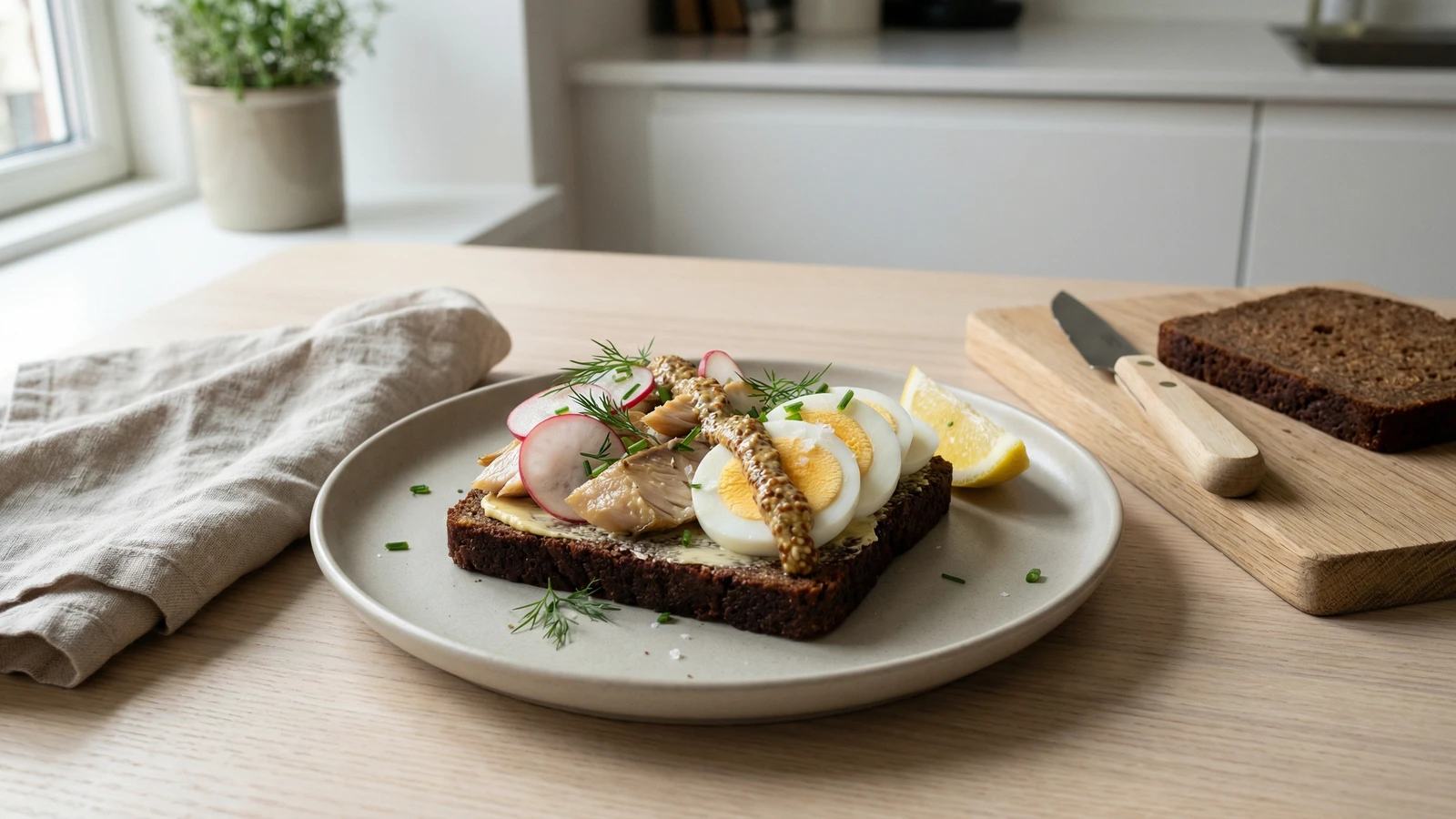
Roget Makrel paa Rugbrod
Created by Chef Freja
Smoked mackerel broken into flaky pieces on buttered rugbrod with sliced egg, radish rounds, and a stripe of mustard. Fifteen minutes from the fridge to the table, and as coastal Danish as lunch gets.
There's a kind of Danish lunch that asks almost nothing of you. You open the fridge on a Tuesday in late August, and what's there is a smoked mackerel wrapped in paper, a loaf of rugbrod from the weekend, a few eggs, a bunch of radishes softening in the bottom drawer. Fifteen minutes later you're sitting at the table with something that tastes like the coast.
Roget makrel paa rugbrod is weeknight smorrebrod at its most honest. No cure, no fry, no technique to master. The smokehouse did the hard work weeks ago, and your job is to treat the fish with respect and build the layers so each one stays visible. This is the kind of food that reminds you why Danish home cooking is so much quieter than people expect. It isn't trying to be clever. It's trying to feed you well with what's already in the house.
Pay attention to two things. The butter on the rugbrod needs to be properly soft and generous, because it seals the bread and carries the other flavors across it. And the mackerel should be flaked into real pieces, not shredded, so you can taste the smoke in proper mouthfuls. Everything else, the mustard stripe, the thin radish rounds, the dill and chives, is punctuation. Get the butter and the fish right and you'll know when it's right because the first bite tells you.
The smoking of mackerel is most closely associated with Bornholm, the small Danish island in the Baltic where white-chimneyed røgerier, the traditional smokehouses, have lined the harbors since the mid-1800s. Alder wood was the fuel then as it is now, giving the fish its pale gold color and its sweet, resinous smoke. Mackerel runs along the Danish coasts in high summer, and the smokehouses worked through the night during the season to preserve the catch before refrigeration existed. The tradition of eating smoked mackerel cold on buttered rugbrod grew directly out of that summer abundance, and it remains one of the most democratic pieces of smorrebrod in the Danish repertoire, as likely to appear in a fisherman's lunch box as on a Copenhagen cafe menu.
The technique, the tradition, and the story behind every dish.
Discover Culinary AdvisorIngredients
smoked mackerel fillets
Quantity
2 whole
skin on
dark rugbrod
Quantity
4 thick slices
good unsalted butter
Quantity
40g
softened
large eggs
Quantity
2
hard-boiled and cooled
breakfast radishes
Quantity
6
sliced into thin rounds
coarse-grained Dijon mustard (or 1 teaspoon grated fresh horseradish)
Quantity
2 teaspoons
fresh dill
Quantity
small bunch
fronds picked
chives
Quantity
2 tablespoons
snipped
flaky sea salt
Quantity
to taste
black pepper
Quantity
freshly ground, to taste
lemon wedges (optional)
Quantity
to serve
| Ingredient | Quantity |
|---|---|
| smoked mackerel filletsskin on | 2 whole |
| dark rugbrod | 4 thick slices |
| good unsalted buttersoftened | 40g |
| large eggshard-boiled and cooled | 2 |
| breakfast radishessliced into thin rounds | 6 |
| coarse-grained Dijon mustard (or 1 teaspoon grated fresh horseradish) | 2 teaspoons |
| fresh dillfronds picked | small bunch |
| chivessnipped | 2 tablespoons |
| flaky sea salt | to taste |
| black pepper | freshly ground, to taste |
| lemon wedges (optional) | to serve |
Equipment Needed
- •Sharp knife
- •Mandoline or very sharp knife for the radishes
- •Small saucepan for the eggs
- •Butter knife or small offset spatula
Instructions
- 1
Flake the mackerel
Peel the skin off the smoked mackerel fillets and lift the flesh away from the central bones with your fingers. Break it into generous flakes, not shreds. You want pieces big enough to recognize as fish when they land on the bread. Check carefully for any stray bones as you go. Smoked mackerel is rich and oily and already fully cooked, so the work here is gentle handling, nothing more.
If the fish is very cold from the fridge, let it sit out for ten minutes before you flake it. Cold mackerel tears. Room temperature mackerel breaks cleanly along its natural seams. - 2
Slice the egg and radish
Peel the hard-boiled eggs and slice them into neat rounds with a sharp knife or an egg slicer if you have one. The yolk should still be bright yellow, just set. Slice the radishes into thin rounds on a mandoline or with a very sharp knife. You want them translucent enough that you can almost see through them. Thick radish slices taste only of heat. Thin ones give you a crisp, peppery lift that belongs to the dish.
- 3
Butter the rugbrod
Spread each slice of rugbrod with a generous, even layer of softened butter, right to the edges. This isn't the moment to be shy with the butter. Rugbrod is dense and assertive, and the butter is what carries the other flavors across it. Cold butter tears the bread, so make sure it's properly soft before you start. You'll know when it's right because the knife glides without resistance.
The butter layer is structural, not decorative. It seals the rye so the oils from the fish don't soak straight through, and it gives the whole piece its finish. - 4
Stripe the mustard
Using the back of a teaspoon, draw a single clean stripe of coarse-grained mustard diagonally across each slice of buttered rugbrod. Not a spread, a stripe. If you're using fresh horseradish instead, grate it at the last moment so it keeps its heat, and scatter it in a thin line across the same diagonal. The mustard or horseradish is a punctuation mark, sharp and bright against the richness of the fish.
- 5
Build the layers
Lay the flaked mackerel generously across each slice, covering most of the bread but letting the dark rye show at the corners. Arrange three or four slices of egg slightly overlapping along one edge. Tuck radish rounds in among the fish where they'll catch the light. The architecture matters. Smorrebrod is read with the eyes before the fork, and each layer should be visible, not buried.
- 6
Finish and serve
Scatter dill fronds and snipped chives across the top. Season the egg slices with a small pinch of flaky salt and a grind of black pepper. Serve immediately with lemon wedges alongside. Eat with a knife and fork, the Danish way, and squeeze a little lemon over the mackerel just before the first bite. The acid lifts the smoke and makes everything on the plate wake up. Tak for mad.
Chef Tips
- •The mackerel is the whole dish, so buy it well. Look for fillets with pale gold skin, firm flesh, and a clean smoky smell. Bornholm-smoked mackerel is the gold standard if you can find it, but any reputable hot-smoked mackerel will work.
- •Use real butter, and use enough of it. Danish butter is cultured, slightly tangy, and generous with itself. A thin layer of cheap butter is not the same dish.
- •If radishes are out of season and woody, skip them. Use thin slices of cucumber instead. The season decides, and a tired radish does nothing for the plate.
- •A cold beer or a small glass of aquavit belongs alongside this. The bitterness of the beer or the caraway of the aquavit cuts the oil of the fish in a way that water simply doesn't.
Advance Preparation
- •The eggs can be boiled a day ahead and kept in their shells in the fridge. Peel just before slicing.
- •Smoked mackerel keeps well in the fridge for several days, sealed in its paper or a container. Take it out ten minutes before you want to flake it so the flesh loosens.
- •Don't build the smorrebrod in advance. Rugbrod softens under wet toppings, and the whole point of this dish is the contrast between the dense bread and everything resting on top.
Frequently Asked Questions
Nutrition Information
1 serving (about 140g)
Where cooking meets culture.
Culinary mentorship, cultural storytelling, and the editorial depth that makes cooking meaningful.
Explore Culinary Advisor