Culinary Advisor
A cooking platform built around craft, culture, and the stories behind what we eat.
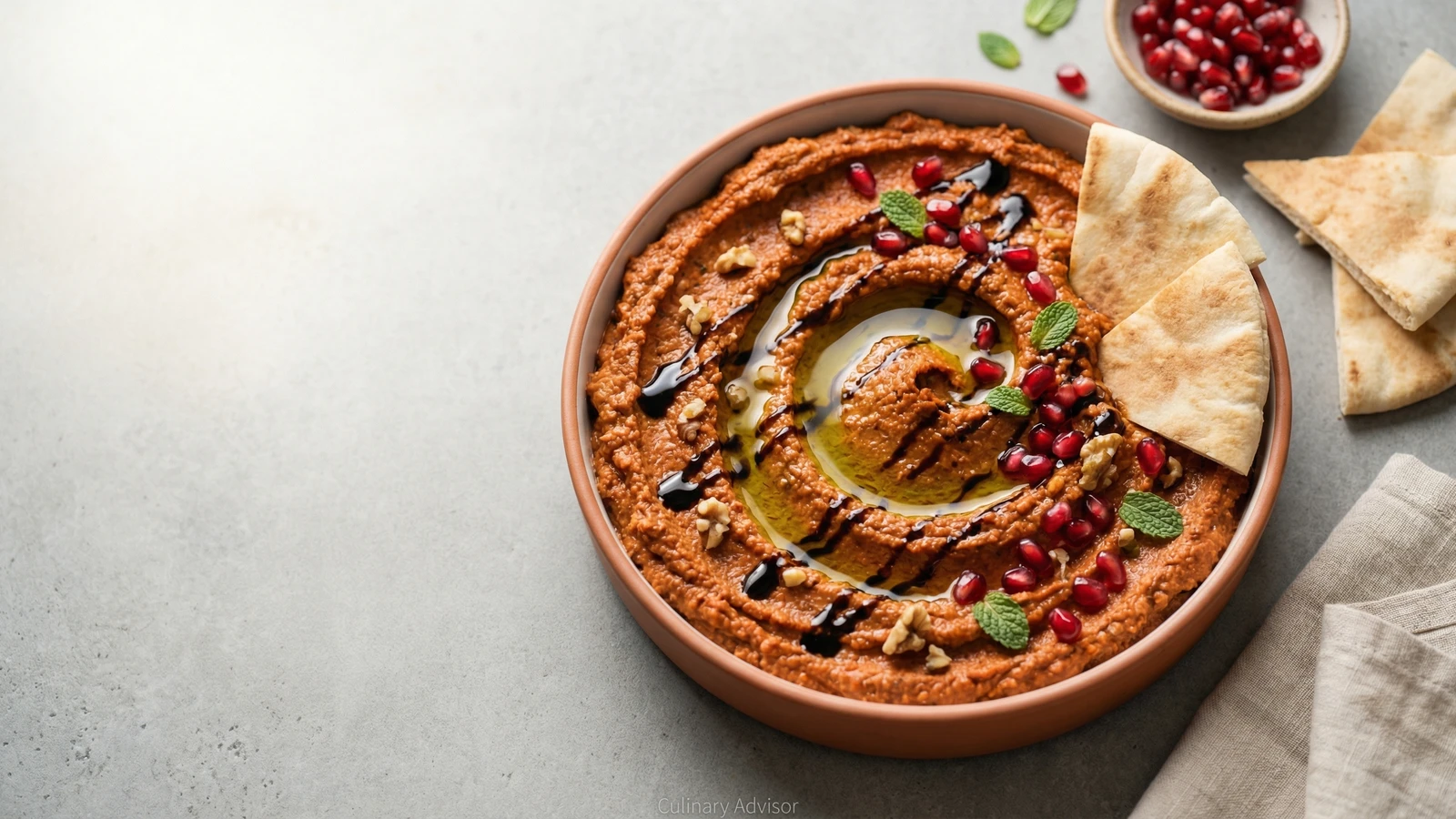
Roasted Red Pepper Muhammara
Created by
A crimson Syrian dip of roasted peppers and toasted walnuts bound with pomegranate molasses, delivering layers of smoke, sweetness, and gentle heat that make hummus seem timid by comparison.
Muhammara has been served in the kitchens of Aleppo for centuries, long before American cooks discovered its charms. The name means "reddened" in Arabic, and one look tells you why. This is a dip the color of old brick, with a texture that falls somewhere between hummus and romesco. It rewards the cook who respects its simplicity.
The foundation is roasted red peppers and toasted walnuts, but the soul lives in the pomegranate molasses. This ingredient transforms everything it touches, adding a tart-sweet depth that no combination of lemon and honey can replicate. If you've never cooked with it, this recipe will change that. One bottle opens doors to a dozen dishes.
I've watched muhammara move from specialty import shops to mainstream grocery shelves over the past decade. American cooks have embraced it because it delivers on promises hummus sometimes breaks: real flavor without drowning in tahini, texture with substance, and a color that stops people mid-reach at the appetizer table. It belongs at your next gathering.
The technique, the tradition, and the story behind every dish.
Discover Culinary AdvisorIngredients
walnut halves
Quantity
1 cup (4 ounces)
roasted red peppers
Quantity
1 jar (12 ounces)
drained and patted dry
fresh breadcrumbs
Quantity
1/2 cup
from 1 slice sturdy bread
pomegranate molasses
Quantity
2 tablespoons, plus more for drizzling
tomato paste
Quantity
1 tablespoon
garlic
Quantity
2 cloves
roughly chopped
Aleppo pepper
Quantity
1 teaspoon
ground cumin
Quantity
1 teaspoon
kosher salt
Quantity
3/4 teaspoon
extra-virgin olive oil
Quantity
1/4 cup, plus more for serving
fresh lemon juice
Quantity
1 tablespoon
pomegranate seeds (optional)
Quantity
for garnish
fresh mint leaves (optional)
Quantity
for garnish
| Ingredient | Quantity |
|---|---|
| walnut halves | 1 cup (4 ounces) |
| roasted red peppersdrained and patted dry | 1 jar (12 ounces) |
| fresh breadcrumbsfrom 1 slice sturdy bread | 1/2 cup |
| pomegranate molasses | 2 tablespoons, plus more for drizzling |
| tomato paste | 1 tablespoon |
| garlicroughly chopped | 2 cloves |
| Aleppo pepper | 1 teaspoon |
| ground cumin | 1 teaspoon |
| kosher salt | 3/4 teaspoon |
| extra-virgin olive oil | 1/4 cup, plus more for serving |
| fresh lemon juice | 1 tablespoon |
| pomegranate seeds (optional) | for garnish |
| fresh mint leaves (optional) | for garnish |
Equipment Needed
- •Food processor
- •10-inch skillet
- •Shallow serving bowl
Instructions
- 1
Toast the walnuts
Spread walnuts in a single layer in a dry skillet over medium heat. Toast, stirring frequently, until fragrant and a shade darker, about five minutes. Watch them carefully. Walnuts contain enough oil that they'll go from perfect to scorched in thirty seconds. Transfer immediately to a plate to cool. Don't skip this step. Raw walnuts taste flat and faintly bitter. Toasted walnuts taste like the reason muhammara exists.
Smell is your best indicator. The moment the kitchen fills with a warm, nutty perfume, they're ready. - 2
Prepare the peppers
Drain the jarred peppers thoroughly, then spread them on paper towels and press firmly to remove excess moisture. This step matters more than you'd think. Waterlogged peppers make watery muhammara. You want concentrated pepper flavor, not diluted. If using fresh peppers, char them over a gas flame or under the broiler until blackened all over, steam in a covered bowl for ten minutes, then peel and seed.
- 3
Make the breadcrumbs
Tear one slice of sturdy bread into chunks and pulse in your food processor until you have coarse crumbs. No need to remove them. They'll process with everything else and give the dip its characteristic body. Fresh breadcrumbs absorb the pepper juices and olive oil, creating cohesion that dried breadcrumbs simply cannot replicate.
- 4
Build the base
Add the cooled walnuts to the food processor with the breadcrumbs. Pulse until the nuts are finely ground but still have some texture, about ten pulses. You want visible bits, not walnut flour. This coarse texture distinguishes good muhammara from the over-processed paste you'll find in mediocre versions.
- 5
Add peppers and aromatics
Add the dried roasted peppers, pomegranate molasses, tomato paste, garlic, Aleppo pepper, cumin, and salt. Process until combined but still retaining texture, about twenty seconds. Stop and scrape down the sides of the bowl. The mixture should look rough and rustic, brick-red flecked with walnut pieces.
- 6
Emulsify with oil
With the processor running, drizzle in the olive oil through the feed tube in a steady stream. The dip will come together and become slightly creamier while maintaining its character. Add the lemon juice and pulse twice to incorporate. Taste. This is where you make it yours.
The balance should be sweet-tart-smoky. Adjust with more pomegranate molasses for sweetness, lemon for brightness, or salt to sharpen all the flavors. - 7
Rest and serve
Transfer to a serving bowl, cover, and refrigerate for at least one hour. This waiting period is not optional. The flavors need time to find each other, for the breadcrumbs to fully hydrate, for the raw garlic edge to mellow. Before serving, let the muhammara sit at room temperature for fifteen minutes. Spread into a shallow bowl, create a well with the back of a spoon, and fill it with olive oil. Drizzle pomegranate molasses in a zigzag across the surface. Scatter pomegranate seeds and mint if you have them. Serve with warm pita triangles or sturdy vegetables.
Chef Tips
- •Pomegranate molasses is the ingredient that makes muhammara impossible to replicate with substitutions. Look for it in Middle Eastern markets, well-stocked grocery stores, or order online. Once opened, it keeps refrigerated for a year. You'll find uses for it everywhere: glazed lamb, roasted vegetables, salad dressings, even drizzled over vanilla ice cream.
- •If you cannot find pomegranate molasses, make a reasonable approximation by simmering one cup pomegranate juice with two tablespoons sugar and one tablespoon lemon juice until reduced to three tablespoons. It won't be identical, but it will be honest.
- •Aleppo pepper brings fruity, moderate heat and a hint of sun-dried tomato. No red pepper flake truly replicates it, but a combination of sweet paprika and cayenne comes closer than red pepper flakes alone. The suggested substitution in the ingredients works well.
- •For a dinner party, make a double batch. This dip disappears faster than you expect, and the person who brings muhammara to a gathering becomes the person everyone wants to invite back.
- •Leftover muhammara becomes an exceptional sandwich spread. Try it with grilled chicken, sliced lamb, or roasted vegetables in a warm pita.
Advance Preparation
- •Muhammara improves with time. Make it up to five days ahead and store refrigerated in an airtight container. The flavors deepen and integrate beautifully.
- •Bring to room temperature before serving, about 30 minutes, and refresh with a drizzle of olive oil and fresh pomegranate molasses.
- •Walnuts can be toasted up to a week ahead and stored in an airtight container at room temperature.
- •For scaling: double or triple the recipe easily by multiplying all ingredients. The food processor handles larger batches well. For a crowd of 20, make two batches rather than one quadruple batch for better texture control.
Frequently Asked Questions
Nutrition Information
1 serving (about 67g)
Where cooking meets culture.
Culinary mentorship, cultural storytelling, and the editorial depth that makes cooking meaningful.
Explore Culinary Advisor