Culinary Advisor
A cooking platform built around craft, culture, and the stories behind what we eat.
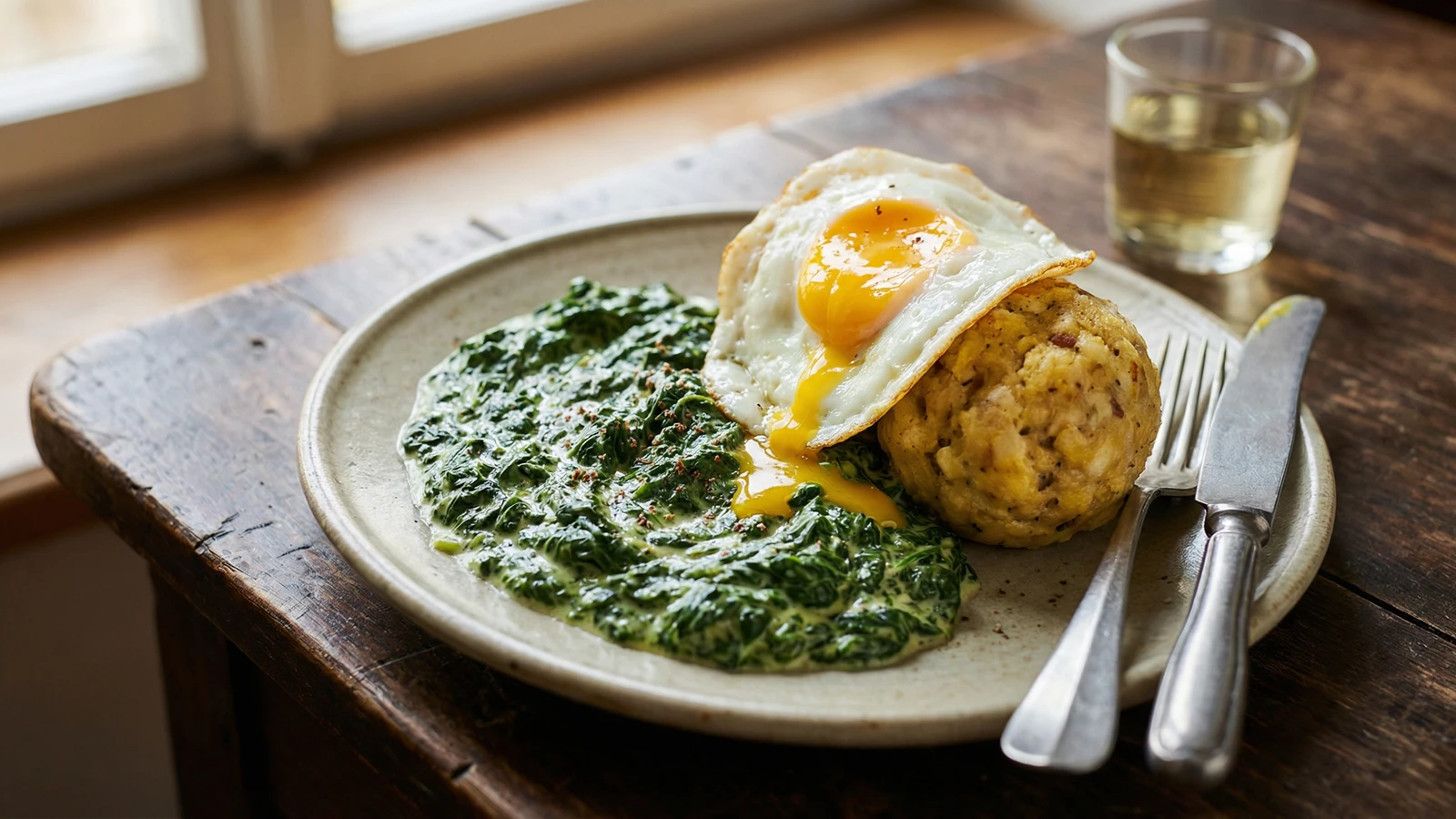
Rahmspinat
Created by Chef Elsa
Finely chopped spinach folded into a nutmeg-scented cream sauce, the Gasthaus side dish that turns a Semmelknödel and a fried egg into one of the most honest meals in Austria.
There's a meal in Austria that costs almost nothing, takes half an hour, and makes you feel like the whole world is in order. A Semmelknödel, golden and soft. A fried egg with a runny yolk. And next to both of them, a generous spoonful of Rahmspinat, warm and green and rich with cream and nutmeg. That's it. Three things on a plate, none of them complicated, every one of them depending on the others. The Rahmspinat is the glue.
I grew up eating this combination at every Gasthaus Gretel and my grandmother Eva took me to on our trips through Austria. It was always on the menu, usually listed as a Beilage, a side dish, which never felt quite right to me. Rahmspinat isn't an afterthought you add to fill the plate. It's what makes the plate work. The cream carries the nutmeg, the spinach cuts through the richness, and when the egg yolk breaks and runs into the whole thing, you understand why Austrians have been eating this way for generations.
The technique is a simple Einmach, which is what Austrians call their version of a roux. Butter, onion, a little flour, then cream stirred in until it thickens. The spinach joins at the end. Nutmeg goes in fresh, always fresh. And a squeeze of lemon right before serving, which does something quiet and essential that you won't notice until you leave it out. This is good Austrian home cooking at its most honest: a few ingredients, treated with respect, landing on the plate as something greater than the sum of what went in.
Rahmspinat belongs to Austria'stradition of Gemüsebeilagen, the vegetable side dishes that accompany the Hauptspeise at every Gasthaus and in every home kitchen. Spinach arrived in Central European cooking through Arab and Mediterranean trade routes during the medieval period, and by the 18th century, creamed spinach with nutmeg had become a fixture of Bürgerlich cooking across the Habsburg lands. The classic trio of Rahmspinat, Semmelknödel, and Spiegelei is so deeply embedded in Austrian identity that it appears on nearly every traditional Gasthaus menu from Vorarlberg to the Burgenland, an unwritten national comfort dish that nobody needed to name.
The technique, the tradition, and the story behind every dish.
Discover Culinary AdvisorIngredients
fresh leaf spinach
Quantity
1 kg
washed and tough stems removed
unsalted butter
Quantity
30g
onion
Quantity
1 medium
finely diced
garlic
Quantity
2 cloves
minced
plain flour
Quantity
20g
heavy cream (Schlagobers)
Quantity
200ml
whole milk
Quantity
100ml
nutmeg
Quantity
1/2 teaspoon
freshly grated
salt
Quantity
to taste
black pepper
Quantity
to taste
freshly ground
lemon juice
Quantity
1 teaspoon
| Ingredient | Quantity |
|---|---|
| fresh leaf spinachwashed and tough stems removed | 1 kg |
| unsalted butter | 30g |
| onionfinely diced | 1 medium |
| garlicminced | 2 cloves |
| plain flour | 20g |
| heavy cream (Schlagobers) | 200ml |
| whole milk | 100ml |
| nutmegfreshly grated | 1/2 teaspoon |
| salt | to taste |
| black pepperfreshly ground | to taste |
| lemon juice | 1 teaspoon |
Equipment Needed
- •Large pot for blanching
- •Heavy-bottomed saucepan (20cm)
- •Microplane or fine grater for nutmeg
- •Clean kitchen towel for squeezing spinach
Instructions
- 1
Wilt the spinach
Bring a large pot of well-salted water to a rolling boil. Drop the fresh spinach in and blanch for sixty seconds, no more. The leaves will collapse from a mountain to a fistful almost instantly. Drain immediately and plunge into ice water to stop the cooking. This keeps the color vivid and bright. Once cool, squeeze the spinach in handfuls over the sink until you've wrung out every drop of water you can. Water hiding in the spinach will thin your sauce later and make the whole dish weep on the plate.
If you're using frozen spinach, skip the blanching. Just thaw it completely and squeeze it dry in a clean kitchen towel. Twist it hard. You'll be amazed how much liquid comes out of something that already looked drained. - 2
Chop the spinach
On a cutting board, chop the squeezed spinach finely. Not pureed, not left in whole leaves. You want it small enough that it becomes part of the sauce, so each spoonful is a mix of cream and greens. Some Austrian cooks use a hand blender for a smoother result. Both ways are right. I prefer the knife because I like a little texture, that feeling of the spinach catching slightly against your teeth.
- 3
Build the Einmach
Melt the butter in a heavy saucepan over medium heat. When it foams, add the diced onion and cook gently for three to four minutes until soft and translucent. You don't want color here. Add the garlic and stir for thirty seconds, just until it smells sweet and warm. Sprinkle the flour over the onion and garlic, stirring constantly for a full minute. This is an Einmach, the Austrian version of a roux, and it needs that minute of cooking to lose the raw flour taste. If you skip this, you'll taste paste in the finished dish.
Gretel always said the Einmach is where Austrian sauces begin. It's the quiet foundation under dozens of dishes. Learn to make a good one and you'll use it everywhere. - 4
Add cream and milk
Pour in the cream and milk gradually, stirring after each addition. Go slowly at first, working a little liquid into the flour paste until it loosens, then add the rest in a steady stream. Whisk as you pour. Lumps form when you add too much liquid at once and the flour clumps together in protest. Bring the sauce to a gentle simmer and let it cook for two to three minutes, stirring occasionally, until it thickens enough to coat the back of a spoon.
- 5
Combine and season
Stir the chopped spinach into the cream sauce. Let it warm through over low heat for three to four minutes, stirring now and then. Grate the nutmeg directly into the pan. Fresh nutmeg is not a suggestion. Pre-ground nutmeg tastes like cardboard compared to a few strokes across a microplane. Season with salt and pepper, then add the lemon juice right at the end. The lemon doesn't make it taste like lemon. It lifts everything, brightens the cream, sharpens the spinach. Without it, the dish sits flat.
- 6
Serve warm
Spoon the Rahmspinat onto a warm plate or into a small dish alongside Semmelknödel and a fried egg. The spinach should be thick enough to hold its shape on the plate but loose enough to spread when you press your fork into it. If it's stiff like paste, stir in a splash more cream. If it's runny, you didn't squeeze your spinach dry enough, but a few more minutes on the heat will help. Mahlzeit!
Chef Tips
- •Buy whole nutmeg and a microplane. Grate it fresh. I will say this until I'm old and gray because the difference between fresh-grated nutmeg and the pre-ground powder from a jar is the difference between the dish working and the dish just being there. Three or four strokes across the grater is all you need.
- •Squeeze your spinach until your hands ache, and then squeeze it once more. Water is the enemy of good Rahmspinat. If liquid pools on the plate around your spinach, that's water you didn't remove, and it dilutes everything you built in the sauce.
- •Serve this with Semmelknödel and a fried egg with a runny yolk. You can serve it alongside Schnitzel or roast pork, and those are fine pairings, but the Knödel-and-egg combination is the one that will make you understand why this dish matters.
- •If fresh spinach isn't in season or looks tired at the market, use frozen. Frozen spinach is blanched and flash-frozen at its peak. Gretel always said there's no shame in frozen spinach if the fresh isn't good. Better honest frozen than sad wilted leaves pretending to be fresh.
Advance Preparation
- •Rahmspinat can be made up to two days ahead and stored in the fridge. Reheat gently over low heat with a splash of cream to loosen it. The nutmeg fades slightly when reheated, so grate a little more in as it warms.
- •Blanched and squeezed spinach can be prepared a day ahead and refrigerated. This makes the final dish come together in under ten minutes.
Frequently Asked Questions
Nutrition Information
1 serving (about 200g)
Where cooking meets culture.
Culinary mentorship, cultural storytelling, and the editorial depth that makes cooking meaningful.
Explore Culinary Advisor