Culinary Advisor
A cooking platform built around craft, culture, and the stories behind what we eat.
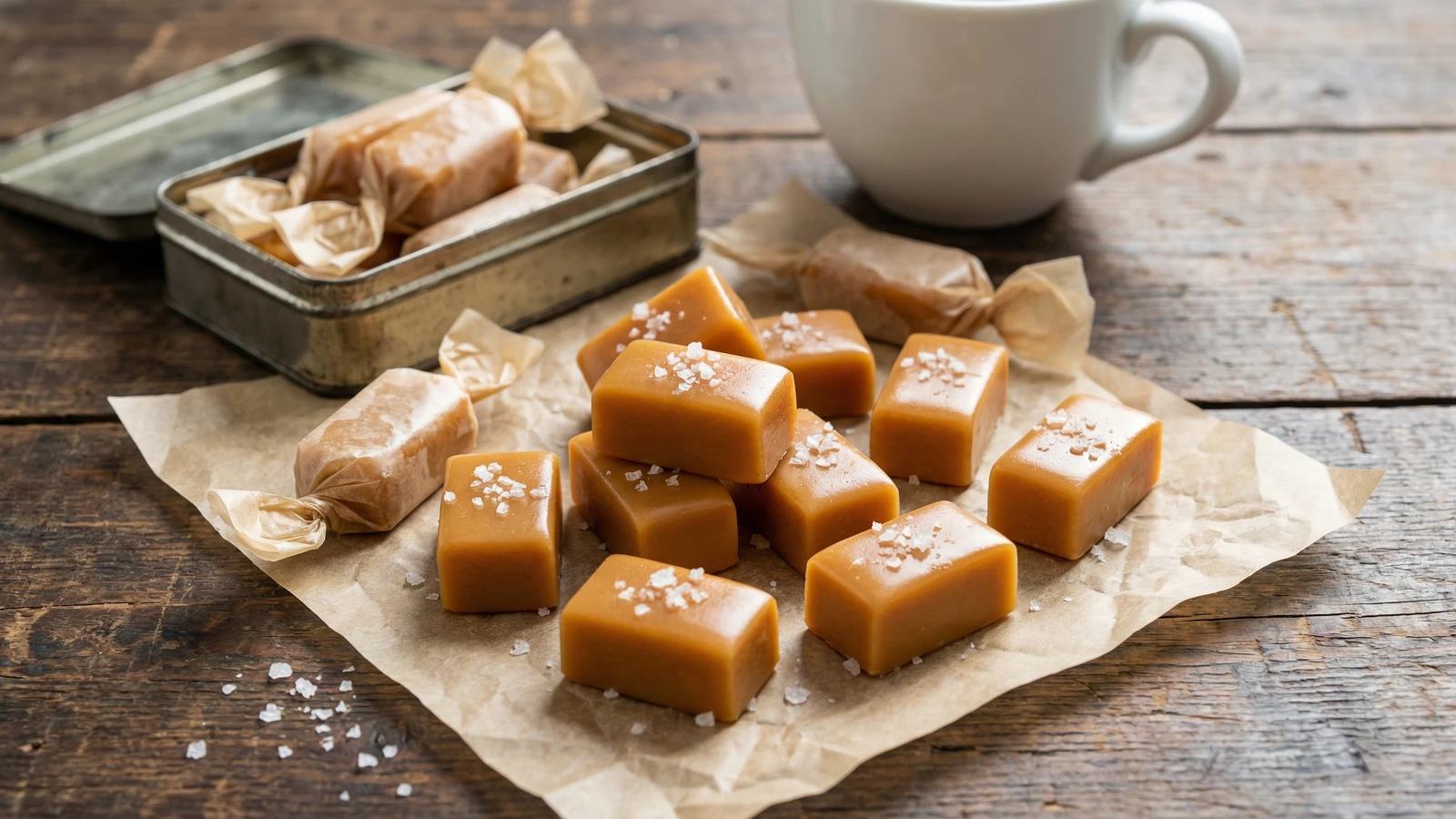
Rahmkaramellen (Alpine Cream Caramels)
Created by Chef Elsa
Soft Alpine cream caramels cooked low and slow in good butter, cut into golden cubes and wrapped in parchment. The kind of sweet that disappears from the tin before anyone admits to eating them.
Every December at the Salzburg Christkindlmarkt, there's a stall near the Dom where a woman sells Rahmkaramellen from a wooden tray lined with wax paper. They're golden brown, soft enough to yield when you press them but firm enough to hold their shape, and they taste like someone melted butter and cream and sugar into a single perfect bite. I bought a bag my first winter in Salzburg and stood in the cold eating them one after another until my fingers were sticky and the bag was empty.
Rahmkaramellen are Alpine candy at its most honest. Cream, sugar, butter, a little honey. That's it. There's no chocolate coating, no fancy mold, no decoration. The flavor comes entirely from what happens when you cook dairy and sugar together slowly enough for the Maillard reaction to do its work. The cream and butter brown. The sugars caramelize. The whole kitchen fills with a smell so good you'll want to stand there breathing it in before you remember you're supposed to be stirring.
Gretel always said the best sweets are the ones with the fewest ingredients and the most patience. Rahmkaramellen prove her right. You need a heavy pot, a sugar thermometer, and about forty minutes of your attention. The technique is not difficult, but it won't forgive you for wandering off to check your phone. Stay with the pot. Stir steadily. Watch the color change from pale ivory to deep gold. When you get it right, you'll have a tin full of caramels that taste like the Austrian Alps in winter, and you'll understand why that woman at the Christkindlmarkt sells out every single night.
Rahmkaramellen belong to the Alpine confectionery tradition that developed across Austria's mountainous regions, where cream and butter from high-pasture dairy cows were abundant but sugar was a costly import until the 19th century. The name itself tells you what matters most: Rahm is the Austrian word for cream, and these caramels are defined by the quality of the dairy, not the sweetener. Salzburg, Tyrol, and the Salzkammergut all claim versions, and the confection became a fixture of Christkindlmärkte across Austria, where they're sold in small paper bags as edible gifts during Advent.
The technique, the tradition, and the story behind every dish.
Discover Culinary AdvisorIngredients
heavy cream (Schlagobers)
Quantity
300ml
full fat
granulated sugar
Quantity
200g
unsalted butter
Quantity
100g
cut into cubes
golden honey
Quantity
80g
vanilla sugar (Vanillezucker)
Quantity
1 teaspoon
fine sea salt
Quantity
1/2 teaspoon
flaky sea salt (optional)
Quantity
for finishing
| Ingredient | Quantity |
|---|---|
| heavy cream (Schlagobers)full fat | 300ml |
| granulated sugar | 200g |
| unsalted buttercut into cubes | 100g |
| golden honey | 80g |
| vanilla sugar (Vanillezucker) | 1 teaspoon |
| fine sea salt | 1/2 teaspoon |
| flaky sea salt (optional) | for finishing |
Equipment Needed
- •Heavy-bottomed saucepan (at least 3-liter capacity)
- •Sugar thermometer
- •20cm square baking tin
- •Wooden spoon or heatproof spatula
- •Sharp knife
- •Parchment paper for lining and wrapping
Instructions
- 1
Prepare your tin
Line a 20cm square baking tin with parchment paper, leaving enough overhang on two sides to lift the finished slab out later. Lightly butter the parchment. This seems fussy but it will save you twenty minutes of frustrated prying when the caramel has set. Do it now while your hands are clean.
- 2
Warm the cream
Pour the cream into a small saucepan and warm it gently over low heat. You don't want it boiling, just warm to the touch. Cold cream hitting hot sugar will seize and spit at you. Warming it first lets it incorporate smoothly when the time comes. Set it aside within arm's reach of your stove.
The best Rahmkaramellen I've ever tasted were made with cream from cows that graze Alpine pastures in summer. The fat content is higher and the flavor has a sweetness you can't replicate. Use the richest, freshest cream you can find. It makes all the difference. - 3
Cook the sugar base
In a heavy-bottomed saucepan, combine the sugar, honey, and butter over medium-low heat. Stir gently with a wooden spoon or heatproof spatula until the butter melts and everything dissolves into a smooth, bubbling liquid. The honey is doing two things here: it adds a floral depth that plain sugar can't match, and it helps prevent crystallization so your caramels stay smooth instead of turning grainy. Let the mixture bubble gently for about three minutes until it deepens to a warm amber.
- 4
Add the warm cream
Pour the warm cream into the sugar mixture in a slow, steady stream, stirring constantly. The mixture will foam up dramatically. This is normal. Don't panic, don't stop stirring, and don't lean your face over the pot. The foaming settles in about thirty seconds, and you'll be left with a smooth, pale caramel sauce. Add the Vanillezucker and fine sea salt now and stir them in.
Use a pot taller than you think you need. The foam when the cream hits the hot sugar can triple the volume for a few seconds. A shallow pan means caramel on your stovetop and possibly on your hands, and hot sugar burns are no joke. - 5
Cook to soft-ball stage
Reduce the heat to low and let the caramel cook gently, stirring every minute or so with long, steady strokes across the bottom of the pot. You're cooking this for about twenty-five to thirty minutes. The color will shift gradually from pale gold to a rich, tawny amber. The mixture will thicken and the bubbles will become slower, lazier, more reluctant to pop. You're aiming for 118°C (244°F) on a sugar thermometer, which is the soft-ball stage. At this temperature, a drop of caramel in cold water will form a soft, pliable ball you can flatten between your fingers.
If you don't have a sugar thermometer, use the cold water test. Drop a small spoonful of the caramel into a glass of ice water. If it forms a soft ball that holds its shape but squishes easily, you're there. If it dissolves, keep cooking. If it turns hard and brittle, you've gone too far and your caramels will be toffee. The window between soft-ball and hard-ball is narrow, so start testing at the twenty-minute mark. - 6
Pour and set
Remove the pot from the heat and give the caramel one final stir. Pour it immediately into your prepared tin. Don't scrape the bottom of the pot. Whatever has stuck there is likely to be overcooked and you don't want it in your caramels. The surface will be glossy and liquid. Tilt the tin gently to level it if needed, but don't fuss. If you want flaky salt on top, scatter it now while the surface is still tacky. Let the tin sit at room temperature until the caramel is completely cool and firm. This takes about two hours. Don't put it in the fridge. Rapid cooling changes the texture.
Sprinkle the flaky salt from about thirty centimeters above the surface so it distributes evenly. You want scattered crystals, not a salt crust. Three or four pinches across the whole surface. The salt doesn't just add flavor; it wakes up the sweetness the way a squeeze of lemon wakes up a soup. - 7
Cut and wrap
Lift the caramel slab out of the tin using the parchment overhang. Place it on a cutting board. Using a sharp knife lightly oiled or buttered, cut the slab into squares, roughly two centimeters each. Work with decisive strokes. If you saw back and forth the edges will tear. Wrap each caramel in a small square of parchment or wax paper, twisting the ends like a bonbon. Pile them in a tin or a jar. Try to resist eating them all before you've finished wrapping. Mahlzeit!
Chef Tips
- •The single most important thing is your cream. Austrian Schlagobers has a fat content around 36%, which gives these caramels their soft, almost fudgy chew. If your cream is thinner, your caramels will be harder and less luxurious. Look for heavy cream or double cream, not whipping cream.
- •Don't stir too aggressively once the mixture starts to thicken. Long, slow strokes across the bottom are what you want. Frantic stirring introduces air bubbles that leave tiny holes in the finished caramel.
- •Store the wrapped caramels in a tin at cool room temperature. They keep beautifully for two weeks, though in my experience they never last that long. In warm weather, the fridge is fine, but let them come back to room temperature before eating. Cold caramels are hard caramels, and these should be soft.
- •If you want to give these as gifts, they're perfect for Advent. A small jar of Rahmkaramellen with a ribbon around it is the kind of present people remember long after they've forgotten what was in the fancy box.
Advance Preparation
- •Rahmkaramellen improve slightly over the first day as the texture settles and the flavors meld. Making them the day before you plan to serve or gift them is ideal.
- •Wrapped caramels keep for two weeks in a cool, dry place. In summer, store them in the fridge and bring to room temperature before serving.
- •The entire recipe can be doubled for gift-giving season. Use a larger tin and expect the cooking time to extend by five to ten minutes.
Frequently Asked Questions
Nutrition Information
1 serving (about 10g)
Where cooking meets culture.
Culinary mentorship, cultural storytelling, and the editorial depth that makes cooking meaningful.
Explore Culinary Advisor