Culinary Advisor
A cooking platform built around craft, culture, and the stories behind what we eat.
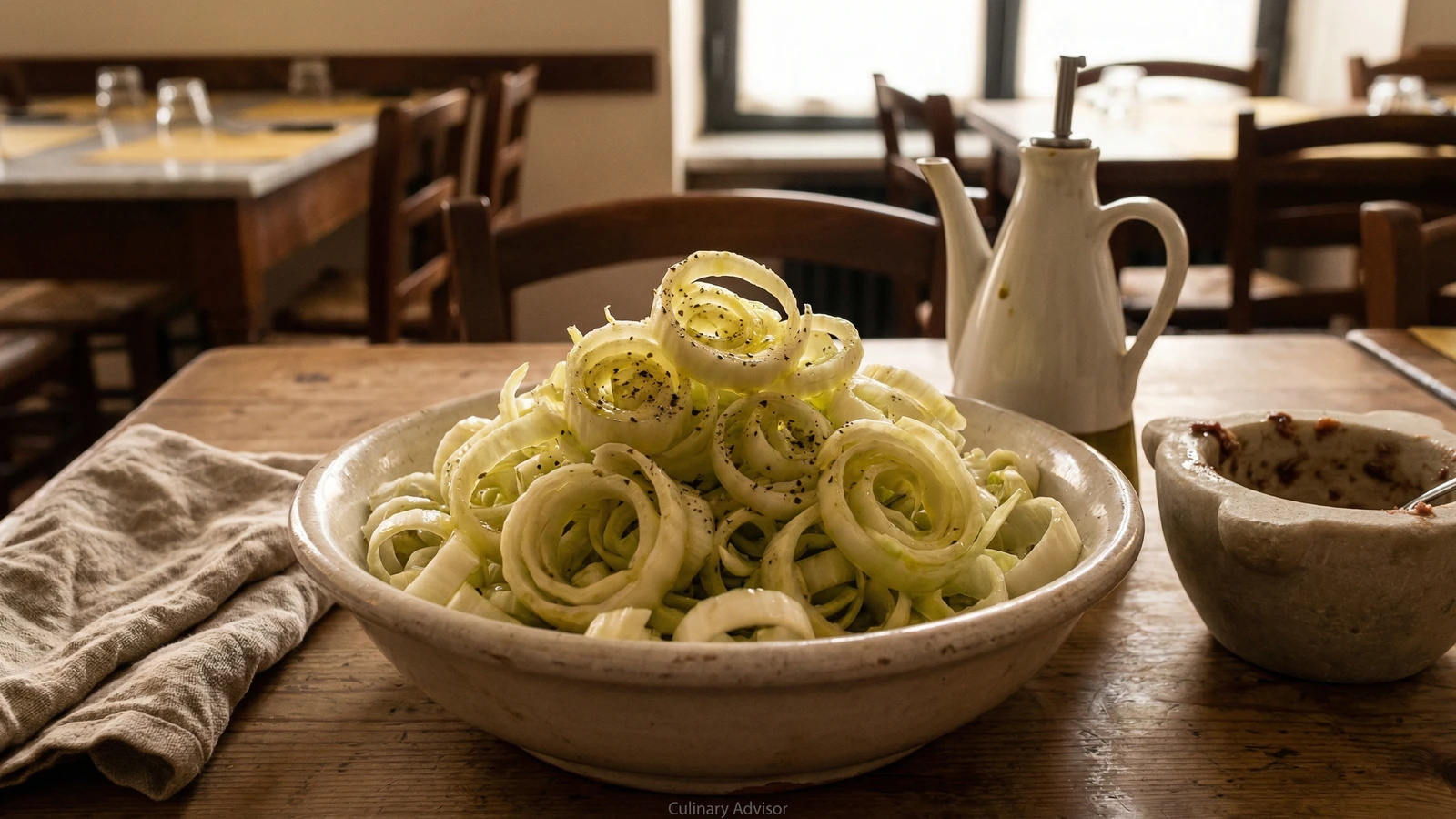
Puntarelle alla Romana
Created by Chef Graziella
The winter salad that Romans guard jealously: bitter chicory shoots curled in ice water, then dressed with an unapologetic anchovy and garlic emulsion that proves boldness and balance are not opposites.
This is Rome in January. The markets are full of these strange, pale green heads of Catalogna chicory with their hollow inner shoots, and Romans queue to buy them because they know what the rest of the world does not: that bitter greens and pungent dressings create the most satisfying salads.
The technique is simple but non-negotiable. You must cut the shoots into thin strips. You must soak them in ice water until they curl. You must make the dressing by hand, pounding anchovies and garlic into a paste before emulsifying with vinegar and oil. Each step matters. Skip the ice water soak and you have limp strips. Use a blender for the dressing and you lose the rustic texture that catches in the curls.
Americans often fear anchovies. This is a mistake. When pounded into a dressing, they do not taste like fish. They provide a savory depth, a saltiness that brings out the character of the bitter chicory. The garlic here is restrained: two cloves for a dressing that will coat an entire head of puntarelle. This is enough. The anchovy does the heavy lifting.
Puntarelle alla Romana has been eaten in Rome since at least the Renaissance, though it became a fixture of Roman trattorias only in the 20th century. The dish requires Catalogna chicory, which grows almost exclusively in Lazio and has resisted cultivation elsewhere, keeping this salad stubbornly, authentically Roman.
The technique, the tradition, and the story behind every dish.
Discover Culinary AdvisorIngredients
puntarelle (Catalogna chicory)
Quantity
1 large head (about 1 1/2 pounds)
salt-packed anchovies
Quantity
6
rinsed and filleted, or 12 oil-packed fillets
garlic cloves
Quantity
2
red wine vinegar
Quantity
1/4 cup
extra virgin olive oil
Quantity
1/2 cup
black pepper
Quantity
to taste
freshly ground
kosher salt
Quantity
to taste
| Ingredient | Quantity |
|---|---|
| puntarelle (Catalogna chicory) | 1 large head (about 1 1/2 pounds) |
| salt-packed anchoviesrinsed and filleted, or 12 oil-packed fillets | 6 |
| garlic cloves | 2 |
| red wine vinegar | 1/4 cup |
| extra virgin olive oil | 1/2 cup |
| black pepperfreshly ground | to taste |
| kosher salt | to taste |
Equipment Needed
- •Mortar and pestle
- •Large bowl for ice water
- •Salad spinner
- •Sharp knife
Instructions
- 1
Prepare the puntarelle
Pull apart the head of puntarelle to separate all the hollow inner shoots from the outer leaves. The outer leaves are bitter and fibrous; set them aside for another use or discard them. What you want are the pale green, hollow shoots that look like little asparagus spears. Rinse them thoroughly under cold water.
- 2
Cut into strips
Working with one shoot at a time, slice each lengthwise into very thin strips, no more than one-eighth inch thick. A sharp knife and patience are required. The thinner you cut them, the tighter they will curl. Romans use a special tool for this, but a knife works if your cuts are consistent and fine.
The traditional Roman tool is called a puntarelle cutter, a contraption of parallel blades that creates uniform strips in one motion. If you make this salad often, it is worth acquiring. - 3
Soak in ice water
Fill a large bowl with ice water. Submerge the cut puntarelle strips completely and refrigerate for at least 30 minutes, up to two hours. As they soak, the strips will curl into tight ringlets. This is the transformation that makes this salad. Do not skip or shorten this step. Drain very thoroughly and spin dry in a salad spinner. Any water clinging to the curls will dilute your dressing.
- 4
Make the anchovy dressing
Using a mortar and pestle, pound the garlic cloves with a pinch of salt to form a paste. Add the anchovy fillets and continue pounding until you have a smooth, homogeneous mixture. No lumps should remain. Slowly drizzle in the vinegar, stirring constantly, then add the olive oil in a thin stream, working the pestle to emulsify. The dressing should be thick enough to coat the back of a spoon.
A mortar and pestle creates the proper emulsion. A food processor produces a different texture, more aggressive and less nuanced. Romans have made this dressing by hand for generations. So can you. - 5
Dress and serve
Place the dried puntarelle curls in a wide serving bowl. Pour the dressing over them and toss thoroughly with your hands, ensuring every curl is coated. The dressing is assertive; the bitter chicory can handle it. Taste and adjust for salt. Grind fresh pepper over the top. Serve immediately. The curls begin to lose their snap within minutes of dressing.
Chef Tips
- •Seek out salt-packed anchovies from Sicily if possible. They require rinsing and filleting, but their flavor is cleaner and more nuanced than oil-packed. The extra effort is worthwhile.
- •The outer leaves of puntarelle are quite bitter and can be sautéed with garlic and chili in olive oil for a separate dish. Nothing should be wasted.
- •If puntarelle is unavailable, you may use the hearts of Belgian endive or the inner leaves of escarole, cut into strips and soaked in ice water. The flavor will differ, but the spirit of the dish survives.
- •The dressing can be made several hours ahead and refrigerated. Whisk vigorously before using, as it will separate. The puntarelle must be cut, soaked, and dried close to serving time.
Advance Preparation
- •The anchovy dressing keeps refrigerated for up to one week. Bring to room temperature and whisk before using.
- •Puntarelle can be cut and soaked in ice water up to four hours ahead, kept refrigerated. Drain and dry just before dressing.
- •Once dressed, the salad must be served within minutes. The acid wilts the curls and they lose their characteristic snap.
Frequently Asked Questions
Nutrition Information
1 serving (about 150g)
Where cooking meets culture.
Culinary mentorship, cultural storytelling, and the editorial depth that makes cooking meaningful.
Explore Culinary Advisor