Culinary Advisor
A cooking platform built around craft, culture, and the stories behind what we eat.
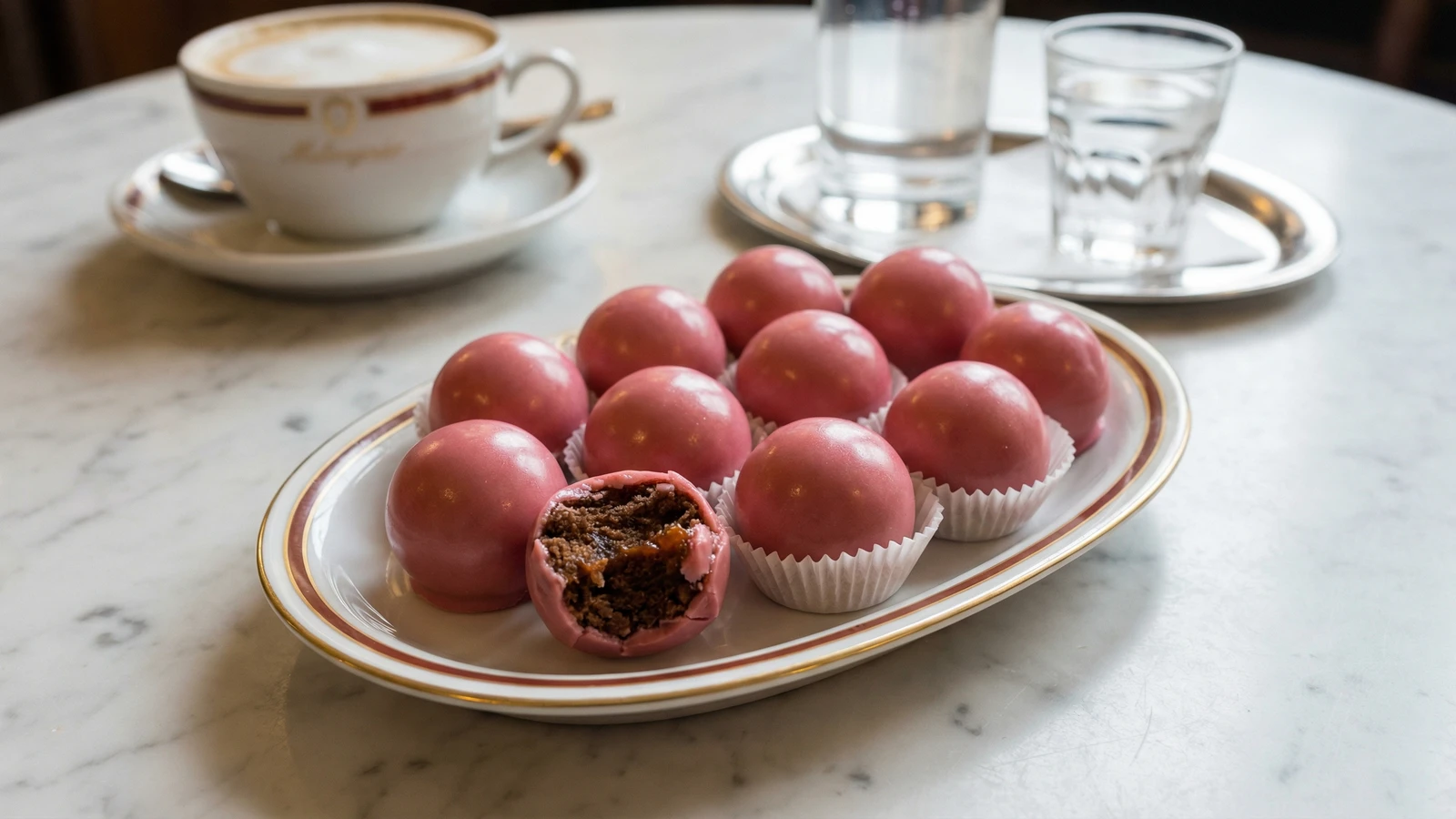
Punschkugeln
Created by Chef Elsa
The shocking pink confection in every Austrian Konditorei window, made from rum-soaked cake crumbs and apricot jam, glazed in rose fondant. Thrift never tasted this good.
Every Konditorei in Austria has a tray of Punschkugeln in the window. You can't miss them. They're the pinkest thing in a country that loves its pastry understated, and they sit there, glossy and round and brazenly bright, next to rows of dignified brown Torten. Gretel always said they were proof that the Viennese have a sense of humor about their baking, even if they'd never admit it.
The secret behind Punschkugeln is thrift. Austrian Konditoren never threw away cake trimmings. When you cut a Torte into perfect layers, you're left with edges and scraps. Those scraps get crumbled, mixed with apricot jam and a heavy pour of rum, shaped into balls, and coated in pink fondant. What starts as waste becomes one of the most beloved confections in the country. In my grandmother Eva's kitchen, Gretel would save every Biskuit offcut in a tin, and when there were enough, she'd announce it was Punschkugeln day. I can still smell the Stroh rum hitting the warm crumbs.
You don't need a Konditorei's worth of scraps to make these at home. A simple sponge cake, baked and crumbled, works beautifully. What you do need is Stroh rum. Not dark rum, not spiced rum, not whatever is on sale. Stroh is an Austrian rum, intensely aromatic, 80 proof, and it's the flavor that makes a Punschkugel taste like a Punschkugel. Everything else is negotiable. The rum is not.
Punschkugeln descend from the Viennese Konditorei tradition of Restlverwertung, the art of using up leftover cake and pastry trimmings rather than wasting them. The 'Punsch' in the name refers to the rum punch popular in Viennese society since the 18th century, when the Habsburgs imported punch culture from the British. The distinctive pink glaze became standard in the early 20th century, and today Punschkugeln and their rectangular cousin Punschkrapfen remain fixtures in every Austrian bakery, a reminder that some of the best confections began as a Konditor's clever solution to yesterday's scraps.
The technique, the tradition, and the story behind every dish.
Discover Culinary AdvisorIngredients
eggs
Quantity
4 large
granulated sugar
Quantity
120g
vanilla sugar (Vanillezucker)
Quantity
1 teaspoon
plain flour
Quantity
120g
salt
Quantity
pinch
apricot jam (Marillenmarmelade)
Quantity
150g
Stroh rum (80% or 60%)
Quantity
80ml
for the mixture
cocoa powder
Quantity
2 tablespoons
powdered sugar
Quantity
200g
for the Punschglasur
warm water
Quantity
3 tablespoons
for the glaze
Stroh rum
Quantity
1 tablespoon
for the glaze
red food coloring
Quantity
1-2 drops
gel or liquid
dark chocolate
Quantity
50g
for dipping the bottoms
| Ingredient | Quantity |
|---|---|
| eggs | 4 large |
| granulated sugar | 120g |
| vanilla sugar (Vanillezucker) | 1 teaspoon |
| plain flour | 120g |
| salt | pinch |
| apricot jam (Marillenmarmelade) | 150g |
| Stroh rum (80% or 60%)for the mixture | 80ml |
| cocoa powder | 2 tablespoons |
| powdered sugarfor the Punschglasur | 200g |
| warm waterfor the glaze | 3 tablespoons |
| Stroh rumfor the glaze | 1 tablespoon |
| red food coloringgel or liquid | 1-2 drops |
| dark chocolatefor dipping the bottoms | 50g |
Equipment Needed
- •23cm square baking tin
- •Electric hand mixer or stand mixer
- •Wire cooling rack
- •Small saucepan
- •Fork for dipping
Instructions
- 1
Bake the sponge
Preheat your oven to 180°C (160°C fan). Line a 23cm square tin with baking paper. Beat the eggs, sugar, and Vanillezucker together until the mixture is thick, pale, and falls off the whisk in a heavy ribbon that holds its shape for three seconds. This takes five to seven minutes with an electric mixer. Don't cut it short. The volume you build now is the only leavening this cake has. Sift the flour and salt over the top in two additions, folding gently with a spatula after each. Fold from the bottom up, turning the bowl as you go. You want to keep the air inside, not knock it out. Pour into the tin and bake for 18 to 20 minutes, until the top springs back when pressed and the edges pull away from the tin.
If you have leftover sponge cake, Biskuit trimmings, or stale Gugelhupf sitting in the kitchen, skip this step entirely. Punschkugeln were invented precisely to use up scraps like these. You need about 300g of crumbled cake. - 2
Crumble the cake
Let the sponge cool completely, then tear it into rough pieces and crumble it between your fingers into a large bowl. You want fine, irregular crumbs, not dust. If there are a few larger bits, that's fine. They'll soften once the rum goes in. A stale cake crumbles more easily than a fresh one, which is exactly why the Konditoren used day-old scraps.
- 3
Mix the Punschmasse
Warm the apricot jam in a small saucepan until it loosens and becomes pourable. If your jam has large fruit pieces, push it through a sieve first. You want a smooth, sticky binding agent, not chunks. Pour the warm jam over the cake crumbs along with the Stroh rum and cocoa powder. Stir everything together with a wooden spoon until the mixture is uniformly dark and damp. It should hold together when you press a spoonful in your hand. If it's too dry, add rum a teaspoon at a time. If it's too wet, add a few more crumbs. Trust your hands more than any measurement here.
The Stroh 80 is the traditional choice and its intensity is the whole point. If the alcohol content concerns you, use Stroh 60 instead, but don't substitute a different rum. Stroh has a specific caramelized, almost burnt sugar character that no Caribbean rum replicates. - 4
Shape the balls
Dampen your hands slightly and roll the mixture into balls about the size of a large walnut, roughly 25 to 30 grams each. Pack them firmly enough to hold their shape but don't crush them into rocks. Set them on a tray lined with baking paper. You should get about 24 balls. Place the tray in the fridge for at least one hour. The balls need to be cold and firm before they go anywhere near the glaze, or they'll fall apart on you.
- 5
Make the Punschglasur
Sift the powdered sugar into a bowl. Add the warm water and the tablespoon of Stroh rum, stirring until completely smooth. The consistency should be like thick cream, coating the back of a spoon in a solid, opaque layer and dripping off slowly. If it's too thick, add water a few drops at a time. If too thin, sift in more sugar. Now add the food coloring. Go slowly. You want a confident rose pink, the color you see in every Konditorei in Vienna. Not red, not pastel. Pink. One or two drops of gel coloring is usually enough. Stir until the color is even throughout.
Gel food coloring gives you more control than liquid. You can always add more, but you can't take it back. Start with one tiny drop and mix thoroughly before deciding you need another. - 6
Glaze the Punschkugeln
Take the chilled balls from the fridge. Set a wire rack over a sheet of baking paper to catch drips. Working one at a time, drop a ball into the pink glaze, roll it gently with a fork to coat all sides, then lift it out and let the excess drip off for a few seconds before setting it on the rack. The coating should be thin and even. If the glaze starts to thicken as you work, stir in a few drops of warm water to bring it back. Let the glazed balls sit at room temperature until the fondant sets firm to the touch, about 30 minutes.
- 7
Finishwith chocolate
Melt the dark chocolate gently in a small bowl over barely simmering water or in short bursts in the microwave. Dip the bottom of each glazed Punschkugel into the melted chocolate, about a third of the way up. Set them back on the rack, chocolate side down, and let the chocolate firm up completely. The dark base against the pink glaze is the classic Konditorei look. Some Konditoren pipe a small chocolate swirl on top instead, or both. Do what pleases you.
If you want to be traditional about it, you can also press a small piece of glacé cherry into the top of each ball before the glaze sets. Some Konditorei do this, some don't. Both are correct.
Chef Tips
- •Stroh rum is not optional and it's not interchangeable. It's an Austrian institution, intensely aromatic with a burnt caramel depth that defines Punschkugeln. Most good liquor shops carry it. If you truly can't find it, order it online before you start. Making Punschkugeln with Bacardi is like making Sachertorte with milk chocolate. Technically possible. Spiritually wrong.
- •Let the mixture sit in the fridge for twenty minutes before shaping. The jam and rum need time to soak into the crumbs fully, and a cold mixture is much easier to roll into clean balls. If the mixture sticks to your hands, dampen them again. A small bowl of water next to your work surface saves frustration.
- •Punschkugeln keep beautifully. Store them in a single layer in an airtight container in the fridge for up to two weeks. The flavor actually improves after a day or two as the rum permeates every crumb. They're ideal for making ahead for holidays or gifting in little paper cases.
- •If you're making these with children, let them do the rolling. They don't need to be perfect spheres. Real Konditorei Punschkugeln aren't uniform either. The slightly lopsided ones always taste the same.
Advance Preparation
- •The sponge can be baked two days ahead and left to go stale at room temperature, loosely covered. Stale cake actually crumbles better and absorbs the rum mixture more evenly.
- •The shaped, unglazed balls can be refrigerated overnight. Glaze them the next day when you're ready for the finishing step.
- •Fully finished Punschkugeln keep in the fridge for up to two weeks in an airtight container. Bring them to room temperature for twenty minutes before serving. The flavor deepens with each day.
Frequently Asked Questions
Nutrition Information
1 serving (about 35g)
Where cooking meets culture.
Culinary mentorship, cultural storytelling, and the editorial depth that makes cooking meaningful.
Explore Culinary Advisor