Culinary Advisor
A cooking platform built around craft, culture, and the stories behind what we eat.
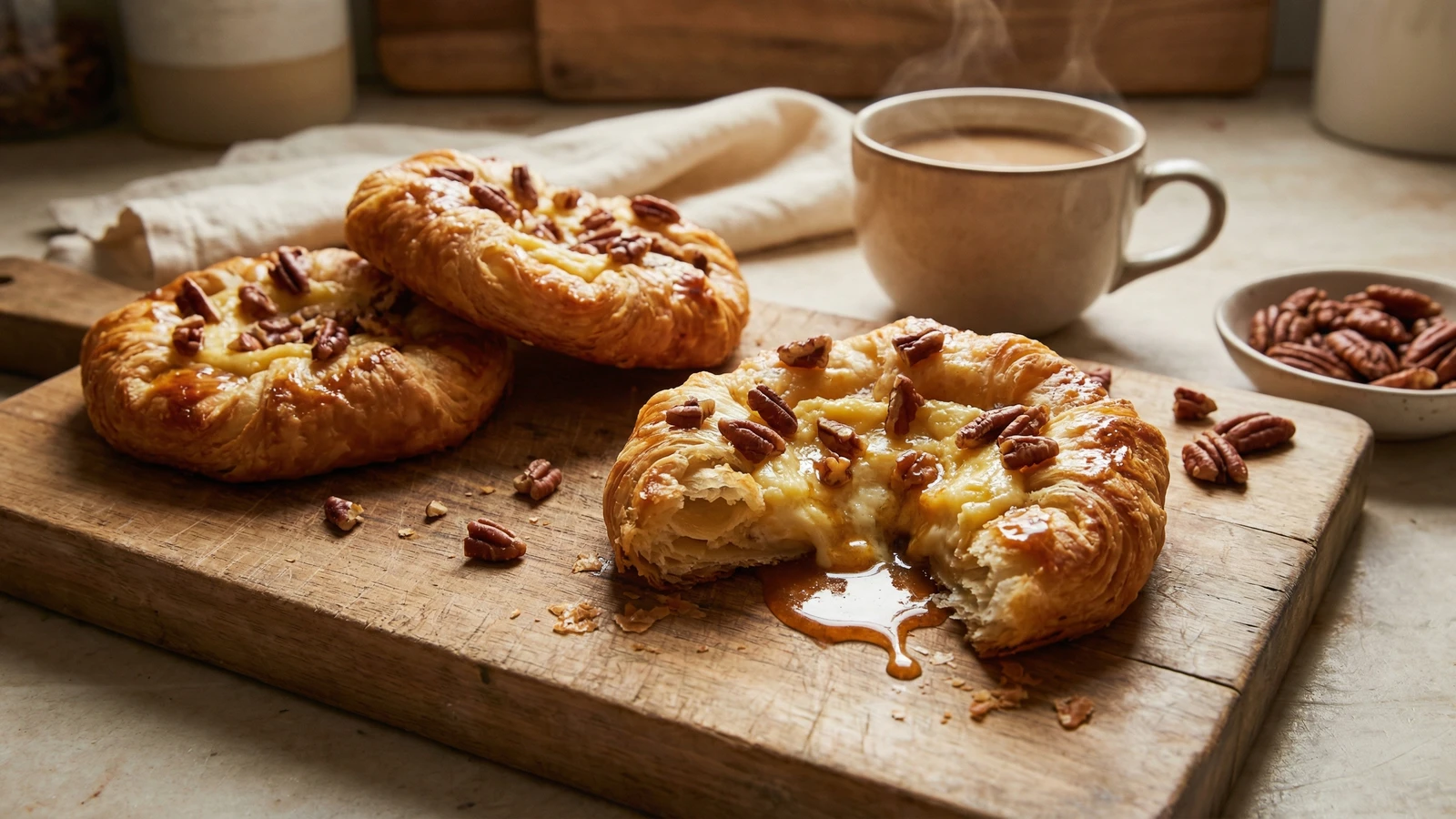
Praline Cream Cheese Danish
Created by Chef Remy
Buttery, shatteringly flaky Danish pastry cradling a pillow of sweet cream cheese, crowned with a decadent pecan praline glaze that pools in every golden crevice, the kind of breakfast worth waking up early for.
Laminated dough intimidates people. I understand why. You're folding cold butter into yeasted dough, rolling it thin, folding again, chilling, repeating. It sounds fussy. But here's the truth: my grandmother Evangeline never went to pastry school, and she made biscuits with the same laminating principle every Sunday morning. Different technique, same idea. You're creating layers. You're building texture. You can do this.
The praline glaze is pure Louisiana. We take that same combination of butter, brown sugar, and pecans that makes our praline candy famous, and we turn it into something that drips down warm pastry and sets into a glossy, caramelized crown. At Lagniappe, we serve these on Christmas morning and Easter brunch. The line forms early.
Now, I won't lie to you. This recipe takes time. The dough needs to rest between turns, the butter needs to stay cold, and you cannot rush the process. But every single step is achievable in a home kitchen. I've taught hundreds of students to make laminated dough, and the ones who succeed are the ones who trust the process and keep their butter cold. That's it. Cold butter, patience, and faith in what you're building.
The technique, the tradition, and the story behind every dish.
Discover Culinary AdvisorIngredients
all-purpose flour
Quantity
3 1/2 cups (440g)
plus more for rolling
granulated sugar (for dough)
Quantity
1/3 cup (65g)
instant yeast
Quantity
2 1/4 teaspoons (1 packet)
fine sea salt (for dough)
Quantity
1 teaspoon
whole milk
Quantity
1 cup
lukewarm
large egg (for dough)
Quantity
1
at room temperature
pure vanilla extract (for dough)
Quantity
1 teaspoon
cold unsalted butter (for laminating)
Quantity
1 1/2 cups (3 sticks/340g)
cream cheese
Quantity
8 ounces
softened
granulated sugar (for filling)
Quantity
1/4 cup (50g)
large egg yolk
Quantity
1
pure vanilla extract (for filling)
Quantity
1/2 teaspoon
fine sea salt (for filling)
Quantity
pinch
unsalted butter (for glaze)
Quantity
1/2 cup (1 stick/113g)
dark brown sugar
Quantity
1 cup (220g)
packed
heavy cream
Quantity
1/4 cup
pecan pieces
Quantity
1 cup (120g)
toasted
pure vanilla extract (for glaze)
Quantity
1/2 teaspoon
fine sea salt (for glaze)
Quantity
1/8 teaspoon
egg wash
Quantity
1 egg beaten with 1 tablespoon water
| Ingredient | Quantity |
|---|---|
| all-purpose flourplus more for rolling | 3 1/2 cups (440g) |
| granulated sugar (for dough) | 1/3 cup (65g) |
| instant yeast | 2 1/4 teaspoons (1 packet) |
| fine sea salt (for dough) | 1 teaspoon |
| whole milklukewarm | 1 cup |
| large egg (for dough)at room temperature | 1 |
| pure vanilla extract (for dough) | 1 teaspoon |
| cold unsalted butter (for laminating) | 1 1/2 cups (3 sticks/340g) |
| cream cheesesoftened | 8 ounces |
| granulated sugar (for filling) | 1/4 cup (50g) |
| large egg yolk | 1 |
| pure vanilla extract (for filling) | 1/2 teaspoon |
| fine sea salt (for filling) | pinch |
| unsalted butter (for glaze) | 1/2 cup (1 stick/113g) |
| dark brown sugarpacked | 1 cup (220g) |
| heavy cream | 1/4 cup |
| pecan piecestoasted | 1 cup (120g) |
| pure vanilla extract (for glaze) | 1/2 teaspoon |
| fine sea salt (for glaze) | 1/8 teaspoon |
| egg wash | 1 egg beaten with 1 tablespoon water |
Equipment Needed
- •Rolling pin
- •Parchment paper
- •Rimmed baking sheets
- •Medium saucepan
- •Pastry brush
- •Bench scraper
Instructions
- 1
Mix the dough
In a large bowl, whisk together the flour, sugar, yeast, and salt. Make a well in the center. Pour in the lukewarm milk, egg, and vanilla. Stir with a wooden spoon until a shaggy dough forms, then turn out onto a lightly floured surface and knead for about 3 minutes. You're not developing gluten here like bread. Just bring it together into a smooth, slightly tacky ball.
The milk should feel like bathwater, around 100F. Too hot kills the yeast. Too cold and nothing wakes up. - 2
First chill
Flatten the dough into a rough rectangle about an inch thick. Wrap tightly in plastic and refrigerate for at least 1 hour, or overnight. This relaxes the gluten and chills everything down, which is essential for what comes next.
- 3
Prepare the butter block
Place your three sticks of cold butter between two sheets of parchment paper. Pound with a rolling pin until pliable but still cold, then roll into an 8-inch square about half an inch thick. The butter should bend without cracking but leave no greasy residue on your fingers. If it gets soft, slide it onto a baking sheet and refrigerate for 10 minutes.
The butter and dough must be the same temperature and pliability. If butter is harder than the dough, it will break into chunks. If softer, it will squish out the sides. Same consistency is the key. - 4
Encase the butter
On a floured surface, roll the chilled dough into a 12-inch square. Place the butter block diagonally in the center so it looks like a diamond on a square. Fold the four corners of dough over the butter like an envelope, pinching the seams to seal completely. You should have a neat package with no butter peeking through.
- 5
First turn
Roll the dough package into a long rectangle, about 8 inches wide and 18 inches long. Keep your movements firm and even. If the dough resists or springs back, let it rest 5 minutes. Fold the bottom third up, then the top third down, like a business letter. This is one turn. Wrap in plastic and refrigerate 30 minutes.
Press a fingertip into the corner of the dough before wrapping. One dimple means one turn completed. This helps you track where you are. - 6
Complete remaining turns
Repeat the rolling and folding process two more times, chilling 30 minutes between each turn. You'll complete three turns total. Each turn multiplies your layers. After the final turn, wrap the dough tightly and refrigerate for at least 2 hours or overnight. This final rest is crucial for the dough to relax completely.
- 7
Make the cream cheese filling
Beat the softened cream cheese with the sugar until smooth and fluffy, about 2 minutes. Add the egg yolk, vanilla, and salt. Beat until completely combined and silky. Taste it. The filling should be sweet but not cloying, with a pleasant tang from the cream cheese. Refrigerate until ready to use.
- 8
Shape the pastries
Roll the chilled dough into a large rectangle, about 12 by 18 inches and a quarter inch thick. Cut into twelve squares, each about 4 inches. Working with one square at a time, fold all four corners toward the center, pressing firmly where they meet. Transfer to parchment-lined baking sheets, spacing 3 inches apart.
- 9
Fill and proof
Press your thumb gently into the center of each pastry to create a shallow well. Spoon about 2 tablespoons of cream cheese filling into each depression. Cover loosely with plastic wrap and let rise in a warm spot until puffy and nearly doubled, about 1 to 1 1/2 hours. The pastries should jiggle when you shake the pan.
- 10
Bake until golden
Preheat your oven to 400F. Brush the exposed dough with egg wash, being careful not to drip onto the filling or let it pool at the edges where it might glue the layers together. Bake 18 to 22 minutes until deeply golden brown and puffed. The layers should be distinct and flaky, the cream cheese filling set but still creamy in the center. Let cool on the pan for 10 minutes.
Rotate the pans halfway through baking for even browning. Every oven has hot spots. - 11
Make the praline glaze
While the pastries bake, melt the butter in a medium saucepan over medium heat. Add the brown sugar and stir until dissolved and bubbling. Pour in the heavy cream carefully; it will sputter. Stir constantly and let the mixture bubble for 2 minutes until slightly thickened. Remove from heat and stir in the toasted pecans, vanilla, and salt. The glaze should be pourable but thick enough to coat a spoon.
- 12
Glaze and serve
Spoon the warm praline glaze generously over the slightly cooled pastries, letting it drip down the sides and pool around the edges. The pecans should scatter across the top like treasure. Serve warm or at room temperature. These are best the day they're made, but I've never seen one last long enough to test that theory.
Chef Tips
- •If your kitchen runs warm, chill your rolling pin and work surface with ice packs before rolling. The enemy of laminated dough is warm butter.
- •Toast your pecans in a dry skillet over medium heat until fragrant, about 5 minutes. Raw pecans taste flat. Toasted pecans taste like Louisiana.
- •The dough freezes beautifully after the final turn. Thaw overnight in the refrigerator, then proceed with shaping. This makes holiday morning baking much more civilized.
- •If the praline glaze thickens too much while you're glazing, warm it gently over low heat and add a splash more cream.
- •For deeper praline flavor, substitute 2 tablespoons of the brown sugar with cane syrup if you can find it. That's the real Louisiana taste.
Advance Preparation
- •The dough can be made through all three turns and refrigerated for up to 2 days, or frozen for up to 1 month. Thaw overnight in the refrigerator before shaping.
- •The cream cheese filling can be made up to 3 days ahead and refrigerated. Bring to room temperature before using so it spreads easily.
- •Shaped and proofed pastries can be refrigerated overnight, covered loosely. Let them come to room temperature for 30 minutes before baking.
- •The praline glaze is best made fresh, but can be made a day ahead and gently rewarmed with an extra splash of cream.
Frequently Asked Questions
Nutrition Information
1 serving (about 140g)
Where cooking meets culture.
Culinary mentorship, cultural storytelling, and the editorial depth that makes cooking meaningful.
Explore Culinary Advisor