Culinary Advisor
A cooking platform built around craft, culture, and the stories behind what we eat.
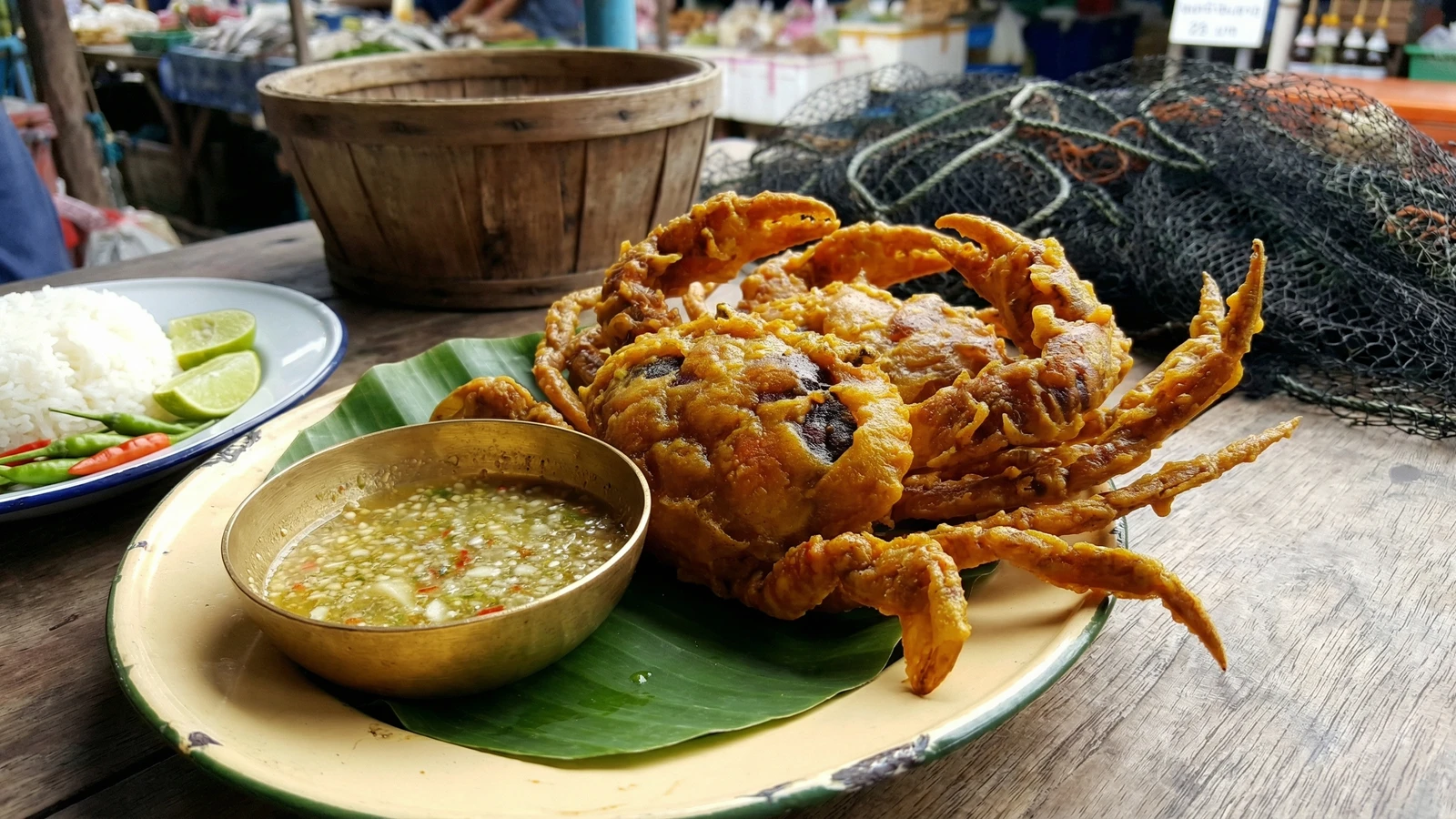
Soft-Shell Crab with Turmeric (Poo Nim Tod Kamin)
Created by
Southern coast, where kamin (turmeric) stains everything golden, soft-shell crab gets dredged in a garlic-turmeric batter and fried whole. The preservation principle became the flavor.
Turmeric is the South's signature. Not galangal. Not lemongrass. Kamin.
Every coastal kitchen from Nakhon Si Thammarat to Krabi uses turmeric the way Central Thai kitchens use garlic: it goes in everything. And the reason isn't mystical. It's science. Turmeric contains curcumin, which is antimicrobial. In a tropical coastal climate where fish and crab come off the boat already fighting the heat, rubbing protein with kamin was how Southern cooks kept it fresh longer. That preservation function became the flavor identity of the entire region. Ajarn always said: "Every Thai ingredient solves a problem. The solution became the tradition."
Poo nim tod kamin is the simplest proof of that principle. Soft-shell crab, cleaned and whole, marinated in a paste of fresh turmeric, garlic, cilantro root, and white pepper, then dredged in rice flour spiked with more turmeric and fried until the shell shatters and the golden batter crisps. The crab is sweet. The kamin is earthy, warm, faintly bitter. The garlic and white pepper tie them together. That's it. Three layers. No paste-in-a-mortar complexity here, just a simple marinade and a hot pan of oil.
The dipping sauce is where the four pillars show up. Nam jim talay: bird's eye chilies pounded with garlic, dissolved with lime juice and fish sauce, barely any sugar. Southern Thai food leans sour and spicy. It doesn't chase sweetness the way Central Thai does. The lime hits first, the chili burns second, and the nam pla holds the whole thing together with salt and umami. That's the Southern balance. Learn it and you understand half the peninsula's kitchen.
Turmeric's dominance in Southern Thai cooking traces directly to the Malay and Indian Ocean trade routes that shaped the peninsula's cuisine for centuries. Coastal communities from Ranong to Pattani adopted kamin not only as a spice but as a practical preservative for the day's catch in equatorial heat. Poo nim tod kamin is a relatively modern dish, emerging as soft-shell crab farming expanded in the Gulf of Thailand and Andaman coast provinces in the 1990s, but the turmeric-dredge technique it uses is ancient, applied to every kind of seafood from pla (fish) to goong (shrimp) for generations.
The technique, the tradition, and the story behind every dish.
Discover Culinary AdvisorIngredients
soft-shell crabs (poo nim)
Quantity
4 (about 80-100g each)
cleaned, gills and apron removed, patted dry
fresh turmeric root (kamin)
Quantity
3 tablespoons
peeled and finely grated (or 2 teaspoons ground turmeric)
garlic (kratiam)
Quantity
6 cloves
peeled
cilantro roots (rak phak chi)
Quantity
3
scraped clean
white peppercorns (prik thai khao)
Quantity
1 teaspoon
fish sauce (nam pla)
Quantity
1 tablespoon
rice flour (paeng khao jao)
Quantity
100g
tapioca starch (paeng man sampalang)
Quantity
30g
ground turmeric (kamin pon)
Quantity
1 teaspoon
for the dredge
fine sea salt
Quantity
1/2 teaspoon
vegetable oil
Quantity
about 3 cups
for deep frying
bird's eye chilies (prik khi nu)
Quantity
10
roughly chopped
garlic (kratiam)
Quantity
4 cloves
for nam jim talay
lime juice (nam manao)
Quantity
3 tablespoons (about 3 limes)
fish sauce (nam pla)
Quantity
2 tablespoons
for nam jim talay
palm sugar (nam tan pip)
Quantity
1 teaspoon
| Ingredient | Quantity |
|---|---|
| soft-shell crabs (poo nim)cleaned, gills and apron removed, patted dry | 4 (about 80-100g each) |
| fresh turmeric root (kamin)peeled and finely grated (or 2 teaspoons ground turmeric) | 3 tablespoons |
| garlic (kratiam)peeled | 6 cloves |
| cilantro roots (rak phak chi)scraped clean | 3 |
| white peppercorns (prik thai khao) | 1 teaspoon |
| fish sauce (nam pla) | 1 tablespoon |
| rice flour (paeng khao jao) | 100g |
| tapioca starch (paeng man sampalang) | 30g |
| ground turmeric (kamin pon)for the dredge | 1 teaspoon |
| fine sea salt | 1/2 teaspoon |
| vegetable oilfor deep frying | about 3 cups |
| bird's eye chilies (prik khi nu)roughly chopped | 10 |
| garlic (kratiam)for nam jim talay | 4 cloves |
| lime juice (nam manao) | 3 tablespoons (about 3 limes) |
| fish sauce (nam pla)for nam jim talay | 2 tablespoons |
| palm sugar (nam tan pip) | 1 teaspoon |
Equipment Needed
- •Heavy granite mortar and pestle (krok hin) for marinade paste and nam jim
- •Wok or deep heavy pan for frying
- •Spider strainer or slotted spoon
- •Wire cooling rack for draining
- •Kitchen thermometer (optional but recommended)
Instructions
- 1
Pound the marinade
In a granite mortar (krok hin), pound the white peppercorns to a coarse powder. Add the garlic and cilantro roots and pound to a rough paste. Not smooth. You want texture. Add the grated fresh turmeric and pound just enough to incorporate it. The paste should be bright orange-gold, wet, and fragrant. Your fingers will be stained yellow. Good. That's how you know you're in a Southern kitchen. Stir in the fish sauce.
Fresh turmeric is ten times better than powder for the marinade. The essential oils in the fresh rhizome are what actually penetrate the crab. Powder works for the dredge, but for the marinade, find the fresh root. Any Asian grocery will have it. - 2
Marinate the crabs
Lay the cleaned soft-shell crabs on a tray. Rub the turmeric paste all over each crab, getting into the crevices, under the shell, across the legs. Every surface. The kamin isn't decoration. It's doing two jobs: flavoring the crab and breaking down surface proteins so the batter adheres. Let them sit for 15 minutes at room temperature. Not longer than 30 minutes or the acid in the turmeric starts softening the shell too much.
Cleaning soft-shell crabs is simple. Lift the pointed edges of the top shell and pull out the spongy gills on each side. Flip the crab and remove the small triangular apron on the belly. Snip off the face (the front 1cm behind the eyes) and squeeze out the greenish bile sac. Rinse quickly and pat bone dry. Moisture is the enemy of crispy frying. - 3
Make the dredge
Mix the rice flour, tapioca starch, ground turmeric, and salt in a wide bowl. The tapioca starch is what gives the crust that shattering crunch. Rice flour alone stays soft. The starch creates glass. This ratio, about 3:1 rice flour to tapioca, is the standard Southern Thai frying dredge for seafood. You'll see it at every market stall from Surat Thani to Satun.
- 4
Dredge the crabs
Press each marinated crab firmly into the flour mixture. Coat every surface. Shake off the excess. The turmeric paste on the crab will grab the flour and create a thick, uneven crust. That's what you want. The irregular surface fries into ridges and valleys of crunch. Set the dredged crabs on a wire rack for 2 minutes. This brief rest lets the coating set and prevents it from falling off in the oil.
- 5
Heat the oil
Pour the oil into a wok or deep pan to a depth of at least 3 inches. Heat to 180°C (350°F). Use a thermometer if you have one. If you don't, drop a pinch of flour into the oil. It should sizzle immediately and float to the surface within one second. If it sinks and sits there, the oil isn't ready. If it burns instantly, it's too hot. That one-second test is how every market vendor in the South checks temperature.
A wok is the traditional vessel for deep frying in Thailand. The curved shape means you need less oil, and the wide opening gives you room to maneuver. If your wok is thin and wobbly on the burner, use a flat-bottomed pan instead. Stability matters when you're dealing with 180-degree oil. - 6
Fry the crabs
Lower two crabs into the oil, belly-side down. Don't crowd the wok. Two at a time, maximum. The temperature will drop when the crabs go in. That's normal. Fry for 3 to 4 minutes, turning once halfway through, until the crust is deep golden with patches of dark turmeric amber. The legs should be completely rigid and crispy. Lift them out with a spider strainer and drain on a wire rack, not paper towels. Paper towels trap moisture against the crust and kill the crunch. Bring the oil back to 180°C before frying the second batch.
- 7
Pound the nam jim talay
While the crabs drain, pound the chilies and garlic in a mortar to a rough paste. Scrape it into a small bowl. Add the lime juice, fish sauce, and palm sugar. Stir until the sugar dissolves. Taste. It should punch you with sour and heat first, salt second, sweet barely there. That's the Southern balance. If you taste sweetness before anything else, you've added too much sugar. Pull it back with more lime.
Southern Thai dipping sauces are aggressive. They're built to cut through the richness of fried seafood. If the nam jim tastes "nice" and "balanced" in a Central Thai way, it's too mild for this dish. Push the sour. Push the heat. That's the point. - 8
Serve immediately
Arrange the crabs on a plate. Serve the nam jim talay alongside. No waiting. Fried soft-shell crab has a window of about five minutes before the shell starts absorbing humidity and softening. Eat it while the legs shatter between your teeth and the turmeric crust crackles. Jasmine rice on the side. That's all it needs.
Chef Tips
- •Fresh turmeric stains everything it touches: hands, clothes, cutting boards, mortars. Wear gloves if you care about your fingernails. Use a dedicated mortar or accept the yellow stain as a badge of honor. Every Southern Thai cook has permanently golden-tipped fingers. That's how you know they're the real thing.
- •Soft-shell crabs must be alive when you buy them, or frozen immediately after harvest. If they smell of ammonia or have soft, mushy bodies, they're past it. Fresh soft-shell crab smells like the sea. Clean and sweet. In the South, vendors sell them live in aerated tanks at the morning market. If you're buying frozen, thaw slowly in the refrigerator overnight, never at room temperature.
- •The rice flour and tapioca starch ratio is critical. Rice flour alone gives a soft, almost chewy coat. Tapioca starch alone gives a glassy, hard shell that cracks in sheets. The blend gives you crunch with structure. Three parts rice flour to one part tapioca is the Southern standard for tod (fried) preparations. Remember the ratio and you can dredge any seafood.
- •Southern Thai food is not Central Thai food with more chilies. The spice profile is fundamentally different: turmeric dominates where galangal would in Central Thai. Cumin, coriander seed, and cardamom appear in Southern Muslim preparations. The Malay border influence is real and ancient. When you cook Southern, you cook a different branch of the Thai system.
Advance Preparation
- •The turmeric marinade paste can be pounded up to a day ahead and refrigerated in an airtight container. The flavors actually intensify overnight.
- •The nam jim talay can be made 2 hours ahead and kept at room temperature. The lime juice will mellow slightly, which some cooks prefer. Add a squeeze of fresh lime before serving to bring back the sharpness.
- •Do not dredge the crabs until you are ready to fry. The flour coating absorbs moisture from the marinade and becomes gummy if it sits too long. Dredge, rest 2 minutes, fry. That's the sequence.
Frequently Asked Questions
Nutrition Information
1 serving (about 150g)
Where cooking meets culture.
Culinary mentorship, cultural storytelling, and the editorial depth that makes cooking meaningful.
Explore Culinary Advisor